Common Water Monitor
Varanus salvator
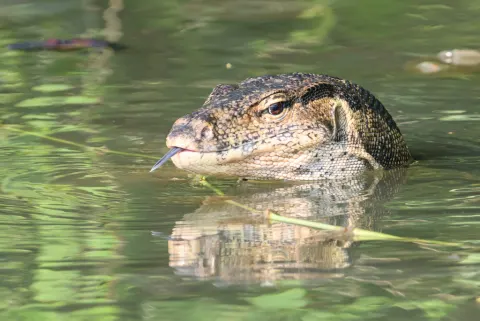
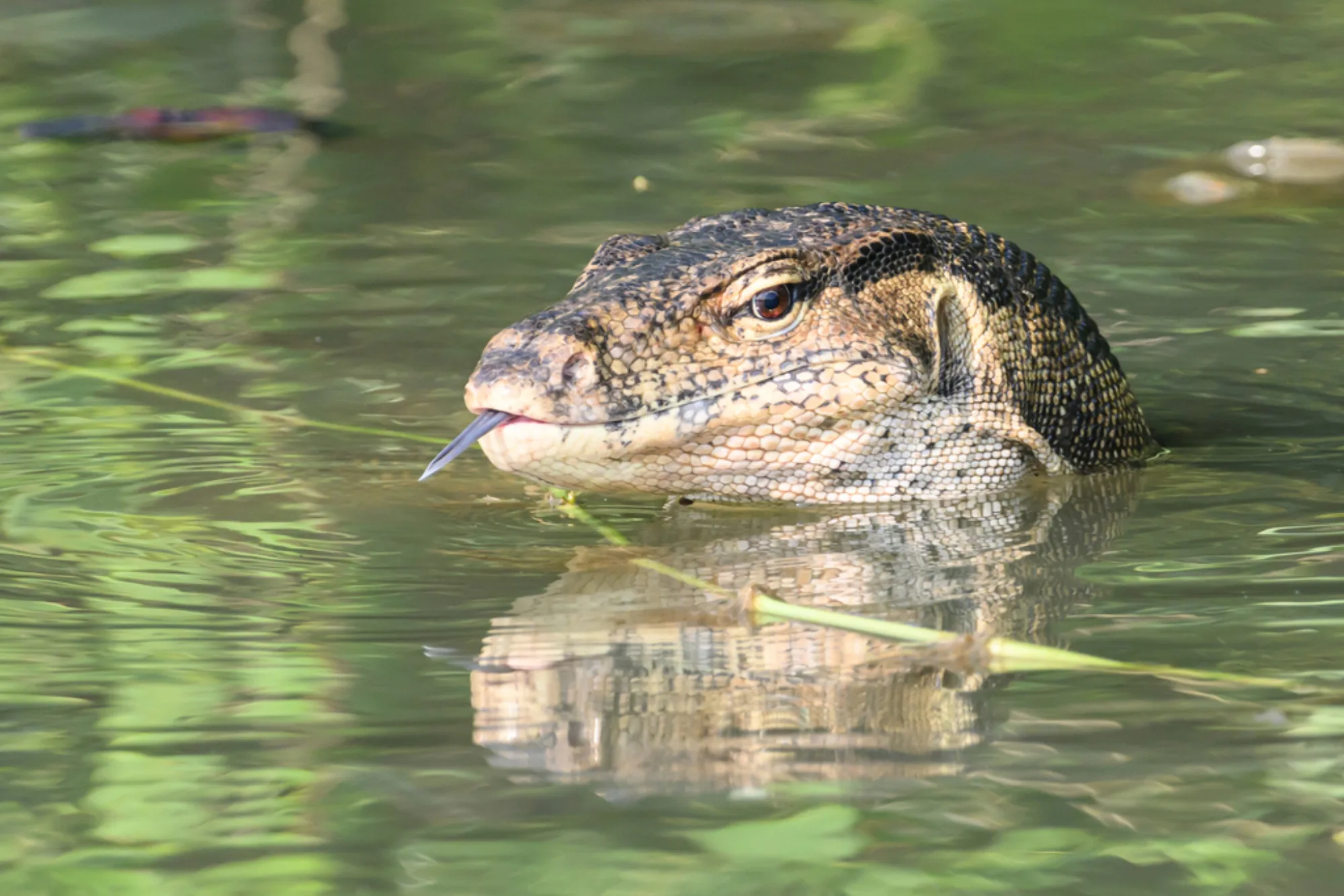
A powerful tail and dark, patterned skin help distinguish the Common Water Monitor, a large lizard native to South and Southeast Asia. Its colouring is dark brown to blackish, with yellow spots underneath that fade with age and yellow-edged dark bands running back from the eyes. Adults rarely grow longer than 1.5 to 2 m, although the largest specimen recorded in Sri Lanka measured 3.21 m. The species ranges from India, Bangladesh and Sri Lanka through mainland Southeast Asia to southern China and islands including Sumatra, Java, Borneo and Sulawesi. It favours lowland freshwater and brackish wetlands, particularly forests and mangrove swamps, but also lives around rivers, ponds and lakes. In places it has adapted to farmland and cities with canals, and it is frequently seen in Bangkok's parks and waterways.
An excellent swimmer, the monitor uses its tail to steer and may climb a tree or jump into a stream to escape a predator. Young monitors spend much of their time in trees, while adults live on the ground. Its varied diet includes fish, frogs, crabs, birds and their eggs, rodents, other lizards and snakes, as well as carrion. On Java, it has been seen hunting bats that have fallen inside caves, venturing in after dark. Breeding takes place between April and October, and females lay 10 to 40 eggs in rotting logs or stumps. The eggs hatch after 6 to 7 months, and the young are independent from the start. People hunt water monitors for their skins, meat and fat, and also collect their eggs. Habitat loss and fragmentation threaten populations, while road traffic kills some monitors.
Written from the English Wikipedia article Asian water monitor (CC BY-SA 4.0).
- Records
- 352
- Countries
- 12
- Atlas places
- 9
- Danum Valley Conservation Area· Malaysia
- Kaziranga National Park· India
- Sundarbans National Park· India
- Tabin Wildlife Reserve· Malaysia
- Everglades National Park· United States
- Baluran National Park· Indonesia
- Gunung Leuser National Park· Indonesia
- Taman Negara National Park· Malaysia
- West Bali National Park· Indonesia
These are open occurrence records, so they show where people looked for and recorded the Common Water Monitor as much as where it lives. Cells are up to 25 km across, and every location is generalised to its cell.
Generalised encounter areas, not exact locations. Each shape is a grid cell coloured by how likely the species is there.
- Very likelyMalaysia25 km zone · medium confidence · 117 records · updated 80 days ago
- Very likelyThailand25 km zone · medium confidence · 86 records · updated 80 days ago
- Very likelySingapore25 km zone · medium confidence · 36 records · updated 80 days ago
- Very likelyIndonesia25 km zone · medium confidence · 35 records · updated 80 days ago
- Very likelyUnited States25 km zone · medium confidence · 30 records · updated 80 days ago
- Very likelyIndia25 km zone · medium confidence · 29 records · updated 80 days ago
- Very likelyBrunei25 km zone · medium confidence · 15 records · updated 80 days ago
- LikelySri Lanka25 km zone · medium confidence · 3 records · updated 80 days ago
- PossibleBangladesh25 km zone · medium confidence · 1 record · updated 80 days ago
- PossibleHong Kong SAR China25 km zone · low confidence · 0 records · updated 80 days ago
Conservation status not assessed here yet, so every location is generalised to its grid cell.