Nile Monitor
Varanus niloticus
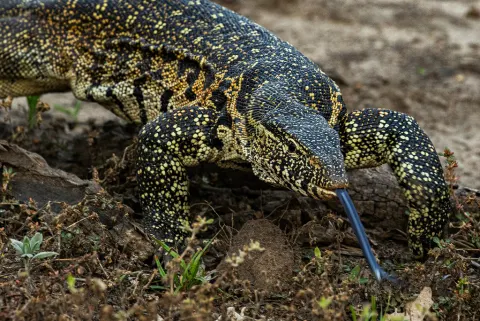
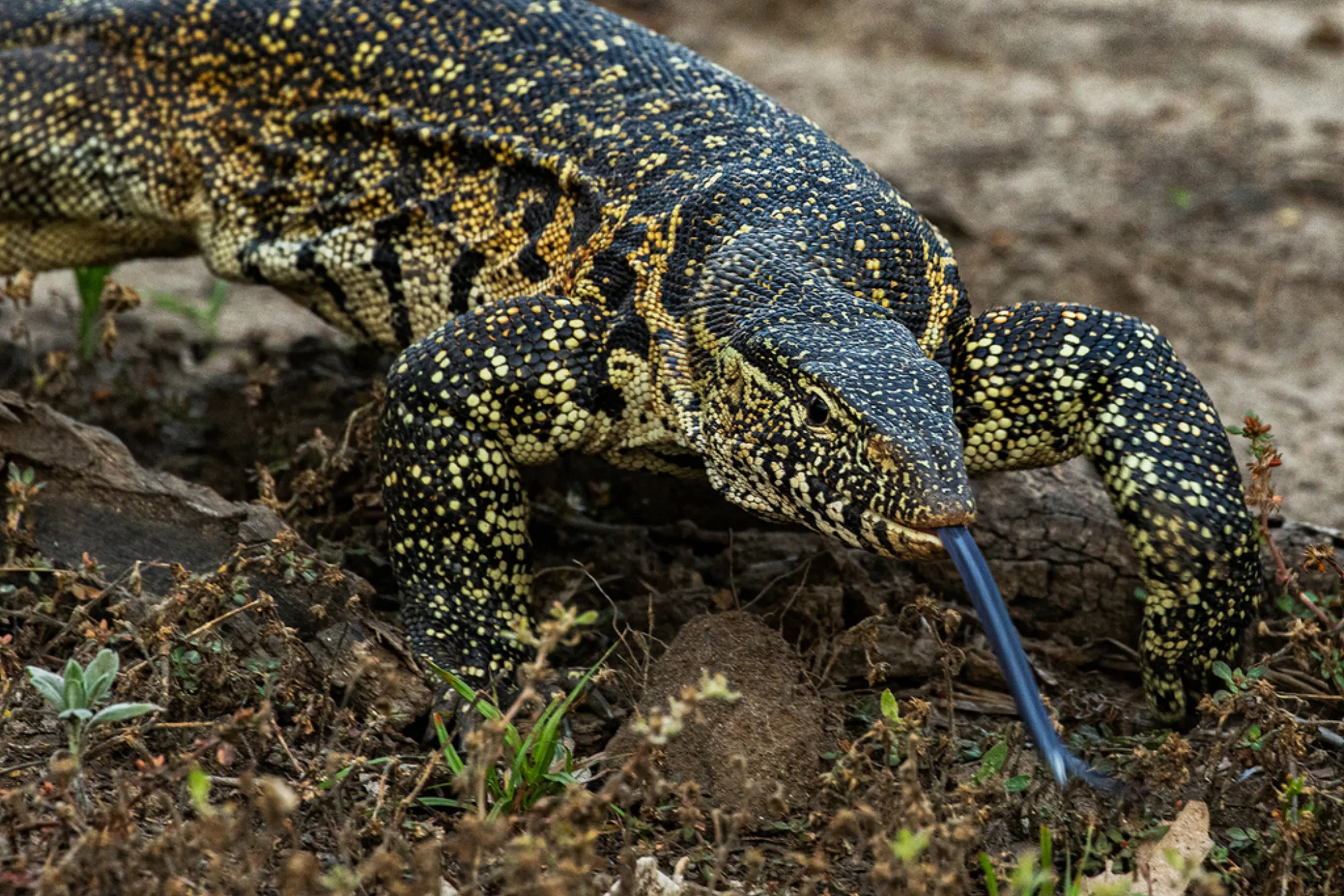
Africa's longest lizard, the Nile Monitor can grow from about 120 to 220 cm, with the largest specimens reaching 244 cm. Its muscular body is greyish-brown above, marked with large greenish-yellow, rosette-like spots, each with a tiny dark centre. Greenish-yellow bars mark the tail, while the throat and underside range from ochre-yellow to creamy-yellow, often with faint bars. Strong legs and sharp claws help it climb and dig, and it is also a quick runner on land. A forked tongue helps it detect scents.
This monitor lives across much of sub-Saharan Africa, favouring dry areas and places near rivers, including the Nile and its tributaries. It does not occur in Africa's desert regions, including the Sahara and Kalahari. At home in water as well as on land, it takes a wide range of food, from fish, frogs and toads to birds, rodents, small reptiles and eggs. Its prey can include young crocodiles, and it raids crocodile nests for eggs. Beetles, crabs, snails and other invertebrates are also on the menu, along with carrion and human waste. Although aggressive and resistant to taming, Nile monitors are commonly sold as pets. Young monitors defend themselves with tail whips, while adults can inflict wounds by biting and scratching. Breeding populations descended from escaped or released pets have become established in parts of Florida, particularly around Cape Coral. The account gives no details of breeding in Africa or of threats to wild populations.
Written from the English Wikipedia article Nile monitor (CC BY-SA 4.0).
- Records
- 2,478
- Countries
- 28
- Atlas places
- 35
- Kruger National Park· South Africa
- Chobe National Park· Botswana
- iSimangaliso Wetland Park· South Africa
- Ngorongoro Conservation Area· Tanzania
- Serengeti National Park· Tanzania
- Tarangire National Park· Tanzania
- Maasai Mara National Reserve· Kenya
- Okavango Delta· Botswana
- Bwabwata National Park· Namibia
- Everglades National Park· United States
- Hluhluwe-iMfolozi Park· South Africa
- Lake Manyara National Park· Tanzania
- Nairobi National Park· Kenya
- Zambezi National Park· Zimbabwe
- Murchison Falls National Park· Uganda
- Nyerere National Park· Tanzania
- Pilanesberg National Park· South Africa
- Queen Elizabeth National Park· Uganda
- Samburu National Reserve· Kenya
- South Luangwa National Park· Zambia
- Addo Elephant National Park· South Africa
- Ai-Ais/Richtersveld Transfrontier Park· Namibia
- Arusha National Park· Tanzania
- Augrabies Falls National Park· South Africa
- Gonarezhou National Park· Zimbabwe
- Hwange National Park· Zimbabwe
- Lake Nakuru National Park· Kenya
- Lower Zambezi National Park· Zambia
- Mana Pools National Park· Zimbabwe
- Mapungubwe National Park· South Africa
- Matobo National Park· Zimbabwe
- Mountain Zebra National Park· South Africa
- Ruaha National Park· Tanzania
- Saadani National Park· Tanzania
- Skeleton Coast· Namibia
These are open occurrence records, so they show where people looked for and recorded the Nile Monitor as much as where it lives. Cells are up to 25 km across, and every location is generalised to its cell.
Generalised encounter areas, not exact locations. Each shape is a grid cell coloured by how likely the species is there.
- Very likelyUnited States25 km zone · medium confidence · 1909 records · updated 80 days ago
- Very likelySouth Africa25 km zone · medium confidence · 186 records · updated 80 days ago
- Very likelyBenin25 km zone · medium confidence · 79 records · updated 80 days ago
- Very likelyTanzania25 km zone · medium confidence · 46 records · updated 80 days ago
- Very likelyKenya25 km zone · medium confidence · 38 records · updated 80 days ago
- Very likelyNamibia25 km zone · medium confidence · 38 records · updated 80 days ago
- Very likelyUganda25 km zone · medium confidence · 34 records · updated 80 days ago
- Very likelyZimbabwe25 km zone · medium confidence · 29 records · updated 80 days ago
- Very likelyGambia25 km zone · medium confidence · 16 records · updated 80 days ago
- Very likelyGuinea-Bissau25 km zone · medium confidence · 14 records · updated 80 days ago
Conservation status not assessed here yet, so every location is generalised to its grid cell.