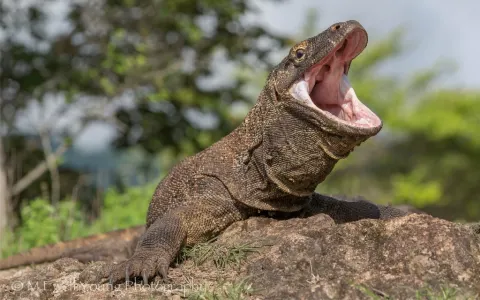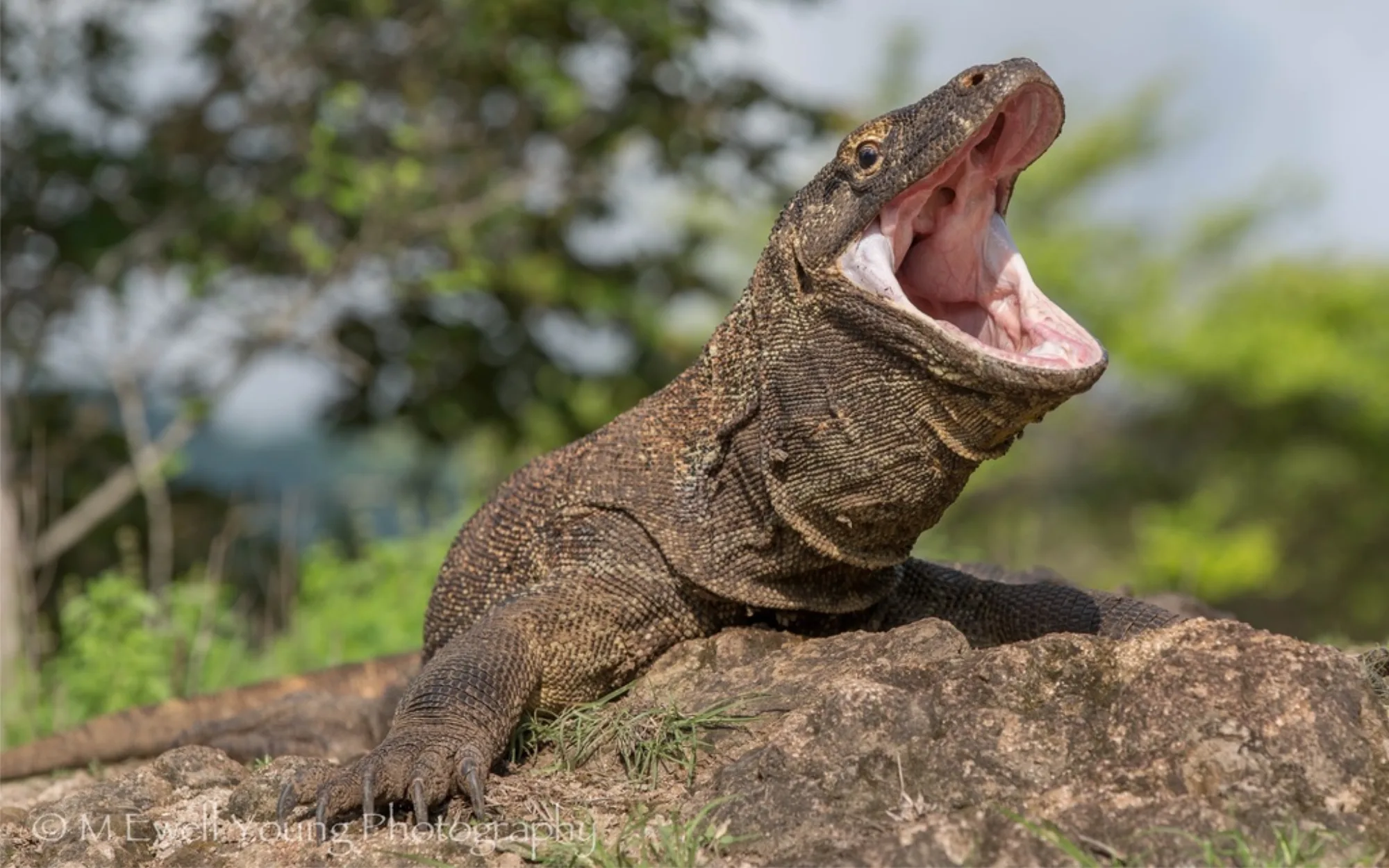
Komodo Dragon
Varanus komodoensis
A long, yellow forked tongue and a tail as long as its body help distinguish the Komodo Dragon, the largest living lizard. Males can reach 3 m in length and weigh up to 150 kg, while the skin is covered in armoured scales. Found only in Indonesia, this monitor lizard lives on Flores and Rinca, as well as Komodo, Gili Motang and Gili Dasami, with its largest remaining population in Komodo National Park. It favours hot, dry places at low elevations, from savanna and open grassland to tropical forest.
Usually solitary, Komodo dragons come together to breed and feed. They are most active during the day, sheltering in shade during the hottest hours and hunting in the afternoon. Adults ambush prey, particularly large mammals such as Javan rusa deer and pigs, and also eat carrion. Young dragons feed on smaller animals, including insects and birds, and live largely among the trees during their early years, safer from predators that include adult dragons. Females lay eggs in abandoned bird nests or holes they dig themselves; the eggs hatch after seven to eight months, when insects are plentiful. Dragons generally avoid people, although a cornered animal may hiss, swing its tail and attack if disturbed further.
Human encroachment has reduced the dragon's wild range. Habitat loss, fires, volcanic activity, earthquakes, tourism, poaching of dragons and the loss of prey to poaching have all contributed to its decline. Climate change is a further threat: drying conditions and rising seas could alter the valleys and low-lying areas the lizards depend on.
Written from the English Wikipedia article Komodo dragon (CC BY-SA 4.0).
- Records
- 148
- Countries
- 1
- Atlas places
- 1
These are open occurrence records, so they show where people looked for and recorded the Komodo Dragon as much as where it lives. Cells are up to 25 km across, and every location is generalised to its cell.
Generalised encounter areas, not exact locations. Each shape is a grid cell coloured by how likely the species is there.
- Very likelyIndonesia25 km zone · high confidence · 148 records · updated 81 days ago
Conservation status not assessed here yet, so every location is generalised to its grid cell.