Perentie
Varanus giganteus
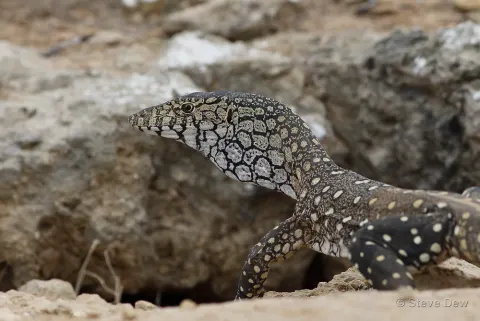
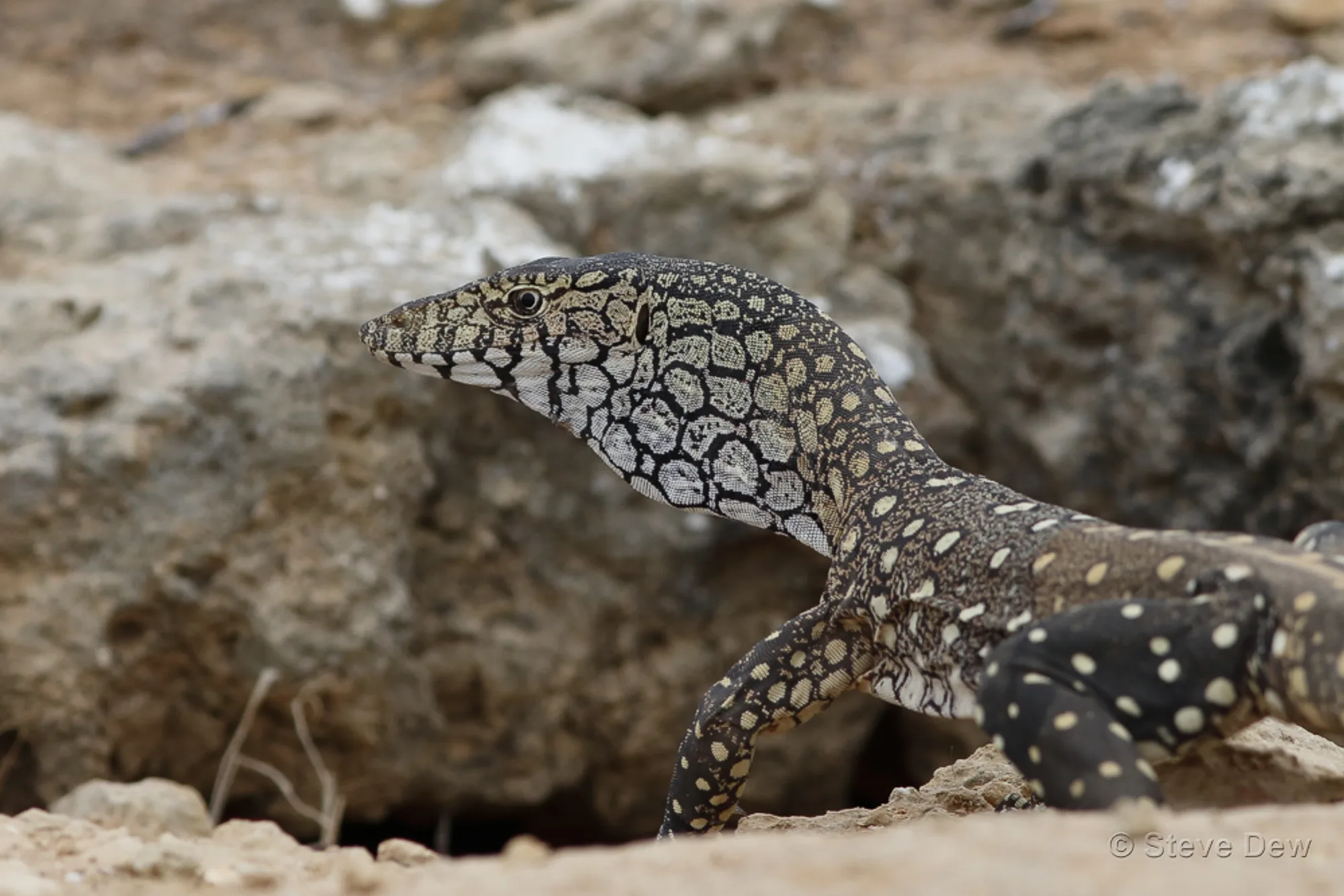
Australia's largest living lizard, the Perentie is a lean monitor that can grow to 2.5 m and weigh up to 20 kg. Its creamy-white head and neck carry a network of black lines and flecks, while its yellow or cream body has brown rosettes across the back. Dark limbs marked with white spots complete the pattern.
In Queensland, the Northern Territory, South Australia and Western Australia, Perenties inhabit arid deserts west of the Great Dividing Range. Look for the rocky outcrops and gorges they inhabit, where the ground holds hard-packed soil and loose stones. Sightings are uncommon: these shy lizards avoid people, often retreating before they are noticed, and much of their range is remote from human habitation. They dig shelter burrows in minutes and use their long claws to climb trees. A Perentie may stand on its hind legs and tail to survey the terrain, or sprint on either two legs or four. When detected, it may lie flat and still until danger passes, or run away. If cornered, it can stand its ground, hiss, lunge or use its claws, teeth and tail in defence.
An active hunter and scavenger, the Perentie feeds mainly on reptiles and small mammals, with birds eaten less often. Its prey includes other monitor lizards and even smaller Perenties, as well as rodents and young kangaroos. Young Perenties mostly eat arthropods, particularly grasshoppers and centipedes. Coastal and island animals often take sea turtle eggs and hatchlings, and may ambush gulls from beneath vehicles. Females can lay their eggs in soil or termite mounds. Adults have no natural predators within their range.
Written from the English Wikipedia article Perentie (CC BY-SA 4.0).
- Records
- 609
- Countries
- 1
- Atlas places
- 1
These are open occurrence records, so they show where people looked for and recorded the Perentie as much as where it lives. Cells are up to 25 km across, and every location is generalised to its cell.
Generalised encounter areas, not exact locations. Each shape is a grid cell coloured by how likely the species is there.
- Very likelyAustralia25 km zone · medium confidence · 609 records · updated 80 days ago
Conservation status not assessed here yet, so every location is generalised to its grid cell.