Savannah Monitor
Varanus exanthematicus
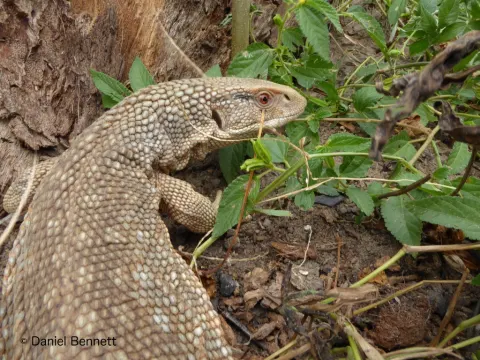
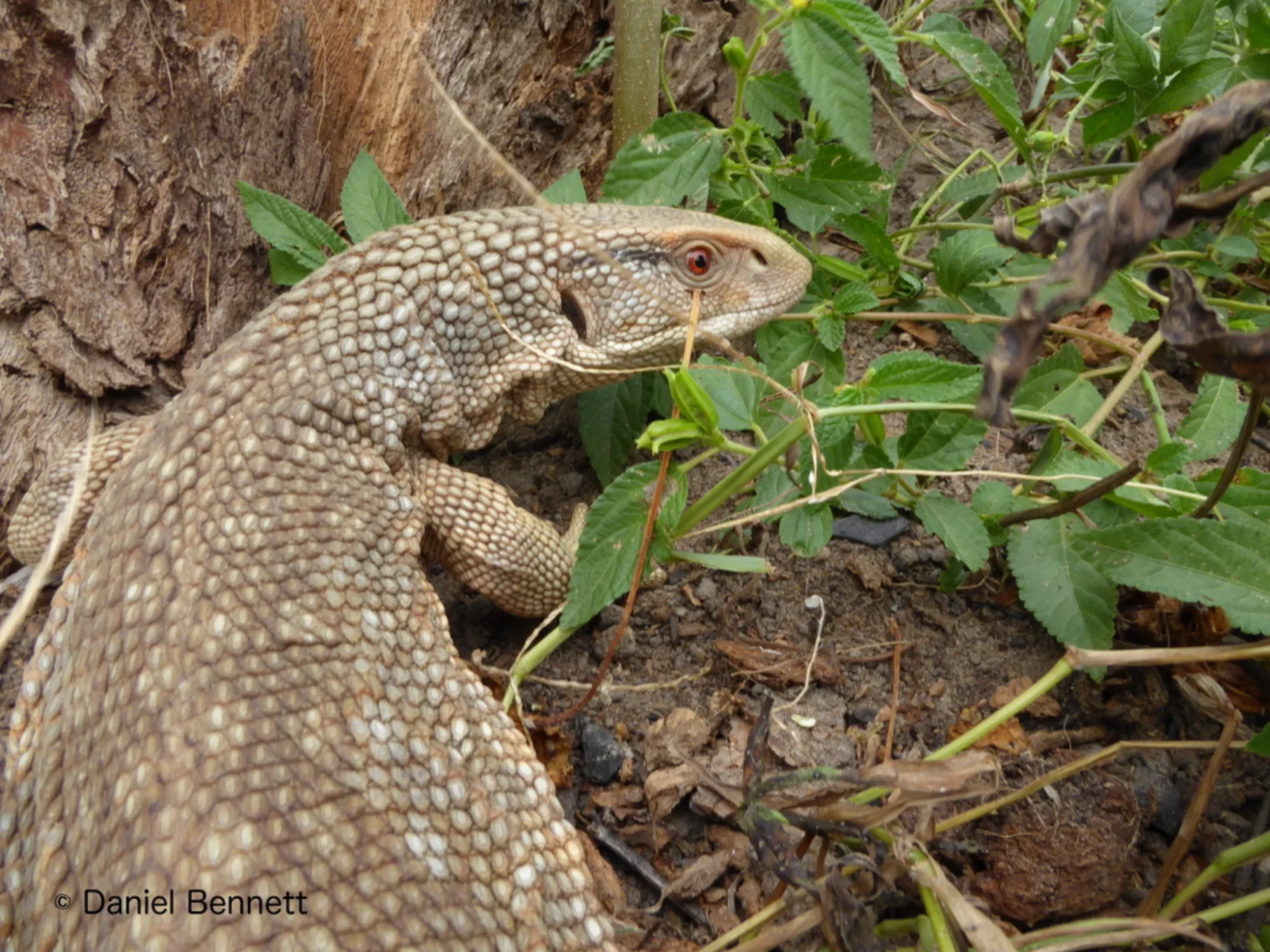
Stout and low to the ground, the Savannah Monitor is a medium-sized African lizard with short limbs and toes, strong digging legs and powerful jaws. It rarely grows beyond 100 cm, and its skin colour varies with the ground in its local habitat. The tail is partly flattened from side to side and has a double ridge along its upper surface. Its range spans an area south of the Sahara, reaching from Senegal to Sudan in the east and almost as far as the Congo River and Rift Valley in the south. It spends most of its time on the ground and takes shelter in burrows, though it can also turn up in bushes or low trees. On Ghana's coastal plain, young monitors are often found around giant cricket burrows.
Much of its food consists of invertebrates, including snails, crabs, scorpions, millipedes, centipedes, insects and other small creatures, as well as frogs. In Senegal, millipedes were the most common prey recorded for adults, while in Ghana small crickets made up most of the diet of monitors less than 2 months old. Many adults eat large quantities of snails, using their blunt teeth to crack the shells, and will also take carrion when they find it. Wild monitors occasionally eat lizard eggs, including those of their own species. Females dig a deep hole in the ground and lay up to 40 or more eggs, which hatch after about 156 to 160 days. People hunt the species for meat and leather and collect it for the international pet trade. Its skins enter the international leather trade, mainly from Chad, Mali and Sudan, and there is substantial undeclared trade from Sudan, Nigeria and elsewhere.
Written from the English Wikipedia article Savannah monitor (CC BY-SA 4.0).
- Records
- 45
- Countries
- 2
No atlas park has a record of the Savannah Monitor in or around it yet.
These are open occurrence records, so they show where people looked for and recorded the Savannah Monitor as much as where it lives. Cells are up to 25 km across, and every location is generalised to its cell.
Generalised encounter areas, not exact locations. Each shape is a grid cell coloured by how likely the species is there.
- Very likelyBenin25 km zone · medium confidence · 45 records · updated 80 days ago
- UncommonUnited States25 km zone · low confidence · 0 records · updated 80 days ago
Conservation status not assessed here yet, so every location is generalised to its grid cell.