Bengal Monitor
Varanus bengalensis
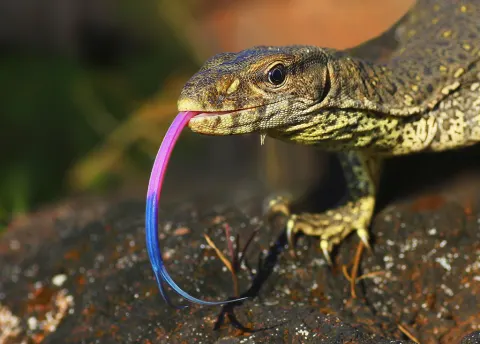
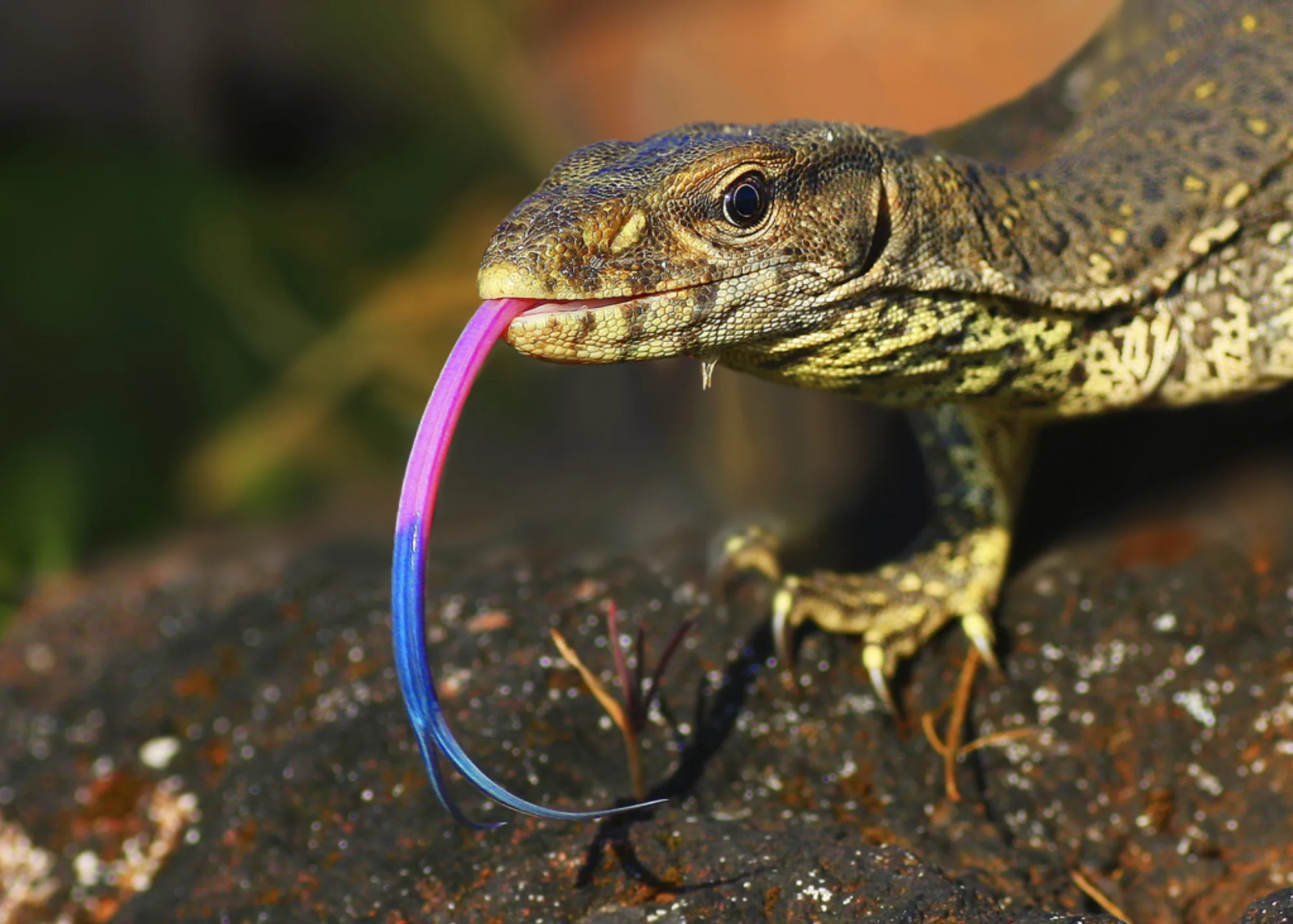
Across a range stretching from Iran to Java, the Bengal Monitor moves through landscapes as different as dry semiarid desert and moist forest. This large monitor lizard can reach 175 cm in length, including a tail of 100 cm. Adults are light brown or grey with dark speckles, while the more colourful young have dark bars across the neck, throat and back. Males are generally larger than females.
In river valleys below 1,500 m, Bengal Monitors favour forest with large trees and plenty of ground cover, though they also inhabit agricultural areas. They usually live alone and spend much of their time on the ground, while young animals are often seen in trees. They shelter in burrows, crevices in rocks or buildings, and sometimes abandoned termite mounds. Active by day, they bask in the morning sun and are usually shy of people. They can move quickly, climb well and swim, remaining underwater for at least 17 minutes. Their varied diet includes beetles and other invertebrates, as well as frogs, fish, snakes, rodents and birds. They also eat carrion and may gather around a large carcass. Large adults sometimes climb tree trunks to hunt roosting bats.
The main breeding season runs from June to September. Females dig nest holes, sometimes use termite mounds, and lay a clutch of about 20 eggs. They often dig false nests nearby. The wild population is decreasing as people hunt these lizards for food, medicinal uses and their skin. Agricultural pesticides also threaten them by reducing the prey available. In Iran, some are killed because people regard them as dangerous.
Written from the English Wikipedia article Bengal monitor (CC BY-SA 4.0).
- Records
- 400
- Countries
- 4
- Atlas places
- 21
- Yala National Park· Sri Lanka
- Nagarhole National Park· India
- Wasgamuwa National Park· Sri Lanka
- Bandipur National Park· India
- Jim Corbett National Park· India
- Kaziranga National Park· India
- Kumana National Park· Sri Lanka
- Manas National Park· India
- Udawalawe National Park· Sri Lanka
- Wilpattu National Park· Sri Lanka
- Chitwan National Park· Nepal
- Gal Oya National Park· Sri Lanka
- Minneriya National Park· Sri Lanka
- Ranthambore National Park· India
- Bandhavgarh National Park· India
- Eravikulam National Park· India
- Gir National Park· India
- Kanha National Park· India
- Pench National Park· India
- Periyar National Park· India
- Tadoba Andhari Tiger Reserve· India
These are open occurrence records, so they show where people looked for and recorded the Bengal Monitor as much as where it lives. Cells are up to 25 km across, and every location is generalised to its cell.
Generalised encounter areas, not exact locations. Each shape is a grid cell coloured by how likely the species is there.
- Very likelySri Lanka25 km zone · medium confidence · 213 records · updated 80 days ago
- Very likelyIndia25 km zone · medium confidence · 172 records · updated 80 days ago
- Very likelyBangladesh25 km zone · medium confidence · 10 records · updated 80 days ago
- Very likelyNepal25 km zone · medium confidence · 5 records · updated 80 days ago
Conservation status not assessed here yet, so every location is generalised to its grid cell.