Black Tree Monitor
Varanus beccarii
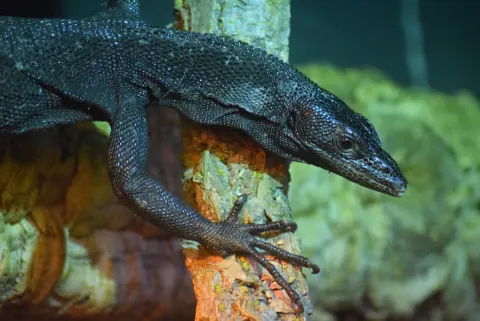
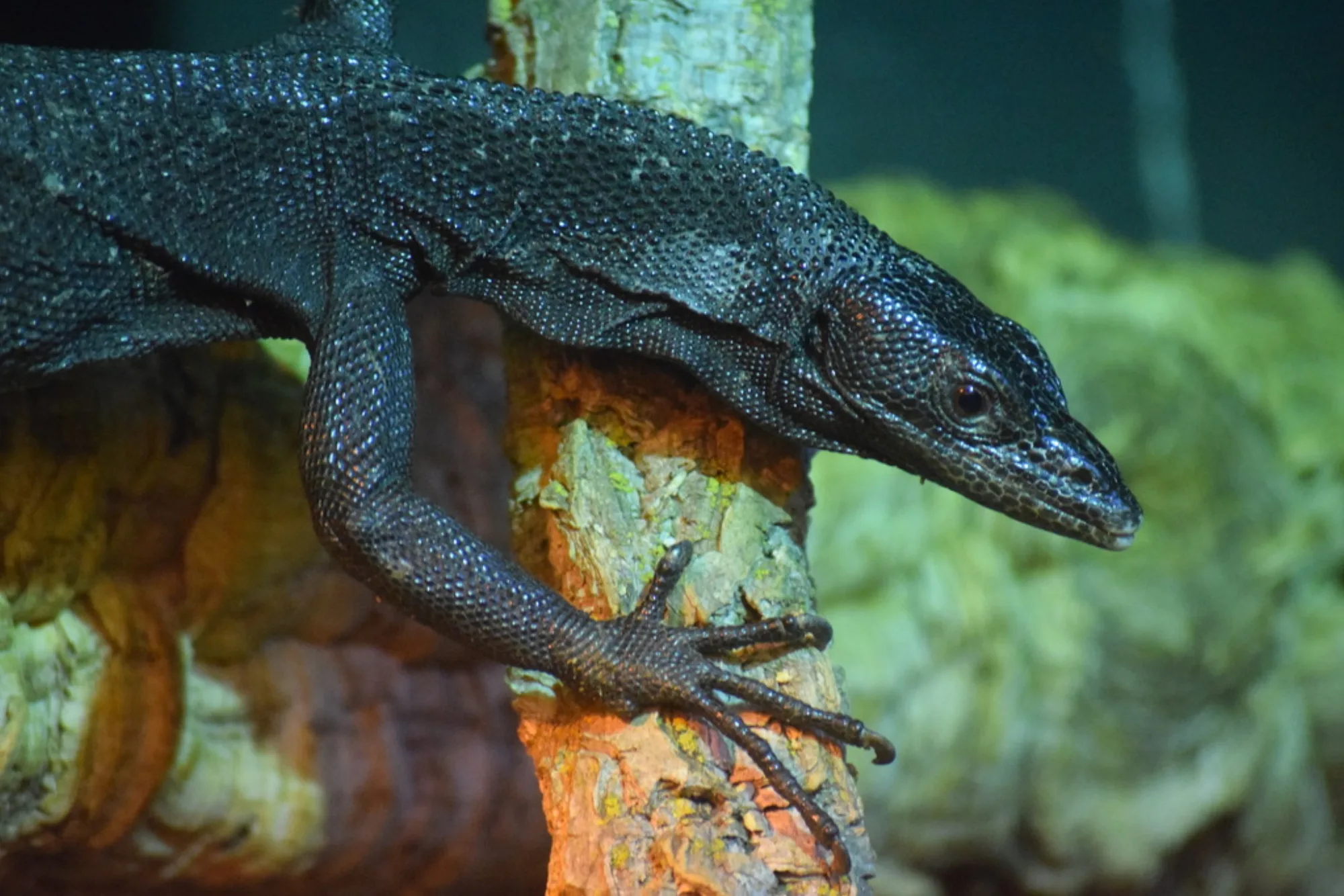
Reaching up to 120 cm in total length, the Black Tree Monitor is easily identified by its entirely black skin and keeled neck scales. While adults are dark, hatchlings are grey with rows of bright yellow-green dots across their backs. These lizards are superbly adapted for a life spent in the canopy. They possess exceptionally long, slender forelimbs and toes tipped with large claws and adhesive soles to maintain their grip. Their prehensile tails, which can account for two-thirds of their body length, act as stabilizers among the branches. Unlike many of their relatives, they do not use these tails for defense, preferring to flee or bite if they feel threatened.
Endemic to the Aru Islands of Indonesia, these monitors inhabit humid forests and mangrove swamps. They are highly intelligent hunters capable of complex problem solving. If prey is hidden in a tight crevice, they use their nimble forelimbs to hook it out with their claws. Their diet is primarily insectivorous, though they also consume scorpions, eggs, small mammals, and bird nestlings. Their unusually long teeth help them secure these meals high in the trees. Although little is known about their wild breeding habits, they may lay eggs inside arboreal termite nests.
Despite being skilled predators, these monitors face pressure from larger snakes, lizards, and introduced foxes. Humans also hunt them, though this specific threat has decreased over time. Today, the most significant dangers to their survival are the international pet trade and the loss of their habitat through deforestation and the expansion of farmland. Because they are nervous and high-strung in the wild, they will often scratch or defecate on those who handle them carelessly.
Written from the English Wikipedia article Black tree monitor (CC BY-SA 4.0).
- Atlas places
- 0
These are open occurrence records, so they show where people looked for and recorded the Black Tree Monitor as much as where it lives. Cells are up to 25 km across, and every location is generalised to its cell.
No encounter zones yet
Where and when you can expect to see Black Tree Monitor is calculated from observation density. No zones have been computed for this species yet.
Conservation status not assessed here yet, so every location is generalised to its grid cell.