Northern Lapwing
Vanellus vanellus
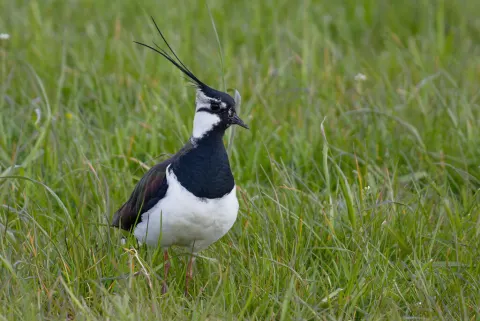
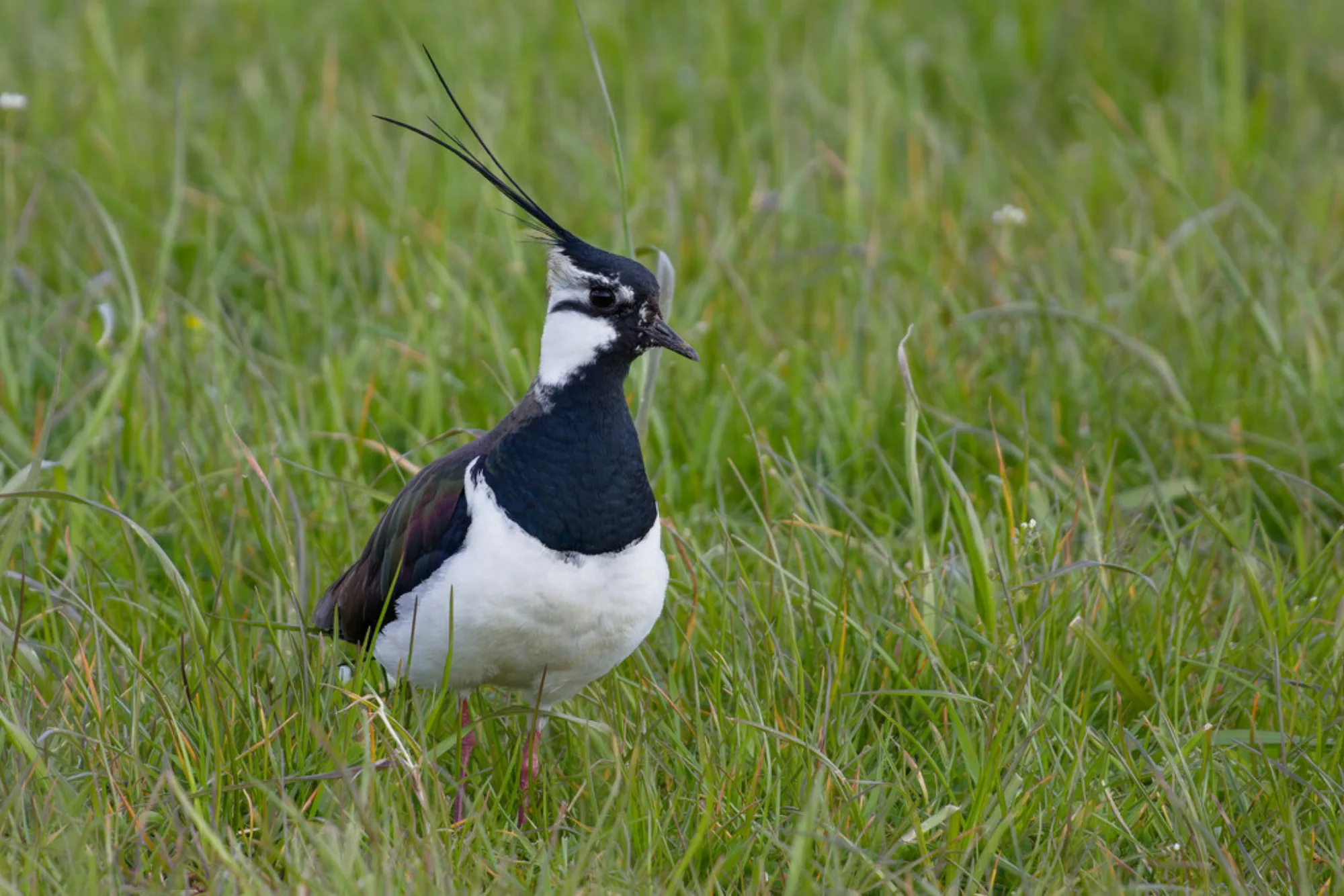
A wispy crest and rounded wings help distinguish the Northern Lapwing, a black-and-white wader with a green-tinted back. It measures 28 to 33 cm long, with a wingspan of 67 to 87 cm. The male's long crest and black markings on the crown, throat and breast stand out against its mostly white face; females and young have less sharply marked heads and shorter crests. Listen for its loud, shrill “pee-wit” contact call, which gives it the name peewit. During the breeding season, males call as they tumble through display flights.
Common across temperate Eurosiberia, the species breeds on cultivated ground and in other places where vegetation is short. Much of the population migrates, mainly by day and often in large flocks, spending winter as far south as North Africa and northern India, as well as Nepal, Bhutan and parts of China. Some lowland breeders in western Europe stay year-round. In winter, huge flocks gather on open land, especially fields and mud-flats. Lapwings eat mainly insects and other small invertebrates, sometimes feeding alongside golden plovers and black-headed gulls. They can bring worms to the surface by beating the ground with one leg, and favour feeding on moonlit nights. A clutch of three to four eggs is laid in a ground scrape, and both adults fiercely defend the nest and young, even against horses and cattle.
Intensive farming has reduced lapwing numbers, with the loss of rough grassland and mixed farms among the pressures in lowland areas. Nest and chick predation also contributes to declines, while overhunting threatens birds along winter migration routes in the Middle East.
Written from the English Wikipedia article Northern lapwing (CC BY-SA 4.0).
- Records
- 933,546
- Countries
- 97
- Atlas places
- 4
These are open occurrence records, so they show where people looked for and recorded the Northern Lapwing as much as where it lives. Cells are up to 25 km across, and every location is generalised to its cell.
Generalised encounter areas, not exact locations. Each shape is a grid cell coloured by how likely the species is there.
- Very likelyUnited Kingdom25 km zone · high confidence · 300939 records · updated 86 days ago
- Very likelyNorway25 km zone · high confidence · 182911 records · updated 86 days ago
- Very likelyBelgium25 km zone · high confidence · 162311 records · updated 86 days ago
- Very likelyFrance25 km zone · high confidence · 58600 records · updated 86 days ago
- Very likelyNetherlands25 km zone · high confidence · 37318 records · updated 86 days ago
- Very likelySpain25 km zone · high confidence · 35897 records · updated 86 days ago
- Very likelyGermany25 km zone · high confidence · 15946 records · updated 86 days ago
- Very likelyFinland25 km zone · high confidence · 14976 records · updated 86 days ago
- Very likelyPortugal25 km zone · high confidence · 12996 records · updated 86 days ago
- Very likelySweden25 km zone · high confidence · 10215 records · updated 86 days ago
Conservation status not assessed here yet, so every location is generalised to its grid cell.