Masked Lapwing
Vanellus miles
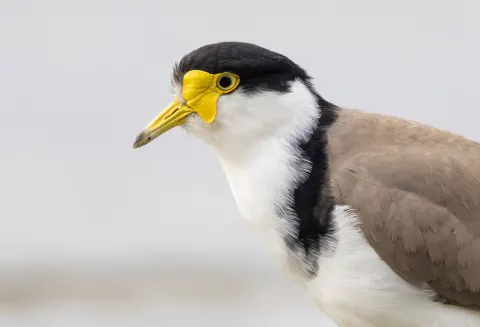
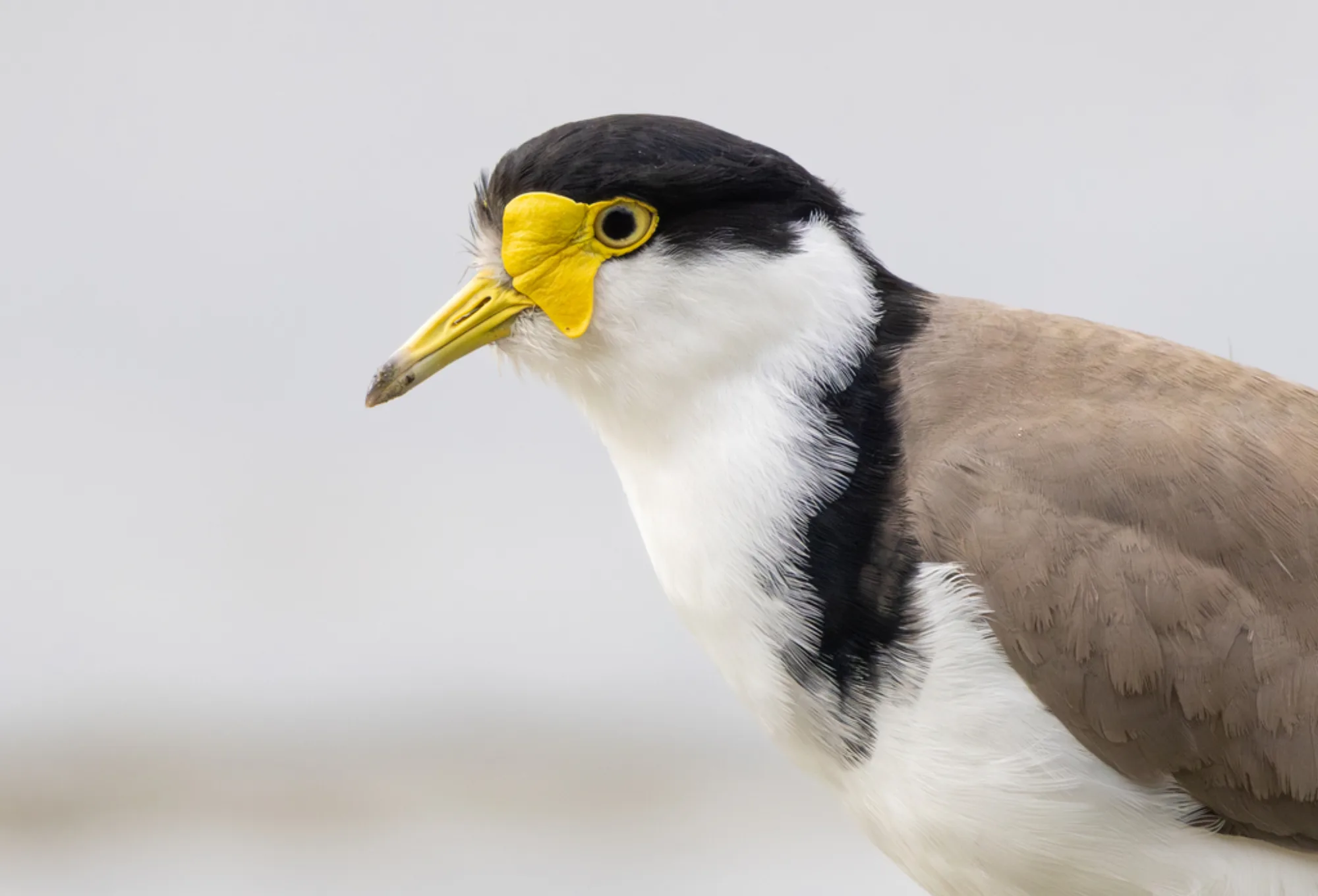
Often seen on the ground, the Masked Lapwing is a large, conspicuous bird with a range of calls that can carry through the day or night. It measures 30 to 37 cm long, with a 75 to 85 cm wingspan and a noticeable yellow spur on each wing. Birds in northern Australia and New Guinea have white necks and large yellow wattles, while those in southern and eastern Australia and New Zealand have a black neck stripe and smaller wattles. The southern form also has black markings on its shoulders and the sides of its chest.
Native to Australia, New Zealand and New Guinea, these lapwings are especially common in northern and eastern Australia. Look for them around wetland edges and other damp, open places, as well as on beaches, coastlines and sometimes in dry areas. They spend much of their time searching the ground for worms and insects, often appearing in pairs or gathering in groups to feed along coasts. Nesting pairs use open ground, including suburban parks, gardens, school ovals, supermarket car parks and flat rooftops. They defend their territory with loud calls, spread wings and fast, low swoops, and may draw predators away from a nest or chicks with a distraction display. Chicks are fully grown at four or five months old and often stay with their parents for one to two years.
Disturbance from pets, pedestrians and cars can prevent some suburban birds from breeding successfully. A bird can also injure a wing while striking an intruder, leaving it unable to fly while the wing heals.
Written from the English Wikipedia article Masked lapwing (CC BY-SA 4.0).
- Records
- 742,918
- Countries
- 13
- Atlas places
- 7
These are open occurrence records, so they show where people looked for and recorded the Masked Lapwing as much as where it lives. Cells are up to 25 km across, and every location is generalised to its cell.
Generalised encounter areas, not exact locations. Each shape is a grid cell coloured by how likely the species is there.
- Very likelyAustralia25 km zone · high confidence · 667459 records · updated 86 days ago
- Very likelyNew Zealand25 km zone · high confidence · 73101 records · updated 86 days ago
- Very likelyPapua New Guinea25 km zone · high confidence · 1190 records · updated today
- Very likelySingapore25 km zone · high confidence · 998 records · updated today
- PossibleFiji25 km zone · medium confidence · 44 records · updated today
- PossibleVanuatu25 km zone · medium confidence · 32 records · updated today
- PossibleNorfolk Island25 km zone · medium confidence · 23 records · updated today
- UncommonIndonesia25 km zone · medium confidence · 26 records · updated today
- UncommonNew Caledonia25 km zone · medium confidence · 22 records · updated today
- UncommonTimor-Leste25 km zone · medium confidence · 12 records · updated today
Conservation status not assessed here yet, so every location is generalised to its grid cell.