Candiru
Vandellia cirrhosa
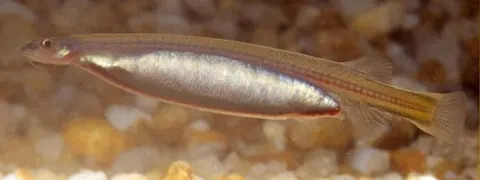
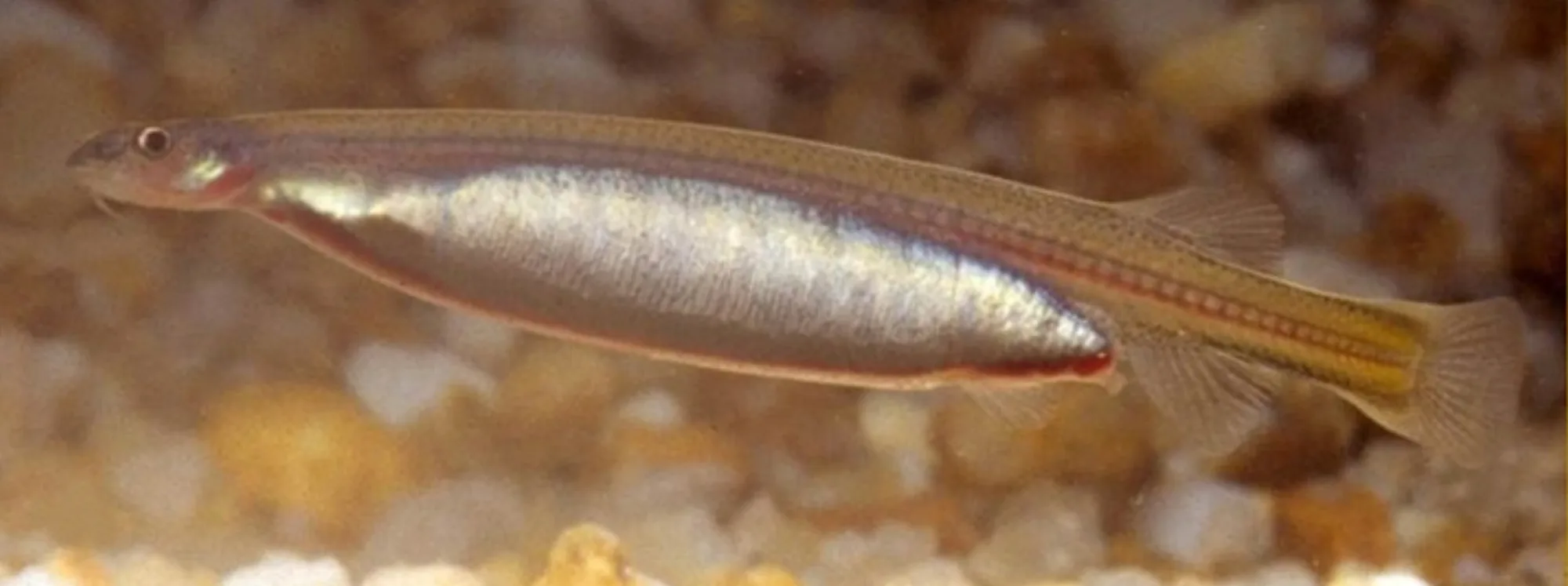
Slender and translucent, the Candiru is a small parasitic freshwater catfish native to the Amazon basin. Its body can be difficult to pick out in cloudy water, though blood may show through its skin after a meal. It has a small head, small eyes with yellow irises, and short sensory barbels around its head. Its belly can look swollen after a large blood meal. Short spines point backwards from its gill covers, and its tail fin is fairly small with a blunt shape.
In lowland Amazonia, the fish occurs in both the Amazon and Orinoco river basins, including Brazil's Purus River. It is also found in Bolivia, Colombia, Ecuador and Peru. It inhabits shallow riffles as well as water with rocky, sandy or muddy beds. It occurs unevenly across its range and seems to stay close to its spawning sites. Some of its habitats are geographically isolated, making them hard to study.
Candiru feed on the blood of larger fish, particularly certain catfish and members of the Characidae family. They have been recorded parasitising many species in the same place, suggesting that availability may matter more than a preference for a particular host. A feeding fish approaches its host, swims alongside it and tries to enter beneath the gill cover. It generally appears to finish feeding within two minutes. The number living in the wild is unknown. Fishing pressure on stocks in the Purus River may affect the Candiru indirectly by reducing the number of potential host fish.
Written from the English Wikipedia article Vandellia cirrhosa (CC BY-SA 4.0).
- Records
- 14
- Countries
- 3
- Atlas places
- 1
These are open occurrence records, so they show where people looked for and recorded the Candiru as much as where it lives. Cells are up to 25 km across, and every location is generalised to its cell.
Generalised encounter areas, not exact locations. Each shape is a grid cell coloured by how likely the species is there.
- Very likelyBrazil25 km zone · medium confidence · 6 records · updated 80 days ago
- LikelyColombia25 km zone · medium confidence · 5 records · updated 80 days ago
- PossiblePeru25 km zone · medium confidence · 3 records · updated 80 days ago
Conservation status not assessed here yet, so every location is generalised to its grid cell.