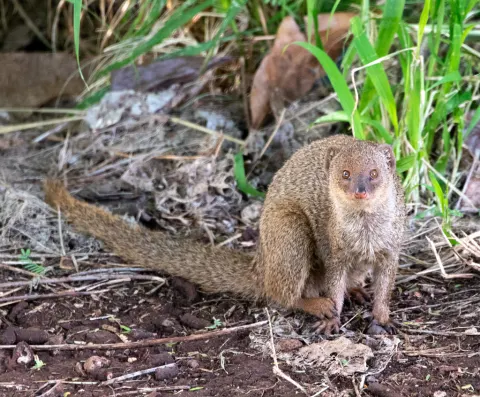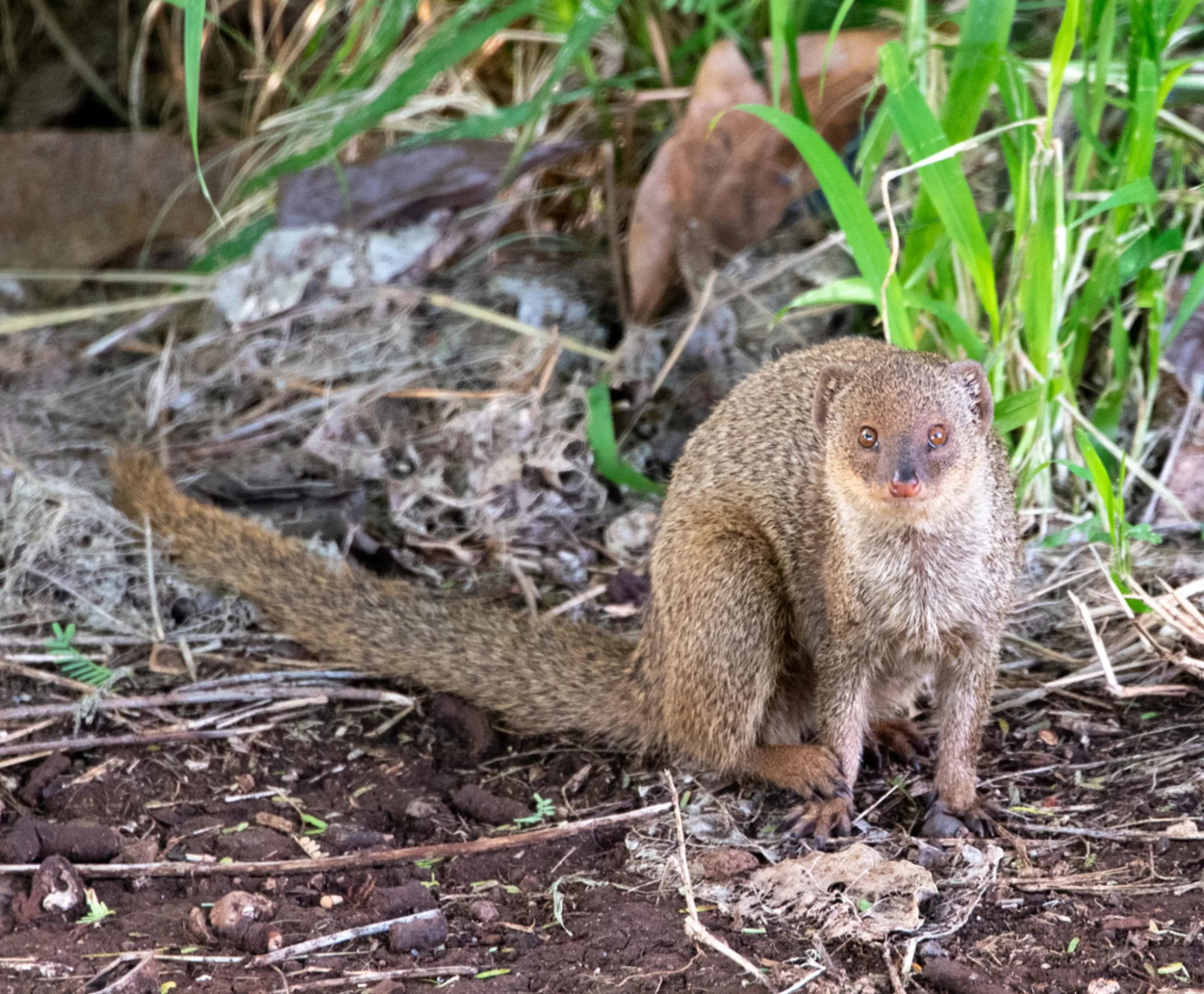
Urva auropunctata
Slender and low to the ground, Urva auropunctata has an elongated head, a pointed snout and short ears. Its head and body measure 509 to 671 mm, and males have larger bodies and broader heads than females. It is somewhat smaller than the Indian grey mongoose, which often shares its range.
The small Indian mongoose occurs from Iraq through southeastern Iran and across parts of South Asia to Myanmar. Introduced populations live on Caribbean islands, islands in the Indian and Pacific Oceans, and in several European countries. It can live at elevations up to 2,100 m. In Iraq, it inhabits riverbank thickets, crop fields and orchards on the Tigris-Euphrates alluvial plains, and has also been seen in the Hammar Marshes. In India, it has been observed in forested areas of Madhya Pradesh, including Panna Tiger Reserve and Gandhi Sagar Sanctuary.
In Pakistan, insects form the main part of its diet, including grasshoppers, dragonflies, beetles and ants. It also takes small mammals, while evidence from droppings shows a broader diet that includes small birds, reptiles, amphibians, fruit and grass seeds. On some islands, introduced mongooses have preyed on native birds and raided green sea turtle nests for eggs and hatchlings. They have also been linked to declines in native reptiles and snakes in the Caribbean. The mongoose uses about 12 different vocalisations. After nine were brought to Jamaica from India, they reproduced within a few months. People have treated the mongoose as vermin on islands where it was introduced, offering bounties in an effort to reduce its population.
Written from the English Wikipedia article Small Indian mongoose (CC BY-SA 4.0).
- Records
- 7,285
- Countries
- 24
- Atlas places
- 2
These are open occurrence records, so they show where people looked for and recorded the Urva auropunctata as much as where it lives. Cells are up to 25 km across, and every location is generalised to its cell.
Generalised encounter areas, not exact locations. Each shape is a grid cell coloured by how likely the species is there.
- Very likelyUnited States25 km zone · medium confidence · 7046 records · updated 80 days ago
- Very likelyMontenegro25 km zone · high confidence · 78 records · updated 80 days ago
- Very likelyGuadeloupe25 km zone · medium confidence · 57 records · updated 80 days ago
- Very likelyMartinique25 km zone · medium confidence · 33 records · updated 80 days ago
- Very likelyIndia25 km zone · medium confidence · 17 records · updated 80 days ago
- LikelyFiji25 km zone · medium confidence · 15 records · updated 80 days ago
- LikelyPuerto Rico25 km zone · medium confidence · 11 records · updated 80 days ago
- LikelyU.S. Virgin Islands25 km zone · medium confidence · 10 records · updated 80 days ago
- LikelyAntigua & Barbuda25 km zone · medium confidence · 5 records · updated 80 days ago
- LikelyBangladesh25 km zone · medium confidence · 4 records · updated 80 days ago
Conservation status not assessed here yet, so every location is generalised to its grid cell.