Asian Black Bear
Ursus thibetanus
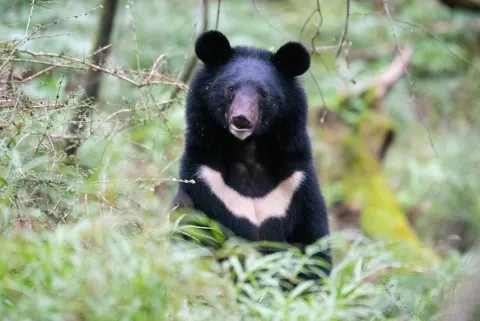
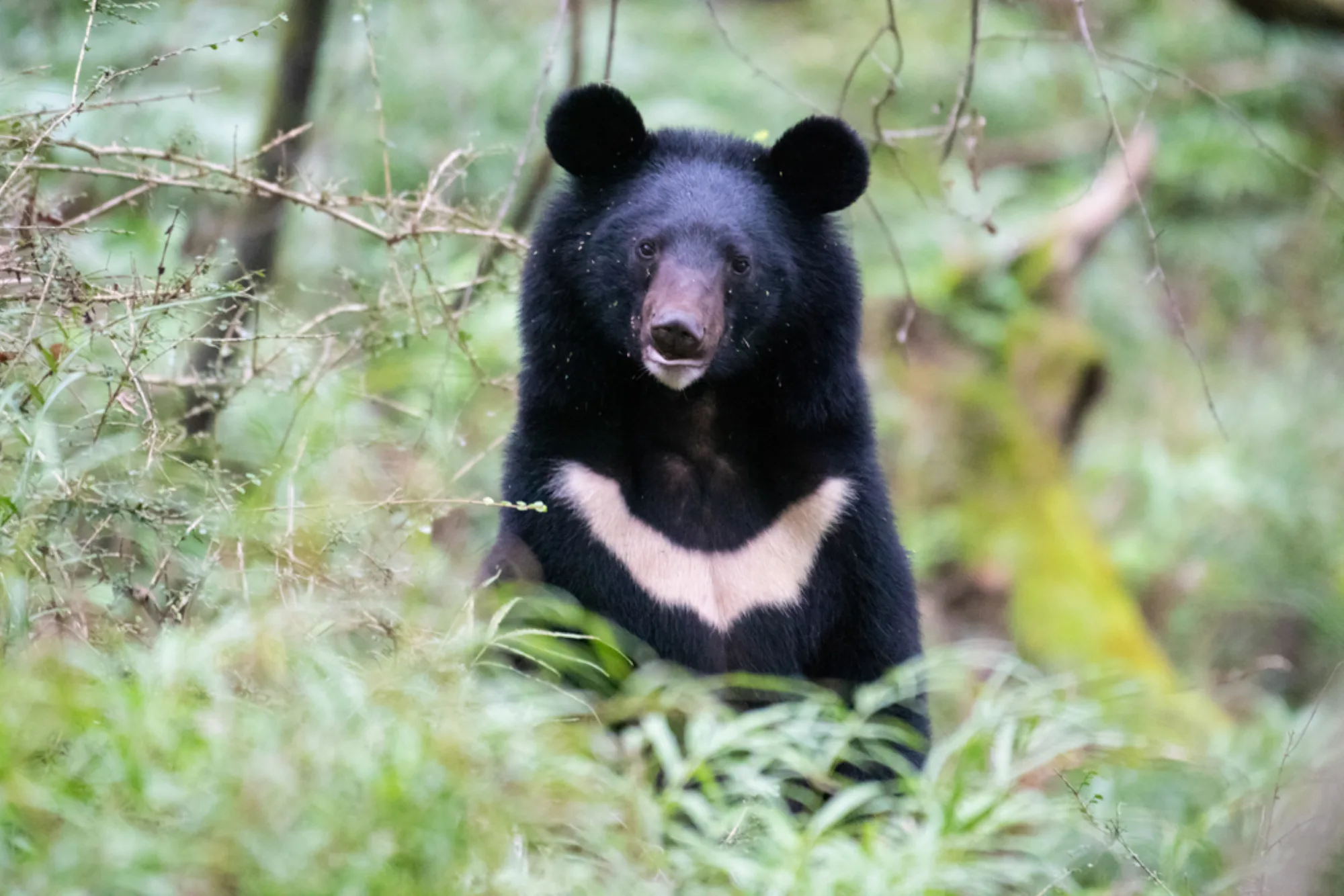
A pale chest patch, sometimes shaped like a V, stands out against the Asian Black Bear's black fur. This medium-sized bear also has a light brown muzzle and long, bell-shaped ears that project sideways. Adults stand 70 to 100 cm at the shoulder and measure 120 to 190 cm in length. Its range stretches from southeastern Iran and the Himalayas across parts of mainland Southeast Asia and China to the Russian Far East, Taiwan and Japan. Its distribution is patchy, and it typically lives in deciduous, mixed and thornbrush forests. In the Himalayas, bears usually spend summer at around 3,500 m, then descend below 1,500 m in winter.
Asian black bears are skilled climbers, using trees for feeding, resting, sunning themselves, escaping enemies and sometimes hibernating. While feeding in the branches, they arrange broken twigs and branches beneath themselves, leaving nest-like platforms in the treetops. They are active by day, but may become nocturnal near human habitation. Their varied diet includes fruit, nuts, insects, honey, grasses and carrion, and they also kill wild animals and livestock. Most do not hibernate, although some in colder northern areas do, and nearly all pregnant females hibernate. In winter or early spring, females typically give birth in hollow trees or caves, with litters averaging two cubs. The young become independent at 24 to 36 months.
Forest cutting and poaching for body parts threaten the species. In Pakistan, habitat loss is also linked to expanding agriculture and plantations, roads and dams, while conflict with people and direct killing add to the pressure.
Written from the English Wikipedia article Asian black bear (CC BY-SA 4.0).
- Records
- 160
- Countries
- 3
No atlas park has a record of the Asian Black Bear in or around it yet.
These are open occurrence records, so they show where people looked for and recorded the Asian Black Bear as much as where it lives. Cells are up to 25 km across, and every location is generalised to its cell.
Generalised encounter areas, not exact locations. Each shape is a grid cell coloured by how likely the species is there.
- Very likelyJapan25 km zone · medium confidence · 150 records · updated 81 days ago
- PossibleThailand25 km zone · medium confidence · 10 records · updated 81 days ago
- RareCambodia25 km zone · low confidence · 0 records · updated 81 days ago
Conservation status not assessed here yet, so every location is generalised to its grid cell.