Polar Bear
Ursus maritimus
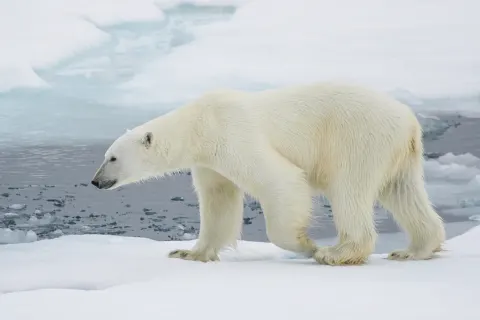
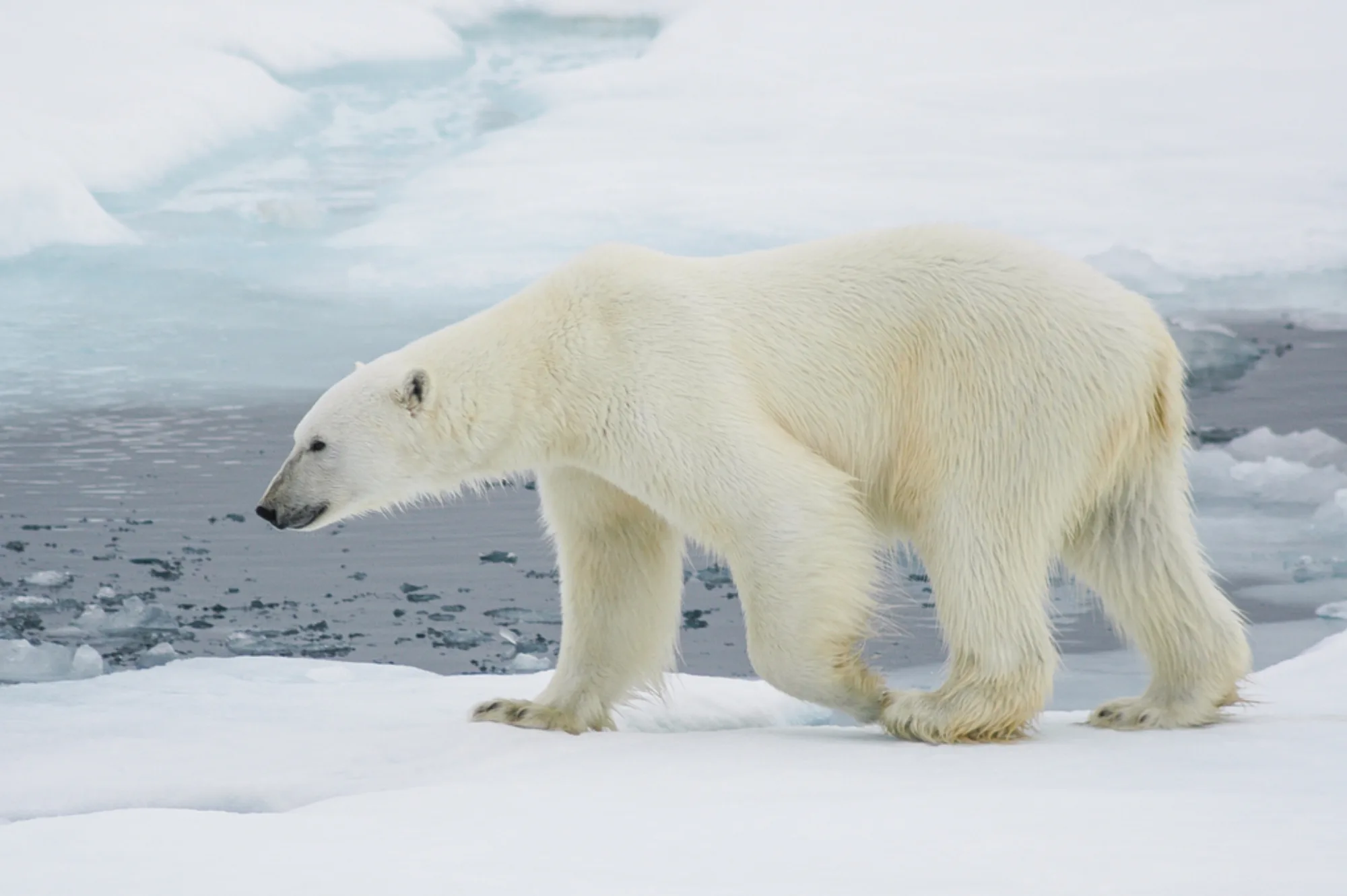
Across the Arctic, the Polar Bear (Ursus maritimus) lives at the meeting point of sea and ice. The largest living bear by weight, it has males that reach 300 to 800 kg as adults, while females are considerably smaller. Its fur looks white or yellowish, while its skin is black, and its large paws help it walk on ice and swim. Compared with a brown bear, it has a slimmer build, its neck is longer and its shoulder hump is lower.
Its range extends across Greenland, Canada, Alaska, Russia and Norway's Svalbard Archipelago. Polar Bears favour annual sea ice, especially places where ice meets open water and seals can be hunted. As ice cover changes, they travel with it, and when the ice disappears in summer, they move onto land. There they may use beaches, rocky areas, forests and mountain habitats. Most are active throughout the year and are usually alone, although bears may gather around food on land.
Seals are their principal prey, particularly ringed seals, and the bears feed on their energy-rich blubber. A bear may stalk a seal across ice or through water, or wait beside a breathing hole for prey to surface. Mothers usually give birth to two cubs in winter dens, and the young may remain with them as long as two and a half years. Climate change, pollution and energy development threaten Polar Bears. As sea ice declines, bears have less access to seals, raising the risk of malnutrition and starvation. More time spent on land also increases the chance of conflict with people, while oil spills pose a further risk.
Written from the English Wikipedia article Polar bear (CC BY-SA 4.0).
- Records
- 489
- Countries
- 5
- Atlas places
- 1
These are open occurrence records, so they show where people looked for and recorded the Polar Bear as much as where it lives. Cells are up to 25 km across, and every location is generalised to its cell.
Generalised encounter areas, not exact locations. Each shape is a grid cell coloured by how likely the species is there.
- Very likelyGreenland25 km zone · medium confidence · 345 records · updated 80 days ago
- Very likelySvalbard & Jan Mayen25 km zone · medium confidence · 68 records · updated 80 days ago
- Very likelyCanada25 km zone · medium confidence · 67 records · updated 80 days ago
- Very likelyRussia25 km zone · medium confidence · 6 records · updated 80 days ago
- Very likelyUnited States25 km zone · medium confidence · 3 records · updated 80 days ago
Conservation status not assessed here yet, so every location is generalised to its grid cell.