Brown Bear
Ursus arctos
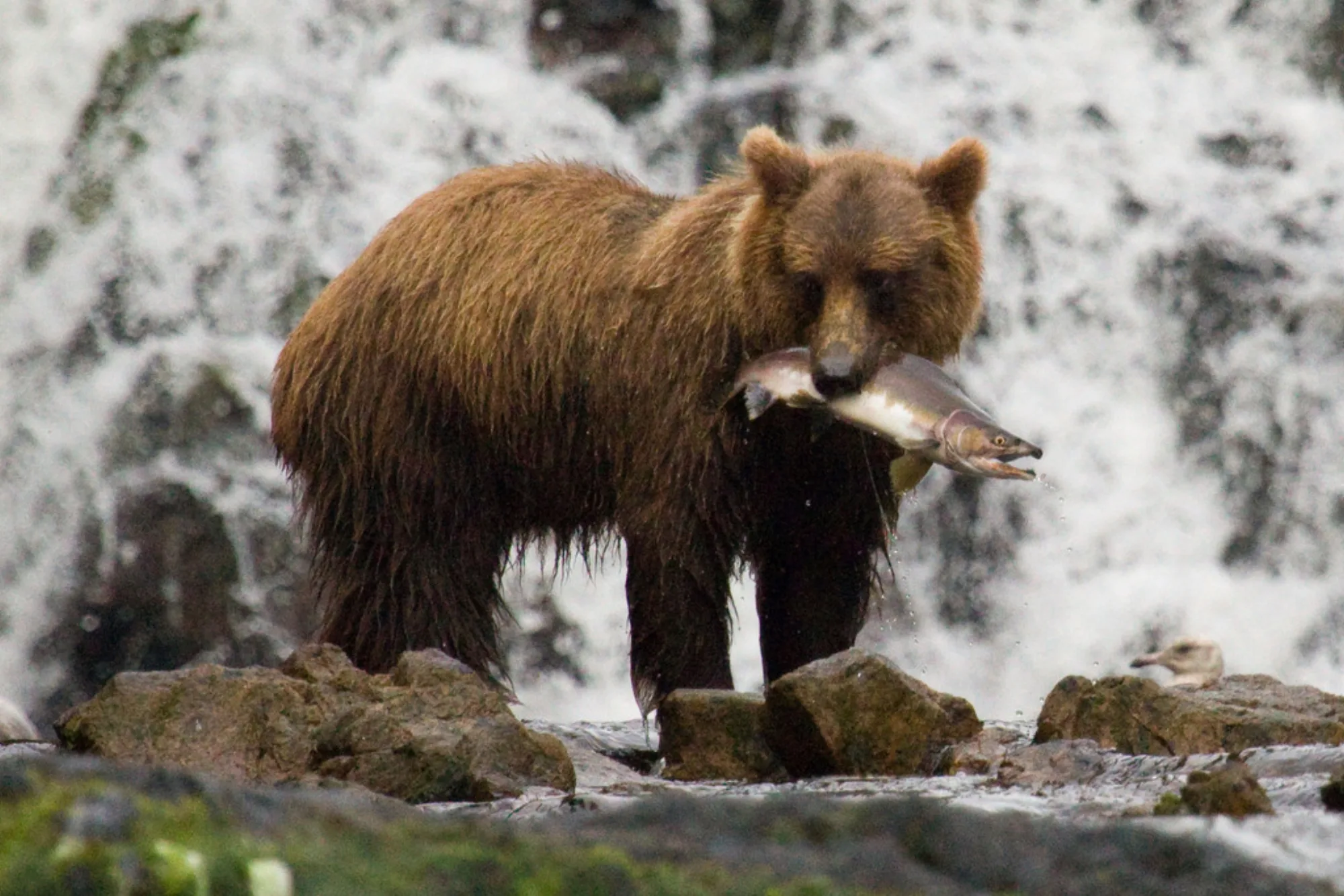
A muscular shoulder hump and a coat that can range from cream through reddish tones to dark brown help distinguish the Brown Bear (Ursus arctos). Its long, thick fur varies between individuals, and its summer coat is shorter and sparser than its winter coat. Brown bears generally weigh 80 to 600 kg, with males larger than females.
Native to Eurasia and North America, the species lives mainly in forested habitats, although it also uses semi-open country with scattered vegetation that provides daytime resting places. It has been recorded from sea level to 5,000 m in the Himalayas. Bears can be active by day or night, with activity peaking in the morning and early evening. They are mostly solitary, but may gather in numbers where food is plentiful, including at rivers where salmon spawn. In winter, they prefer a sheltered den, which may be a cave, a hollow log or a space among tree roots. Females usually give birth to one to three cubs, which learn by following and copying their mother and stay with her for 1.5 to 4.5 years.
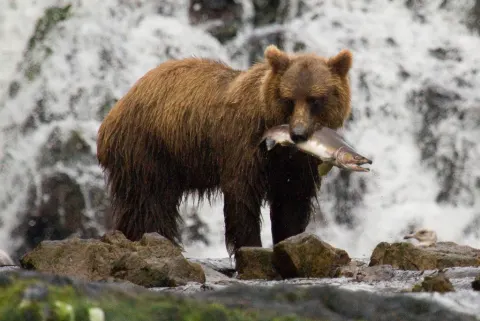
Despite its size, the bear gets much of its food from plants, eating berries, grasses, roots and other vegetation. Its diet also includes insects, rodents and larger animals, while bears in parts of coastal Alaska feed largely on spawning salmon. The species has disappeared from parts of its former range, and hunting drove several populations to extinction. Today, small populations are especially exposed to habitat loss and fragmentation, while overhunting threatens larger populations. Poaching, collisions with vehicles and killing in retaliation for livestock losses also threaten bears in some places.
Written from the English Wikipedia article Brown bear (CC BY-SA 4.0).
- Records
- 19,153
- Countries
- 10
- Atlas places
- 1
These are open occurrence records, so they show where people looked for and recorded the Brown Bear as much as where it lives. Cells are up to 25 km across, and every location is generalised to its cell.
Generalised encounter areas, not exact locations. Each shape is a grid cell coloured by how likely the species is there.
- Very likelyNorway25 km zone · high confidence · 12742 records · updated 80 days ago
- Very likelySweden25 km zone · medium confidence · 4995 records · updated 80 days ago
- Very likelyUkraine25 km zone · high confidence · 322 records · updated 80 days ago
- Very likelyFrance25 km zone · high confidence · 275 records · updated 80 days ago
- Very likelySwitzerland25 km zone · high confidence · 211 records · updated 80 days ago
- Very likelyUnited States25 km zone · high confidence · 164 records · updated 80 days ago
- Very likelyRussia25 km zone · high confidence · 151 records · updated 80 days ago
- Very likelyEstonia25 km zone · medium confidence · 118 records · updated 80 days ago
- Very likelyItaly25 km zone · high confidence · 117 records · updated 80 days ago
- Very likelyAustria25 km zone · medium confidence · 58 records · updated 80 days ago
Conservation status not assessed here yet, so every location is generalised to its grid cell.