American Black Bear
Ursus americanus
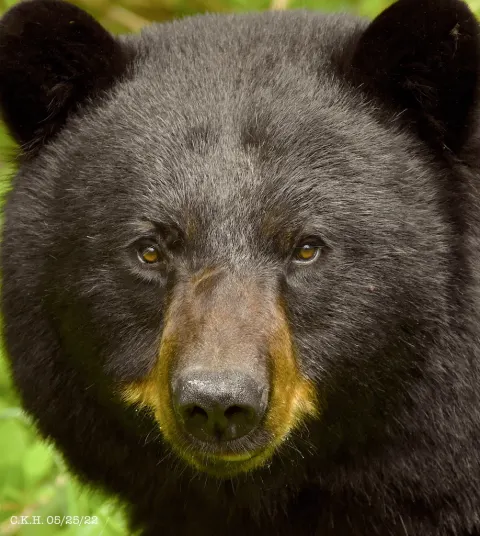
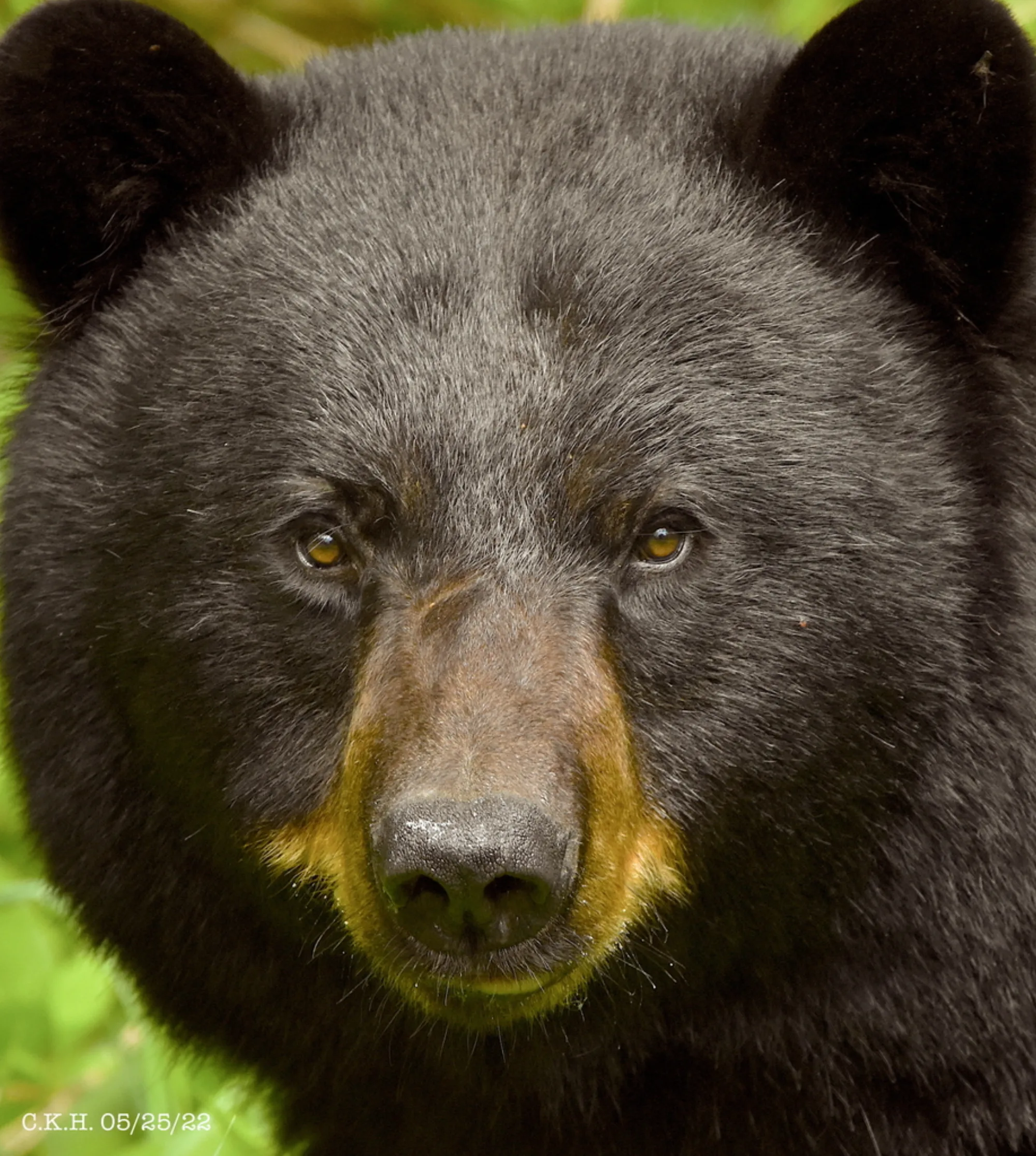
North America’s smallest bear, the American Black Bear is a medium-sized animal with small, rounded ears and a short tail. Its name can be misleading: coats range from black and chocolate brown to cinnamon, blonde or even white. Adults typically measure 120 to 188 cm from head to body, and males are generally heavier than females.
The bear occupies much of its original Canadian range and lives across broad areas of the United States, including Alaska, the Rocky Mountains and the Appalachian Mountains. It also occurs in Mexico, though knowledge of its distribution there is limited. It favours forested areas with thick undergrowth, plentiful food and terrain that can be difficult to reach. Habitats vary from swampy hardwood sites in the southeast to chaparral and pinyon-juniper woodland in the southwest. Bears can also live near towns where food and vegetation are available, and may leave the forest to feed.
Usually solitary and territorial, black bears sometimes gather where food is abundant. They climb trees to feed or escape danger and are strong swimmers. Their diet changes with the seasons, from fresh shoots in spring to berries in summer and nuts in autumn; they also eat insects and, along some coasts, salmon. They may also eat food left by people, including refuse and birdseed. Bears typically hibernate for 3 to 8 months, depending on the climate, in dens that may be under rocks or in tree cavities. Cubs are usually born in late January or early February, with two or three in a typical litter. Human activity accounts for most bear deaths, including legal hunting, poaching and vehicle collisions. Cubs also face predators, including coyotes, cougars and other bears, and flooding can kill newborns in their dens.
Written from the English Wikipedia article American black bear (CC BY-SA 4.0).
- Records
- 3,592
- Countries
- 2
- Atlas places
- 19
- Yellowstone National Park· United States
- Yosemite National Park· United States
- Great Smoky Mountains National Park· United States
- Banff National Park· Canada
- Kenai Fjords National Park· United States
- Jasper National Park· Canada
- Pacific Rim National Park Reserve· Canada
- Sequoia National Park· United States
- Kootenay National Park· Canada
- Glacier National Park· United States
- Grand Teton National Park· United States
- Olympic National Park· United States
- Redwood National and State Parks· United States
- Rocky Mountain National Park· United States
- Yoho National Park· Canada
- Algonquin Provincial Park· Canada
- Big Bend National Park· United States
- Shenandoah National Park· United States
- Waterton Lakes National Park· Canada
These are open occurrence records, so they show where people looked for and recorded the American Black Bear as much as where it lives. Cells are up to 25 km across, and every location is generalised to its cell.
Generalised encounter areas, not exact locations. Each shape is a grid cell coloured by how likely the species is there.
- Very likelyUnited States25 km zone · medium confidence · 2481 records · updated 80 days ago
- Very likelyCanada25 km zone · medium confidence · 1111 records · updated 80 days ago
Conservation status not assessed here yet, so every location is generalised to its grid cell.