Phantastic Leaf-tailed Gecko
Uroplatus phantasticus
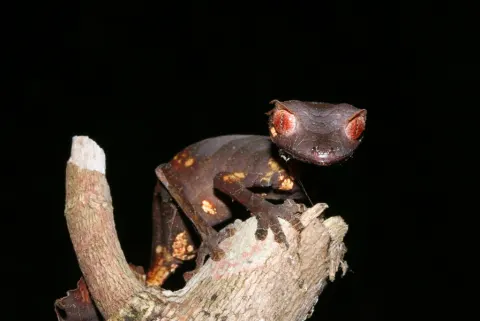
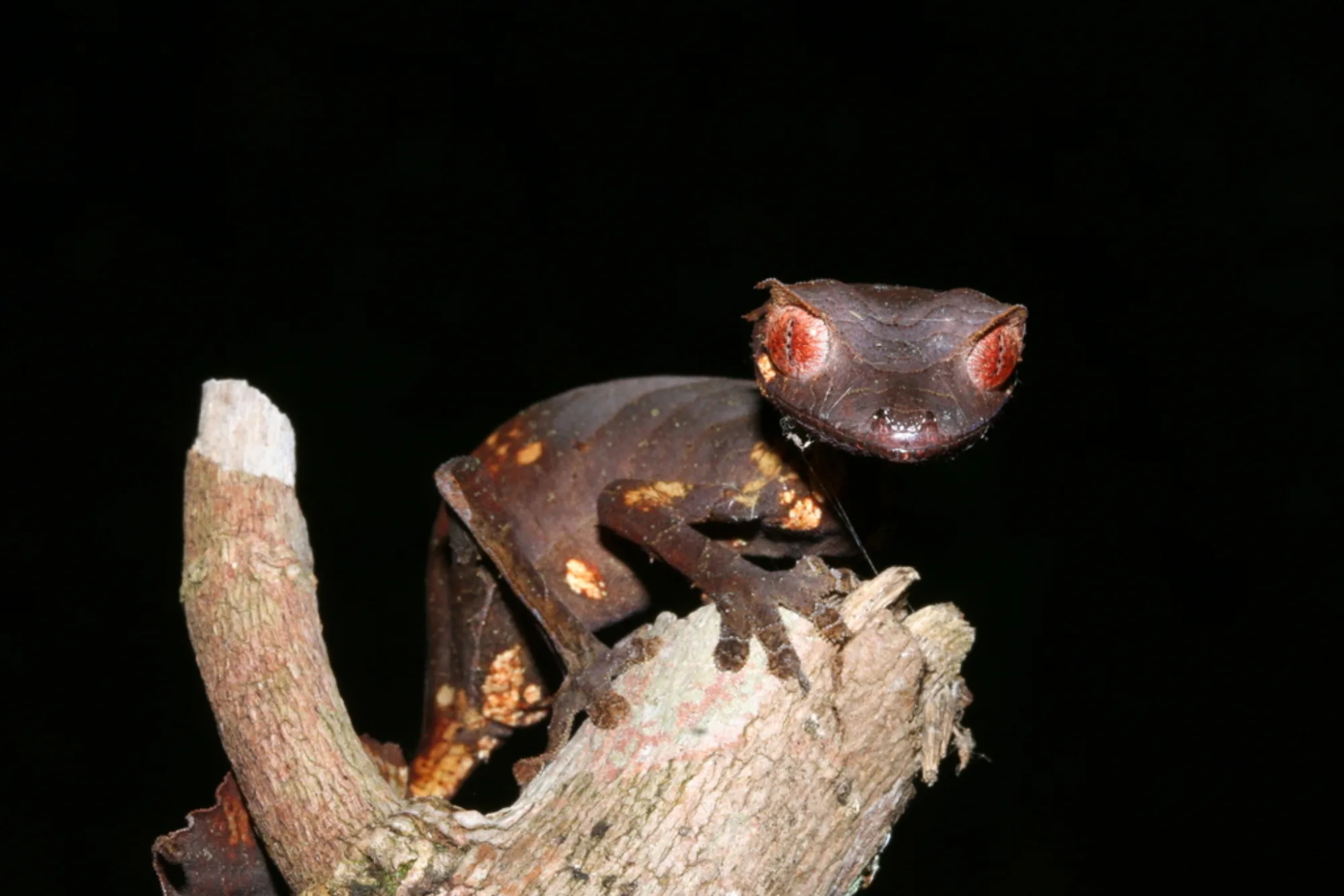
Among the leaves of Madagascar's tropical forests, the Phantastic Leaf-tailed Gecko relies on camouflage to blend into its surroundings. Found nowhere else, it lives in trees in the north and centre of the island. Adults reach up to 90mm in total length, including a flattened tail shaped like a leaf. Some have notches in the tail that make it look like a decaying leaf, a feature that seems more common in males. Above each eye is an eyelash-like projection, while its colouring ranges from purple, orange, tan and yellow to the mottled brown it often wears. Small black dots on its underside help distinguish it from similar species.
By day, the gecko's disguise helps it merge with its surroundings. At night, it moves through the rainforest looking for insects, with camouflage helping it hunt. Adhesive scales beneath its fingers and toes, together with strong curved claws, help it move through the trees. When threatened by a predator, it can press its body flat to reduce its shadow, open its jaws to reveal a bright red mouth or shed its tail. Breeding begins with the rainy season, when females lay clutches of two spherical eggs on the ground beneath leaf litter or among dead leaves on plants.
Forest loss and damage, along with capture for the pet trade, threaten the species. Studies suggest it needs a very specific environment and cannot tolerate degradation of its natural habitat. It occurs in at least three protected areas, including Marojejy National Park, Anjanaharibe Special Reserve and Tsaratanana Strict Nature Reserve. Even within protected areas, however, illegal harvesting of leaf-tailed geckos takes place.
Written from the English Wikipedia article Uroplatus phantasticus (CC BY-SA 4.0).
- Records
- 70
- Countries
- 1
No atlas park has a record of the Phantastic Leaf-tailed Gecko in or around it yet.
These are open occurrence records, so they show where people looked for and recorded the Phantastic Leaf-tailed Gecko as much as where it lives. Cells are up to 25 km across, and every location is generalised to its cell.
Generalised encounter areas, not exact locations. Each shape is a grid cell coloured by how likely the species is there.
- Very likelyMadagascar25 km zone · medium confidence · 70 records · updated 80 days ago
Conservation status not assessed here yet, so every location is generalised to its grid cell.