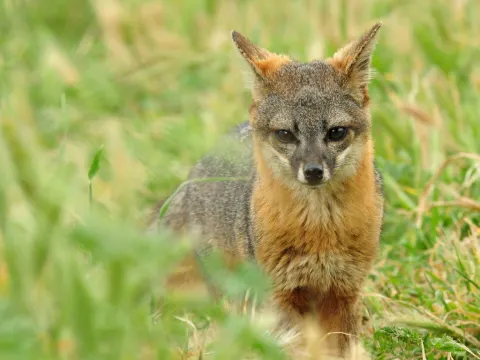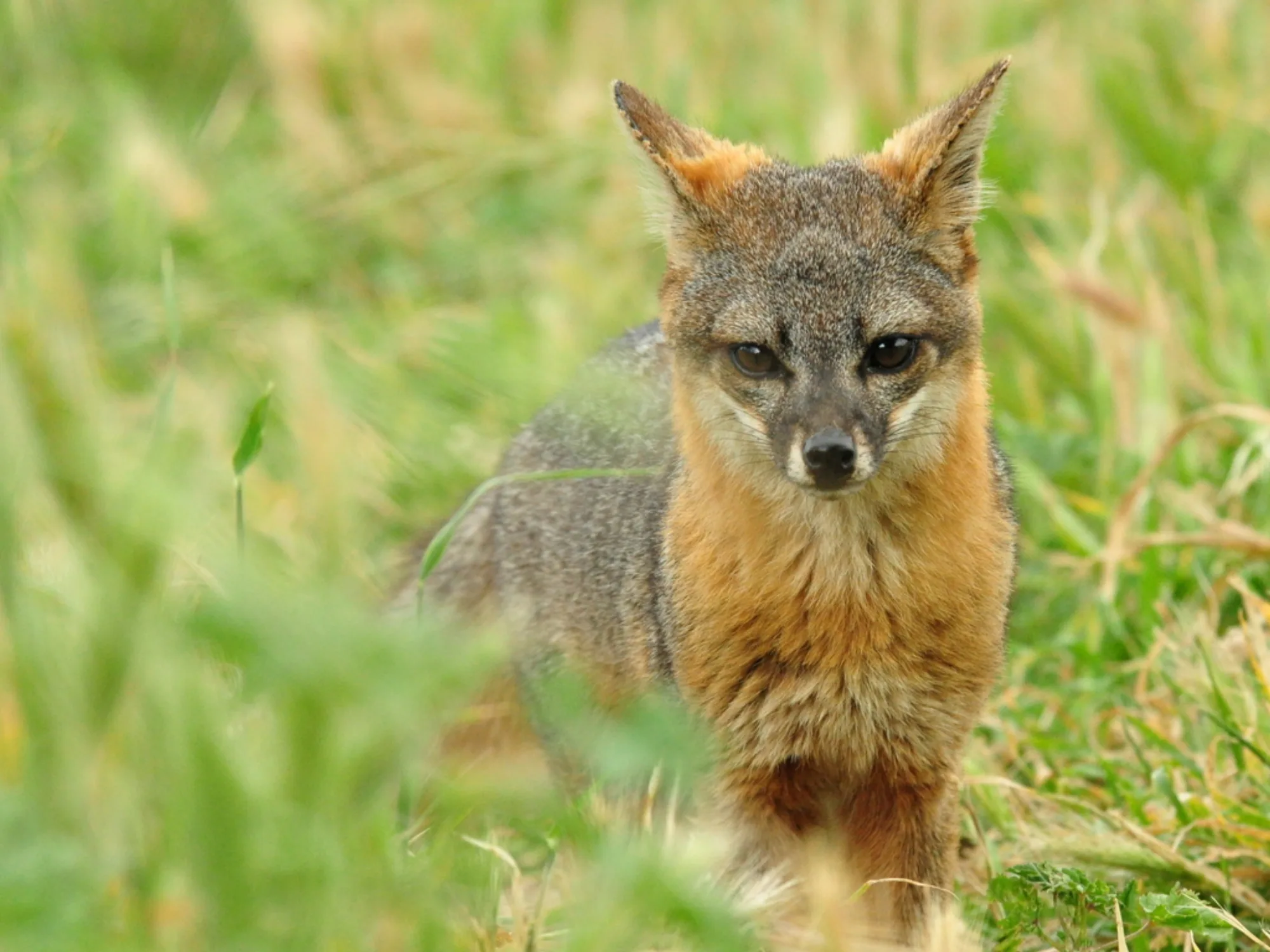
Island Gray Fox
Urocyon littoralis
Small enough to weigh just 1 to 2.8 kg, the Island Gray Fox has a grey head, reddish sides and white fur across its belly, throat and lower face. A black stripe runs along the top of its tail, and its head and body measure 48 to 50 cm. It lives only on six of California's Channel Islands, with a distinct subspecies on each island. The fox uses habitats ranging from temperate forest and grassland to chaparral, favouring layered vegetation rich in woody shrubs that bear fruit year-round.
Usually travelling alone, the fox is generally active at night, with peaks around dawn and dusk. Summer brings more daytime activity than winter, and on Santa Catalina Island foxes have adapted to heavy tourism and can often be seen searching campsites for food. Their varied diet includes fruit, insects, birds, eggs, crabs, lizards and small mammals; they also scavenge along beaches and eat human refuse. Foxes are generally docile and show little fear of people, although they may be aggressive at first. Breeding pairs are typically monogamous and are often seen together from January through the breeding season. In spring, females give birth in dens to litters typically containing one to five pups, which emerge in early summer.
Golden eagle predation and human activity devastated numbers on several islands in the 1990s. Isolation leaves the fox susceptible to introduced diseases and parasites, including those carried by domestic dogs. Drought and rising temperatures have reduced vegetation and food sources, while wildfires destroy shrubs and habitat needed by the fox's prey. Introduced mammals have also degraded habitat and reduced the food available to foxes.
Written from the English Wikipedia article Island fox (CC BY-SA 4.0).
- Records
- 27
- Countries
- 1
- Atlas places
- 1
These are open occurrence records, so they show where people looked for and recorded the Island Gray Fox as much as where it lives. Cells are up to 25 km across, and every location is generalised to its cell.
Generalised encounter areas, not exact locations. Each shape is a grid cell coloured by how likely the species is there.
- Very likelyUnited States25 km zone · medium confidence · 27 records · updated 80 days ago
Conservation status not assessed here yet, so every location is generalised to its grid cell.