Richardson's Ground Squirrel
Urocitellus richardsonii
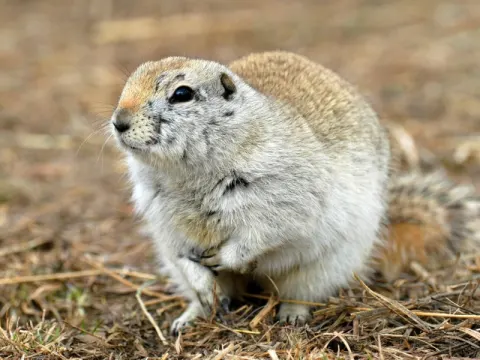
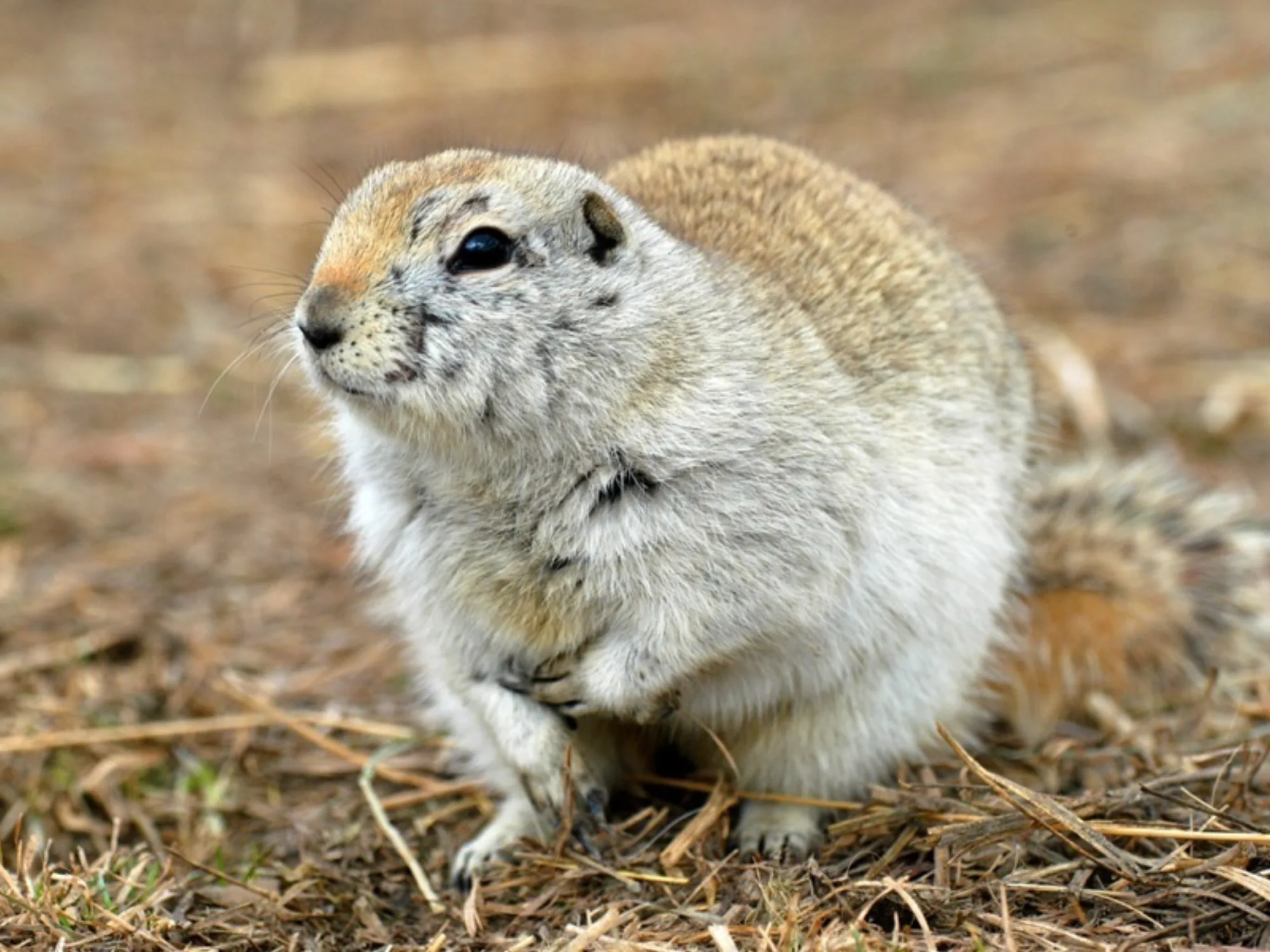
A trembling tail gives the Richardson's Ground Squirrel one of its other names, the flickertail. Adults are about 30 centimetres long, with dark brown upperparts and a tan underside. Their tails are shorter and less bushy than those of other ground squirrels, while their ears are so short they look like holes.
Native to short grass prairies, these squirrels live mainly in the northern United States and western Canada. Their range includes North Dakota and Montana, as well as parts of Alberta, Saskatchewan and Manitoba. They also adapt to suburban surroundings, where they may dig tunnels beneath sidewalks and patios. Burrows lie close together in colonies, and the squirrels sound alarms when possible predators approach. A whistle warns of predators on the ground, while a chirp signals aerial hunters such as hawks. Females tolerate close female relatives, but defend territories around their nest sites. They eat seeds, nuts, grains, grasses and insects, and carry seeds in their cheek pouches to store underground. Adults may begin hibernating as early as July, while young in their first year stay active until September.
Females have one litter a year, with an average of six young born in April or May. The young stay in the burrow until they are about 30 days old, emerging from late May to mid-June. Their predators range from coyotes and American badgers to owls, hawks, weasels and snakes. People also kill them because they eat crops or dig burrows, using methods including trapping, shooting and poisoning. The squirrels have also become popular in the exotic pet trade.
Written from the English Wikipedia article Richardson's ground squirrel (CC BY-SA 4.0).
- Records
- 930
- Countries
- 2
- Atlas places
- 2
These are open occurrence records, so they show where people looked for and recorded the Richardson's Ground Squirrel as much as where it lives. Cells are up to 25 km across, and every location is generalised to its cell.
Generalised encounter areas, not exact locations. Each shape is a grid cell coloured by how likely the species is there.
- Very likelyCanada25 km zone · medium confidence · 838 records · updated 80 days ago
- Very likelyUnited States25 km zone · medium confidence · 92 records · updated 80 days ago
Conservation status not assessed here yet, so every location is generalised to its grid cell.