Eastern Barn Owl
Tyto javanica
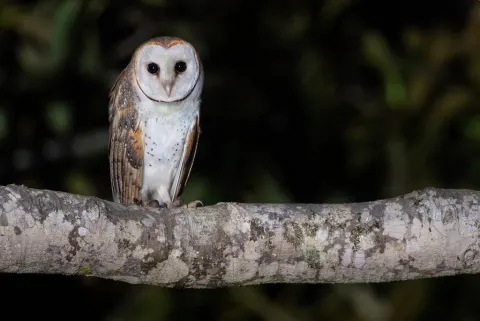
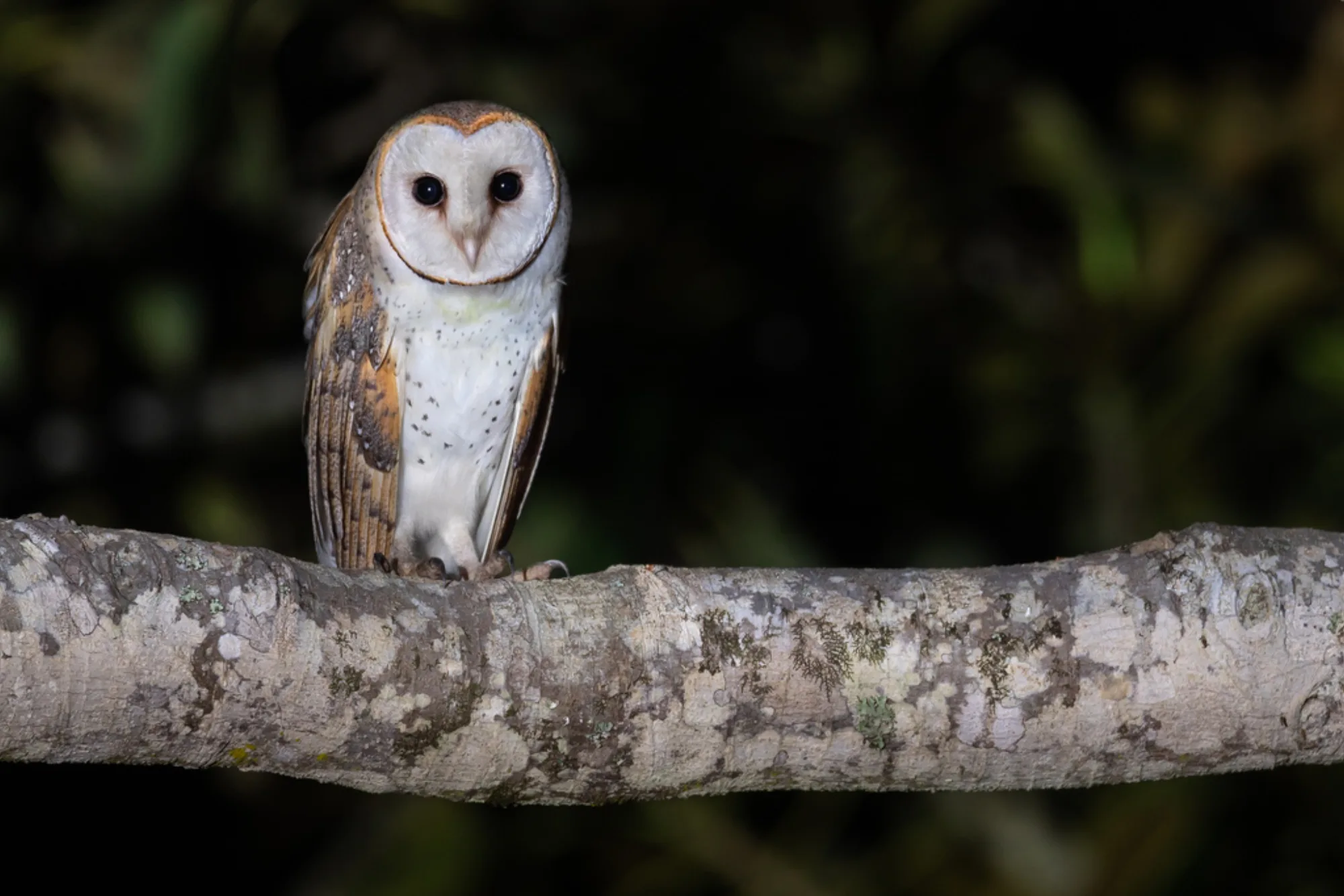
Silent, wavering flight over open ground can signal an Eastern Barn Owl on the hunt. This medium-sized owl has long, broad wings and flies slowly, quartering the ground or hovering over places where prey may be hidden. Its range extends from the Indian subcontinent through Southeast Asia to Australia and numerous Pacific islands; it is also native to New Zealand. Look for it in open farmland or grassland broken up by woodland, often along wood edges or rough strips beside pasture. It usually lives below 2,000 metres, though it can occur as high as 3,000 metres in the tropics.
Mostly active at night, the owl often starts moving shortly before dusk and may be seen by day when changing roosts. On some Pacific islands it also hunts in daylight. Acute hearing helps it find prey on the ground, even in complete darkness. Small mammals make up nearly all its food, although it also takes birds, bats, lizards, amphibians, insects and spiders. Pairs generally stay together for life, and nesting can take place at different times of year depending on the location. Eggs are laid in a tree hollow, an old building or a cliff fissure; the female incubates while the male supplies her and the young chicks with food.
Starvation is likely to be a major cause of death in temperate areas, especially for young birds during autumn and winter. Road collisions and pesticides also kill barn owls, while a shortage of suitable nest sites can limit their numbers. In Malaysia, forest clearing for oil palm plantations reduced the number of tree cavities available for breeding.
Written from the English Wikipedia article Eastern barn owl (CC BY-SA 4.0).
- Records
- 27,411
- Countries
- 14
- Atlas places
- 10
- Blue Mountains National Park· Australia
- Kakadu National Park· Australia
- Annapurna Conservation Area· Nepal
- Daintree National Park· Australia
- Grampians (Gariwerd) National Park· Australia
- Lamington National Park· Australia
- Langtang National Park· Nepal
- Ranthambore National Park· India
- Sundarbans National Park· India
- Yala National Park· Sri Lanka
These are open occurrence records, so they show where people looked for and recorded the Eastern Barn Owl as much as where it lives. Cells are up to 25 km across, and every location is generalised to its cell.
Generalised encounter areas, not exact locations. Each shape is a grid cell coloured by how likely the species is there.
- Very likelyIndia25 km zone · medium confidence · 12963 records · updated 80 days ago
- Very likelyAustralia25 km zone · medium confidence · 11055 records · updated 80 days ago
- Very likelyNepal25 km zone · medium confidence · 906 records · updated 80 days ago
- Very likelyCambodia25 km zone · high confidence · 852 records · updated 80 days ago
- Very likelyBangladesh25 km zone · medium confidence · 414 records · updated 80 days ago
- Very likelyVanuatu25 km zone · high confidence · 284 records · updated 80 days ago
- Very likelySri Lanka25 km zone · high confidence · 210 records · updated 80 days ago
- Very likelyThailand25 km zone · medium confidence · 190 records · updated 80 days ago
- Very likelySingapore25 km zone · high confidence · 176 records · updated 80 days ago
- Very likelyMalaysia25 km zone · medium confidence · 145 records · updated 80 days ago
Conservation status not assessed here yet, so every location is generalised to its grid cell.