American Barn Owl
Tyto furcata
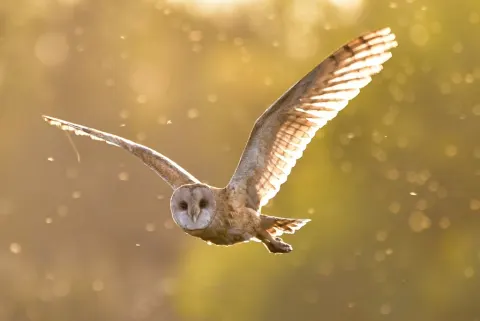
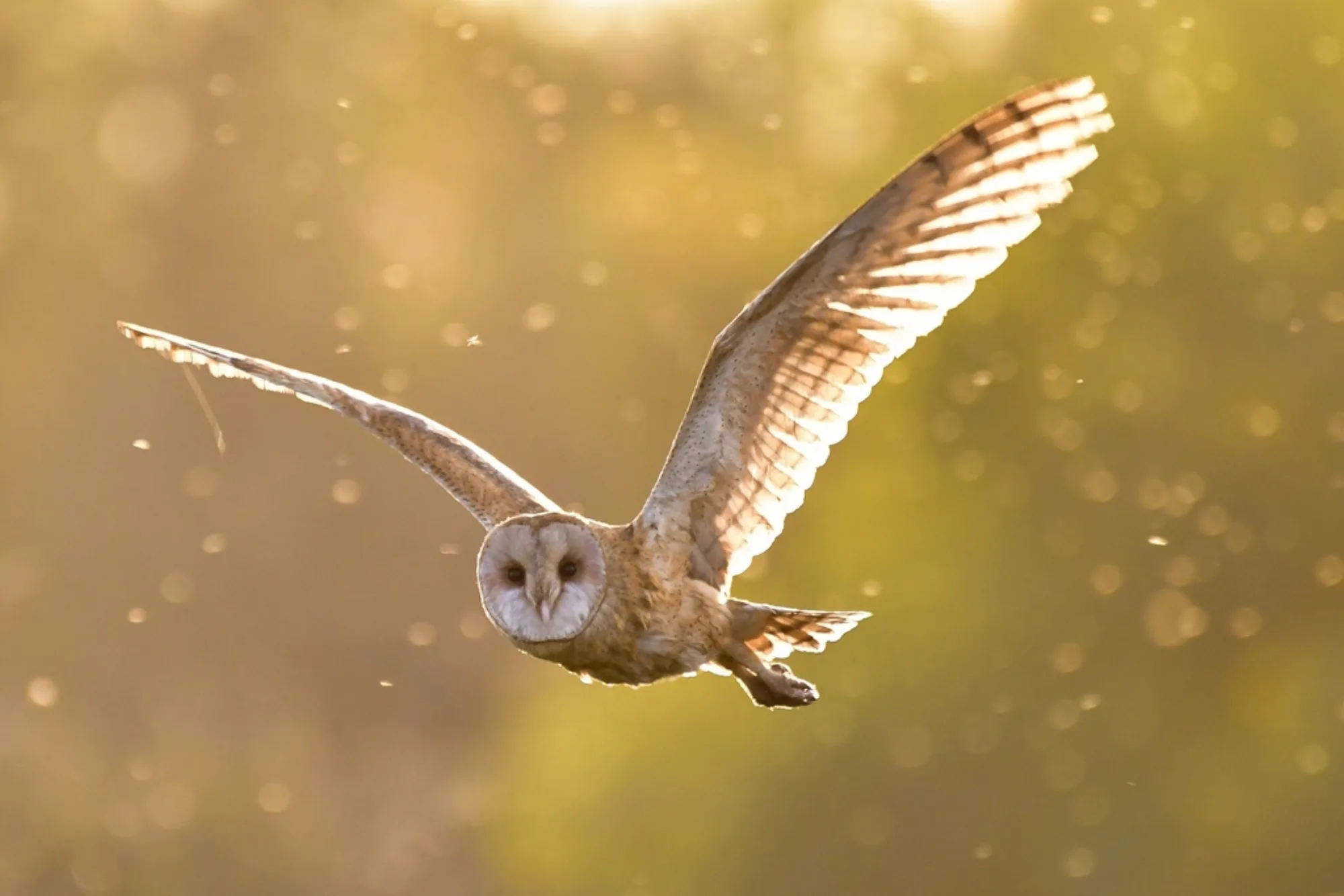
With its pale, heart-shaped face and dark eyes, the American Barn Owl (Tyto furcata) can look like a masked figure in flight. This medium-sized owl has long wings, a short, squarish tail and feathered legs that dangle as it flies. Its head and back are typically pale brown to grey, while its underparts range from white to reddish buff, sometimes with small dark speckles. Native to North and South America, it has also been introduced to Hawaii. Look for it in open farmland or grassland interspersed with woodland, usually below 2,000 metres, although it occurs higher in the tropics.
Mostly nocturnal, the owl often becomes active shortly before dusk, but may be seen by day moving between roosts. It shelters in places such as tree holes, cliff fissures, disused buildings and haysheds. Hunting silently, it flies slowly over the ground or watches from a branch or fence post, using its acute hearing to locate prey. Small mammals dominate its diet in many places, with voles and shrews particularly common in North America. It also takes birds, bats, reptiles, amphibians and insects, depending on what is locally available. Most North American nesting occurs from March to June. Pairs usually stay together for life and nest in cavities, including tree holes and cliff fissures. The female lays an average of five eggs, and the young remain dependent on their parents until about 13 weeks old.
Loss of rough grassland to agricultural development reduces hunting habitat, while a shortage of suitable nest sites can also limit numbers. Other threats include rodenticides, collisions with vehicles and power lines, starvation and predators such as the great horned owl.
Written from the English Wikipedia article American barn owl (CC BY-SA 4.0).
- Records
- 128,941
- Countries
- 12
- Atlas places
- 5
These are open occurrence records, so they show where people looked for and recorded the American Barn Owl as much as where it lives. Cells are up to 25 km across, and every location is generalised to its cell.
Generalised encounter areas, not exact locations. Each shape is a grid cell coloured by how likely the species is there.
- Very likelyUnited States25 km zone · high confidence · 119577 records · updated 81 days ago
- Very likelyBelize25 km zone · high confidence · 2302 records · updated 81 days ago
- Very likelyMexico25 km zone · high confidence · 2078 records · updated 81 days ago
- Very likelyCosta Rica25 km zone · high confidence · 1133 records · updated 81 days ago
- Very likelyEcuador25 km zone · high confidence · 844 records · updated 81 days ago
- Very likelyGuatemala25 km zone · high confidence · 727 records · updated 81 days ago
- Very likelyNicaragua25 km zone · high confidence · 634 records · updated 81 days ago
- Very likelyChile25 km zone · high confidence · 530 records · updated 81 days ago
- Very likelyArgentina25 km zone · high confidence · 334 records · updated 81 days ago
- Very likelyBrazil25 km zone · high confidence · 263 records · updated 81 days ago
Conservation status not assessed here yet, so every location is generalised to its grid cell.