Barn Owl
Tyto alba
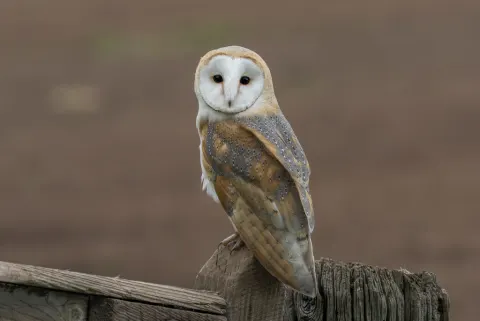
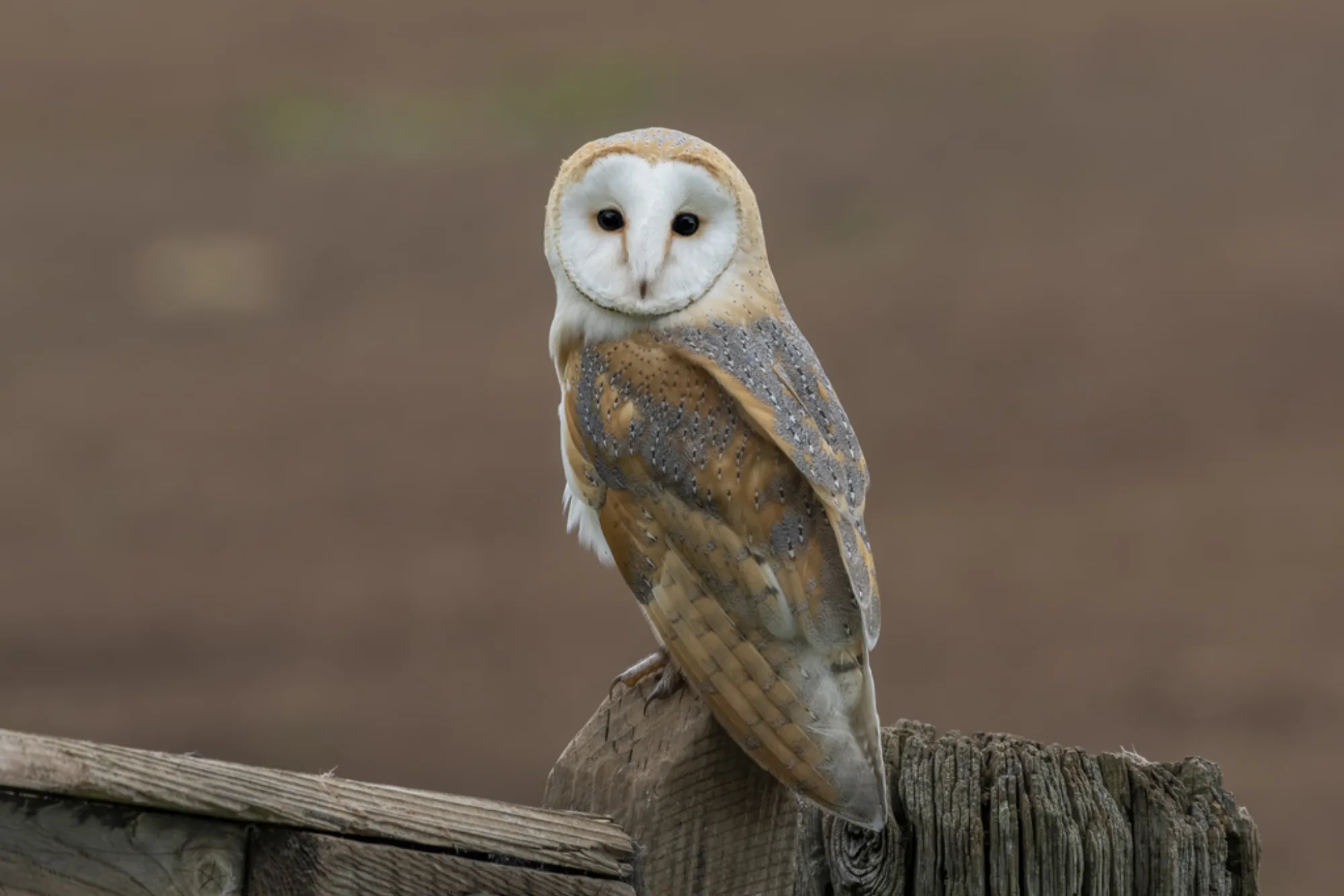
With its pale, heart-shaped face and silent flight, the Barn Owl (Tyto alba) is a distinctive sight over open ground. Its head and back are mottled grey or brown, while its underparts range from white to brown and may carry dark speckles. Long wings, a short, squarish tail and dangling feathered legs help distinguish it in flight. It does not hoot: its call is a piercing, drawn-out screech.
Its range extends across Africa, Europe and southwestern Asia, with the densest clusters in Western and Central Europe and around the Mediterranean. It lives in open wetlands, grasslands, savannas, heathlands and shrublands, as well as farmland and areas on the edges of towns. Across most of its range it is nocturnal, though in Britain it sometimes hunts during the day. It often becomes active shortly before dusk, flying slowly over the ground and hovering above places where prey may be hiding. It also scans from branches or fence posts, and favours woodland edges and rough grass beside pasture. Acute hearing helps it find prey, most of which consists of small mammals. Pairs usually stay together for life, nesting in hollow trees, old buildings or cliff fissures. Breeding times vary with location, and good years for rodents can bring two broods.
Hunger is a major cause of death in temperate areas, especially for young birds learning to hunt through autumn and winter. Cars also kill barn owls, with fledglings at greater risk than adults, while agricultural changes can reduce the small prey available to them. Other threats include exposure to rodenticides and the demolition of buildings used by the owls.
Written from the English Wikipedia article Western barn owl (CC BY-SA 4.0).
- Records
- 84,168
- Countries
- 18
- Atlas places
- 3
These are open occurrence records, so they show where people looked for and recorded the Barn Owl as much as where it lives. Cells are up to 25 km across, and every location is generalised to its cell.
Generalised encounter areas, not exact locations. Each shape is a grid cell coloured by how likely the species is there.
- Very likelyUnited Kingdom25 km zone · high confidence · 31236 records · updated 80 days ago
- Very likelyFrance25 km zone · high confidence · 21122 records · updated 80 days ago
- Very likelyBelgium25 km zone · high confidence · 9857 records · updated 80 days ago
- Very likelySouth Africa25 km zone · high confidence · 7955 records · updated 80 days ago
- Very likelySpain25 km zone · high confidence · 3646 records · updated 80 days ago
- Very likelyIsrael25 km zone · high confidence · 2946 records · updated 80 days ago
- Very likelyLuxembourg25 km zone · high confidence · 2297 records · updated 80 days ago
- Very likelyPortugal25 km zone · high confidence · 1940 records · updated 80 days ago
- Very likelyZimbabwe25 km zone · high confidence · 792 records · updated 80 days ago
- Very likelyNamibia25 km zone · high confidence · 715 records · updated 80 days ago
Conservation status not assessed here yet, so every location is generalised to its grid cell.