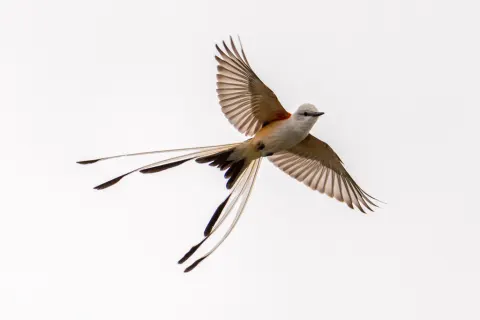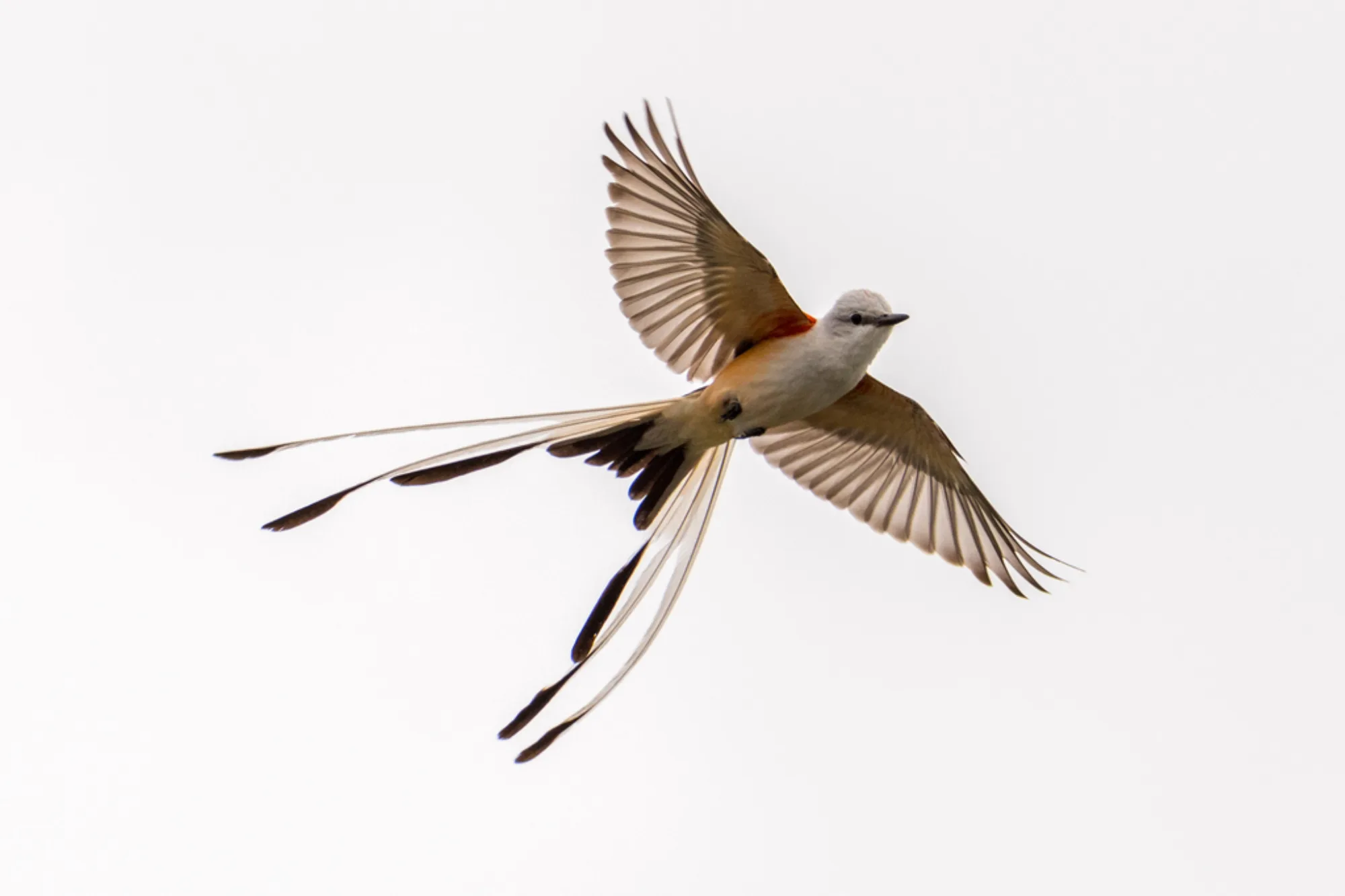
Scissor-tailed Flycatcher
Tyrannus forficatus
Arenal and Monteverde are the two atlas places where the Scissor-tailed Flycatcher is recorded, with records concentrating most heavily in the United States, Mexico, Costa Rica, Belize, and Nicaragua. The atlas holds about 422,000 open records of this bird from six countries. Because its map tracks where records concentrate, it represents a partial view of its distribution.
Records are available for most of the year, though they are at their fewest during January, February, and December.
- Records
- 421,821
- Countries
- 6
- Atlas places
- 2
Each bar is the share of its 200 month-dated grid cells with records in that month.
These are open occurrence records, so they show where people looked for and recorded the Scissor-tailed Flycatcher as much as where it lives. The atlas keeps a species' 200 best-recorded grid cells, so the map shows where records concentrate rather than its whole range. Cells are up to 25 km across, and every location is generalised to its cell.
Generalised encounter areas, not exact locations. Each shape is a grid cell coloured by how likely the species is there.
- Very likelyUnited States25 km zone · high confidence · 384223 records · updated 40 days ago
- Very likelyMexico25 km zone · high confidence · 25599 records · updated 40 days ago
- Very likelyCosta Rica25 km zone · high confidence · 6767 records · updated 40 days ago
- Very likelyBelize25 km zone · high confidence · 2125 records · updated 40 days ago
- Very likelyNicaragua25 km zone · high confidence · 1885 records · updated 40 days ago
- Very likelyHonduras25 km zone · high confidence · 1222 records · updated 40 days ago
Conservation status not assessed here yet, so every location is generalised to its grid cell.