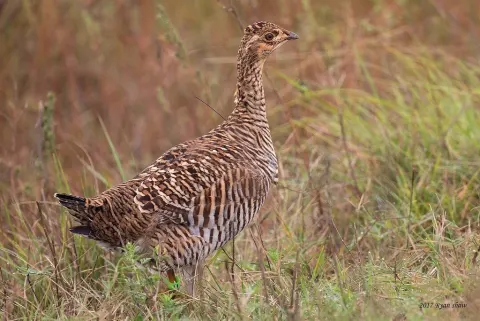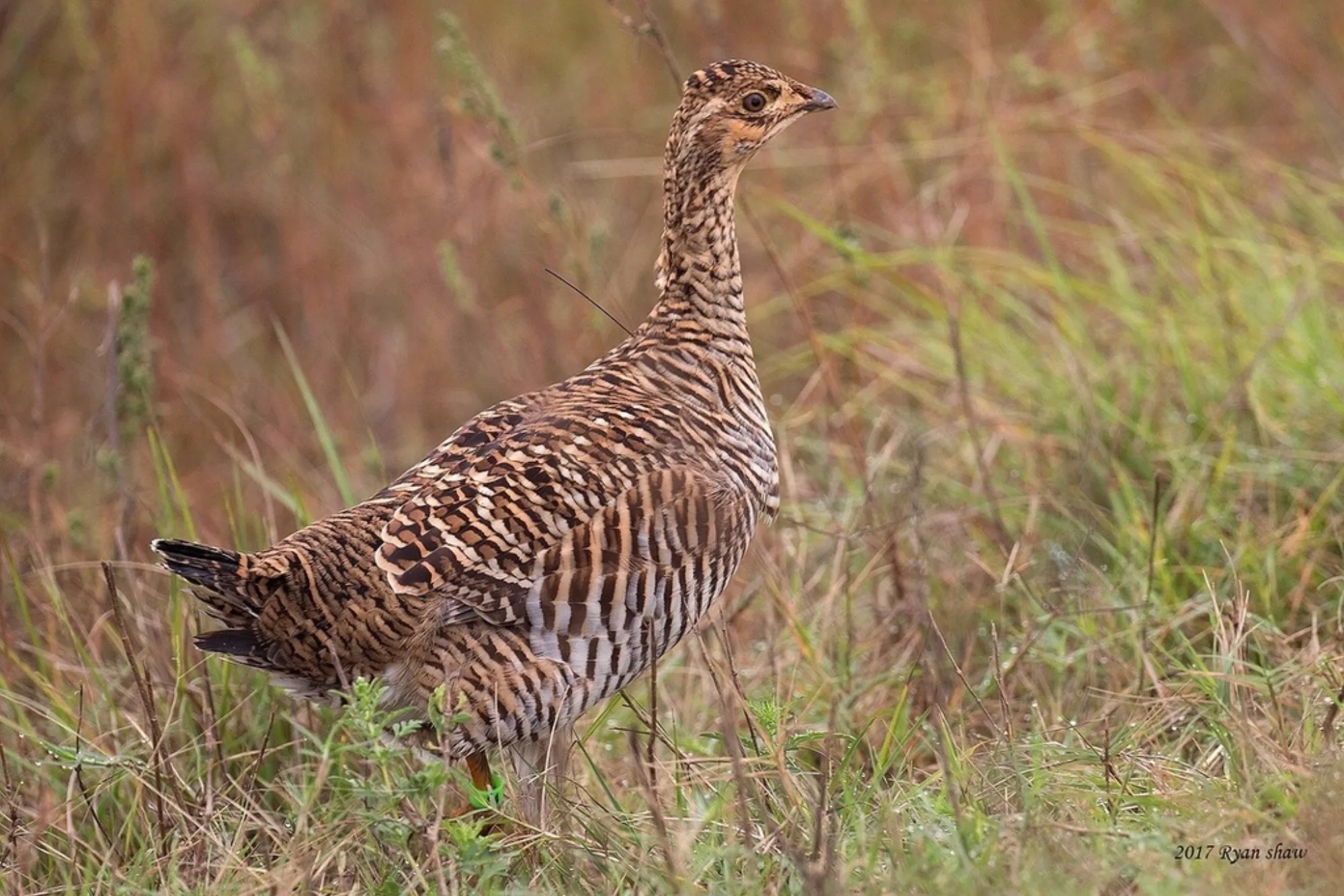
Greater Prairie Chicken
Tympanuchus cupido
Stocky and chicken-like, the Greater Prairie Chicken is a North American grouse with rounded wings and a short, usually rounded tail. Adults are about 43 cm long and weigh 700 to 1,200 g. Males have orange feathers above the eyes and long, dark head feathers that they can raise or lay along the neck. Females have shorter head feathers and lack the male's orange neck patch.
Originally a bird of tallgrass prairie, it favours areas left undisturbed but can also live in a mix of prairie and farmland. It does not migrate, and its numbers tend to be thinner in more heavily farmed areas. In central Wisconsin, visitors can look for birds on managed prairie, where surveys found 38 booming grounds in 2025. Each April, the Central Wisconsin Prairie Chicken Festival draws birdwatchers from around the world. Seeds and fruit make up most of the diet, supplemented in summer by green plants and insects, including grasshoppers, crickets and beetles.
During the breeding season, usually beginning in late March and continuing through April in the United States, males gather at sparsely vegetated booming grounds to display. They defend these sites and may display for almost two months. Females build nests away from the booming grounds, lay 5 to 17 eggs and raise the young, which fledge in one to four weeks. Habitat loss has been the greatest historical threat, with much tallgrass prairie converted to cropland. Hunting and natural disasters have also contributed to the bird's disappearance or rarity across much of its range. Predators can take eggs, while pheasants lay their own eggs in prairie-chicken nests, reducing breeding success.
Written from the English Wikipedia article Greater prairie-chicken (CC BY-SA 4.0).
- Records
- 19,768
- Countries
- 1
- Atlas places
- 1
These are open occurrence records, so they show where people looked for and recorded the Greater Prairie Chicken as much as where it lives. Cells are up to 25 km across, and every location is generalised to its cell.
Generalised encounter areas, not exact locations. Each shape is a grid cell coloured by how likely the species is there.
- Very likelyUnited States25 km zone · high confidence · 19768 records · updated 80 days ago
Conservation status not assessed here yet, so every location is generalised to its grid cell.