Mistle Thrush
Turdus viscivorus
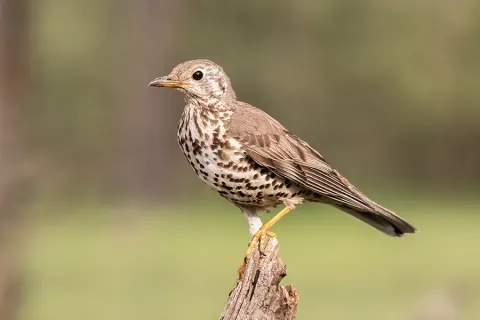
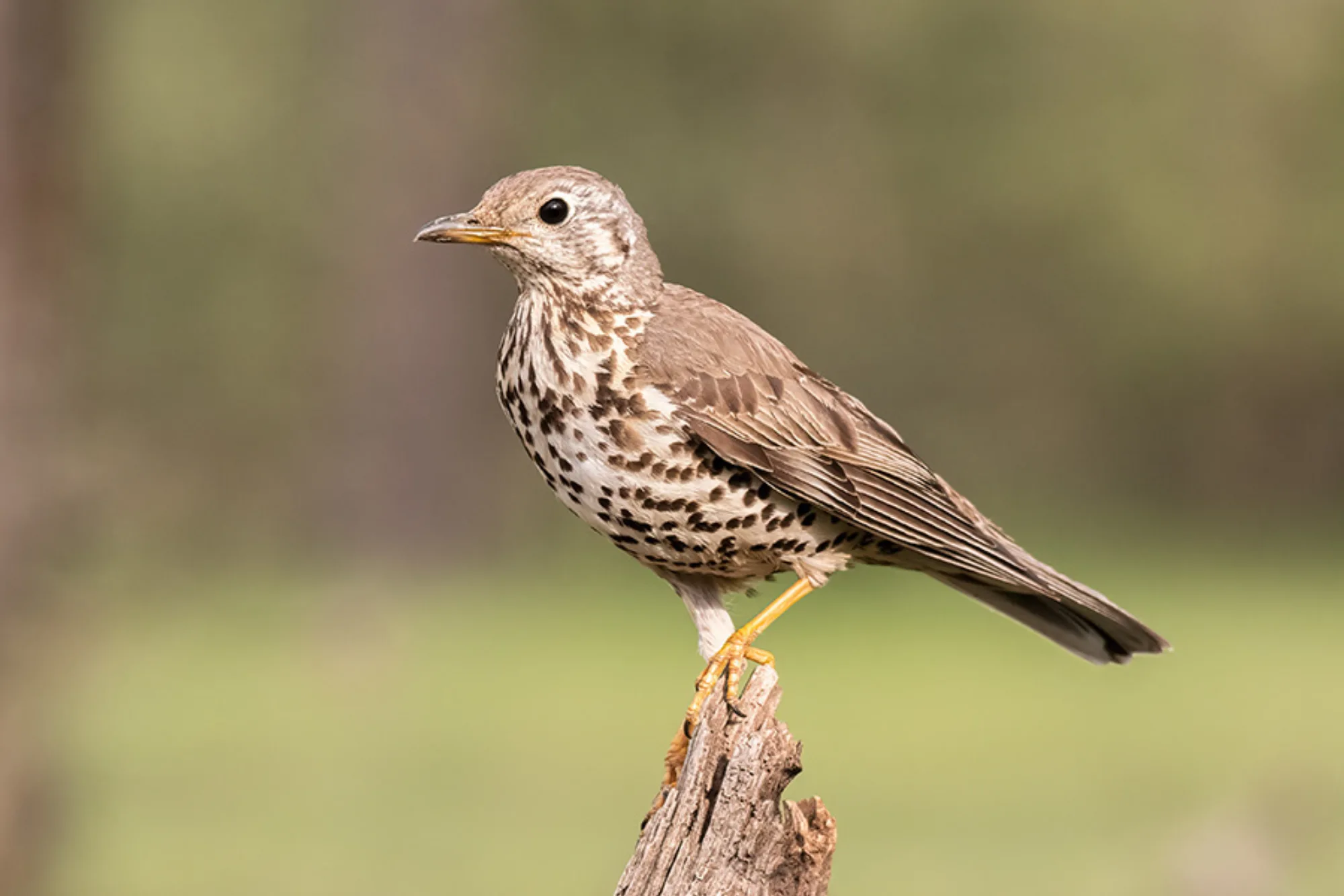
A large, upright thrush with a spotted breast, the Mistle Thrush has pale grey-brown upperparts, a greyish-white throat and round black spots across its yellowish-buff breast and off-white belly. On the ground it hops with its head raised, while in flight it alternates bounding movements with glides. Listen for the male's loud, fluted song from a treetop or another high perch, especially in the early morning. He may sing in wet and windy weather, a habit behind the old name stormcock.
The species ranges through North Africa and temperate parts of Asia, as well as much of Europe, occupying open woods, plantations, hedges and town parks. Farmland, moors and grassy hills are used extensively in winter or during migration. Many birds remain in their range year-round, while northern and eastern populations move south for winter, often travelling alone or in small groups. Mistle thrushes usually spend much of the year alone or in pairs, though families forage together in late summer and may join larger flocks where food is plentiful.
Their varied diet includes earthworms, insects, slugs, snails, fruit and berries. In winter, an individual or pair may guard fruit-bearing trees, favouring those with mistletoe and chasing away other birds. The female builds a large cup nest, usually against a tree trunk or in a fork, and both parents feed the chicks. The birds defend their nest boldly, sometimes even attacking humans. Recent declines may be linked to the loss of pastures rich in invertebrates and mixed farms, while disappearing ancient forests may have contributed to a local decline in Finland.
Written from the English Wikipedia article Mistle thrush (CC BY-SA 4.0).
- Records
- 281,056
- Countries
- 16
No atlas park has a record of the Mistle Thrush in or around it yet.
These are open occurrence records, so they show where people looked for and recorded the Mistle Thrush as much as where it lives. Cells are up to 25 km across, and every location is generalised to its cell.
Generalised encounter areas, not exact locations. Each shape is a grid cell coloured by how likely the species is there.
- Very likelyUnited Kingdom25 km zone · high confidence · 112670 records · updated 80 days ago
- Very likelyFrance25 km zone · high confidence · 68843 records · updated 80 days ago
- Very likelySpain25 km zone · high confidence · 29170 records · updated 80 days ago
- Very likelyBelgium25 km zone · high confidence · 24542 records · updated 80 days ago
- Very likelyNorway25 km zone · high confidence · 19171 records · updated 80 days ago
- Very likelyIreland25 km zone · high confidence · 5546 records · updated 80 days ago
- Very likelySwitzerland25 km zone · high confidence · 4688 records · updated 80 days ago
- Very likelyFinland25 km zone · high confidence · 3827 records · updated 80 days ago
- Very likelyPortugal25 km zone · high confidence · 2781 records · updated 80 days ago
- Very likelyCzechia25 km zone · high confidence · 2584 records · updated 80 days ago
Conservation status not assessed here yet, so every location is generalised to its grid cell.