Fieldfare
Turdus pilaris
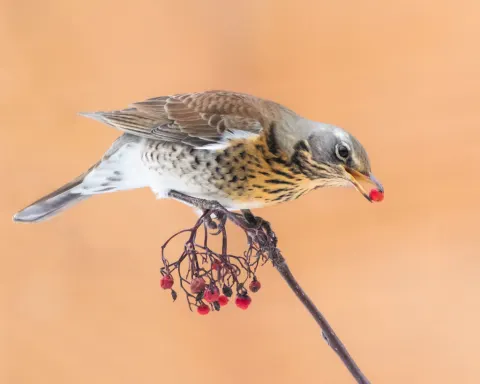
A grey head and rump, brown back and boldly spotted breast make the Fieldfare a distinctive thrush. It measures 25 cm long, with dark wings and tail, a reddish wash across the breast and white underparts. Look for the white underwings in flight and listen for its harsh, chattering call. Males and females look much alike, though females are somewhat browner.
Fieldfares breed in woodland and scrub across northern Europe and the Palearctic, with a range extending east to Siberia and North West China. In summer they frequent mixed woodland, often close to marshes or open ground, and also visit orchards, parks and gardens. Many northern birds migrate south for winter, with large numbers spending the season in the UK, parts of southern Europe, North Africa or the Middle East. Winter flocks favour open country, farmland and orchards, wandering in search of plentiful food.
These sociable birds often feed on the ground with redwings, pausing upright to look around before moving on. Their summer diet includes earthworms, insects and molluscs, while berries, grain and seeds become important in winter. Fieldfares often nest close together, which may help protect them from predators, and adults defend their nests by dropping faeces on intruders. A female builds the nest, usually laying five or six eggs, and both parents feed the chicks. The young leave the nest after about a fortnight, and pairs in southern parts of the range may raise two broods. When food runs out or winter weather is particularly harsh, the birds may move to marshes or the shore to find molluscs.
Written from the English Wikipedia article Fieldfare (CC BY-SA 4.0).
- Records
- 628,759
- Countries
- 67
No atlas park has a record of the Fieldfare in or around it yet.
These are open occurrence records, so they show where people looked for and recorded the Fieldfare as much as where it lives. Cells are up to 25 km across, and every location is generalised to its cell.
Generalised encounter areas, not exact locations. Each shape is a grid cell coloured by how likely the species is there.
- Very likelyNorway25 km zone · high confidence · 306634 records · updated 86 days ago
- Very likelyFinland25 km zone · high confidence · 126481 records · updated 86 days ago
- Very likelyBelgium25 km zone · high confidence · 43510 records · updated 86 days ago
- Very likelyUnited Kingdom25 km zone · high confidence · 38504 records · updated 86 days ago
- Very likelySweden25 km zone · high confidence · 16177 records · updated 86 days ago
- Very likelyFrance25 km zone · high confidence · 13339 records · updated 86 days ago
- Very likelyRussia25 km zone · high confidence · 12933 records · updated 86 days ago
- Very likelyCzechia25 km zone · high confidence · 10958 records · updated 86 days ago
- Very likelyPoland25 km zone · high confidence · 7864 records · updated 86 days ago
- Very likelyGermany25 km zone · high confidence · 6068 records · updated 86 days ago
Conservation status not assessed here yet, so every location is generalised to its grid cell.