Common Blackbird
Turdus merula
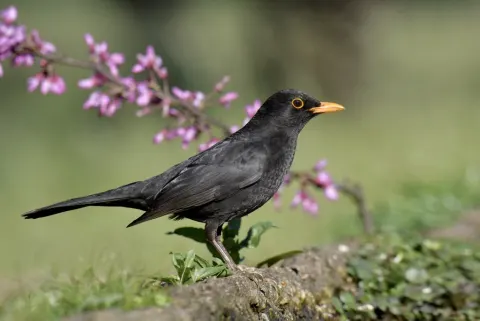
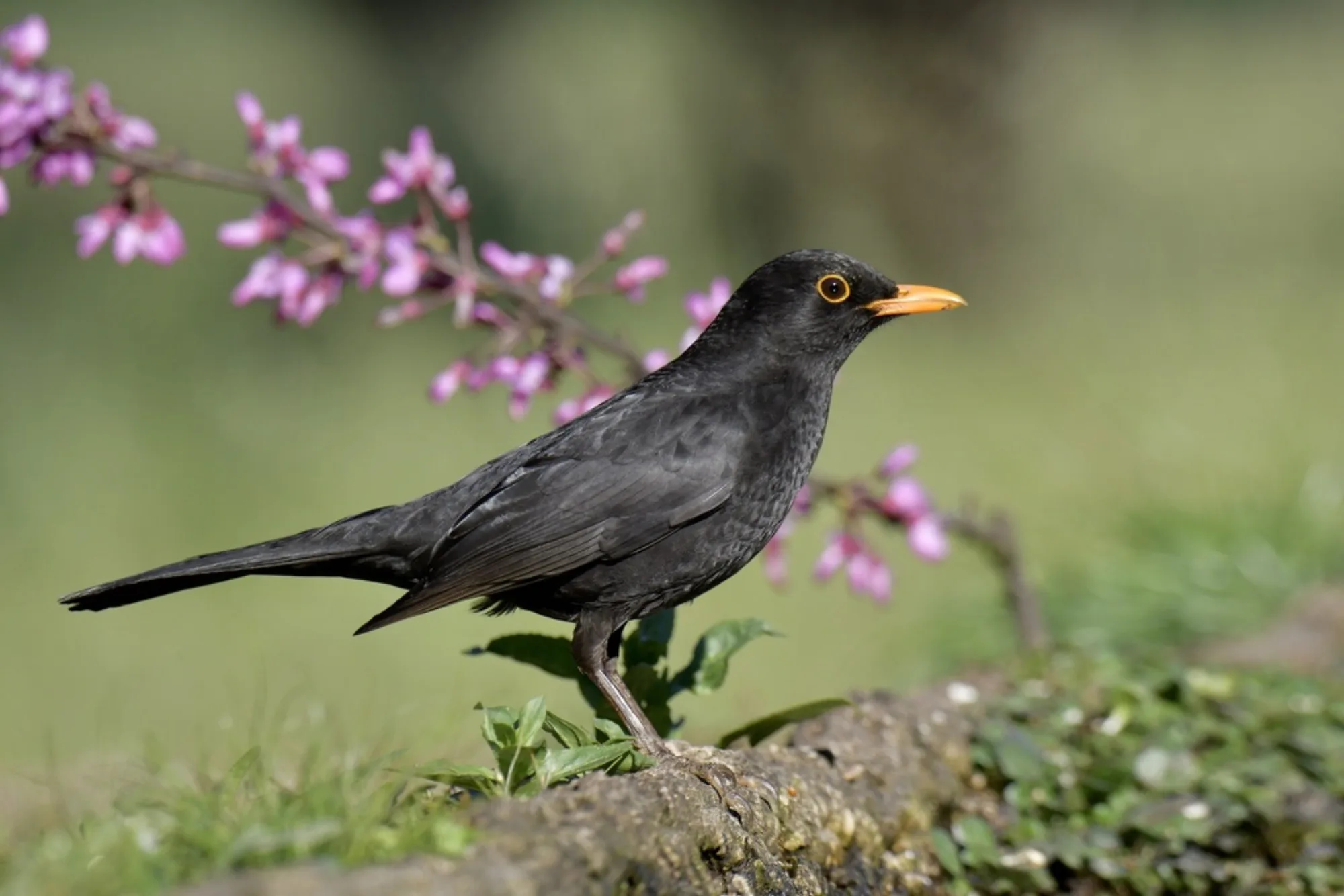
A familiar sight in woods and gardens, the Common Blackbird is a thrush with a rich, melodious song. In the subspecies found across most of Europe, the adult male is black with a yellow eye-ring and bill, while females and juveniles are mainly dark brown. The male sings a varied, fluting song from trees, rooftops and other high perches, chiefly from March to June.
Blackbirds breed across Europe, western Asia and North Africa, and have been introduced to Australia and New Zealand. They favour woodland with deciduous trees and dense undergrowth, but also live in parks, gardens and hedgerows. Some stay in their territories throughout the year where conditions are mild and food is available; northern birds may migrate south for winter. Migrants travel in small flocks and feed in loose groups on their wintering grounds. On the ground, a blackbird runs and hops in short bursts, looking for earthworms and searching leaf litter for other invertebrates. It also eats insects, seeds, berries and fruit, and may take berries from bushes.
Both sexes defend breeding territories, and males may chase rivals away. The female builds a cup-shaped nest of vegetation held together with mud, often in a creeper or bush, and lays three to five eggs. Both parents feed the chicks, and second broods are common. Many nesting attempts fail because predators find the nests; near settlements, domestic cats are a particular danger, especially to newly fledged young. Local declines, especially on farmland, may be linked to the removal of nesting hedgerows and changes that reduce invertebrate food. In Europe, the mosquito-borne Usutu virus has also significantly reduced blackbird numbers.
Written from the English Wikipedia article Common blackbird (CC BY-SA 4.0).
- Records
- 2,686,573
- Countries
- 82
- Atlas places
- 1
These are open occurrence records, so they show where people looked for and recorded the Common Blackbird as much as where it lives. Cells are up to 25 km across, and every location is generalised to its cell.
Generalised encounter areas, not exact locations. Each shape is a grid cell coloured by how likely the species is there.
- Very likelyUnited Kingdom25 km zone · high confidence · 615213 records · updated 86 days ago
- Very likelyNorway25 km zone · high confidence · 314094 records · updated 86 days ago
- Very likelyBelgium25 km zone · high confidence · 286534 records · updated 86 days ago
- Very likelyFrance25 km zone · high confidence · 271914 records · updated 86 days ago
- Very likelySpain25 km zone · high confidence · 207038 records · updated 86 days ago
- Very likelyAustralia25 km zone · high confidence · 176278 records · updated 86 days ago
- Very likelyPortugal25 km zone · high confidence · 155334 records · updated 86 days ago
- Very likelyNew Zealand25 km zone · high confidence · 97114 records · updated 86 days ago
- Very likelyFinland25 km zone · high confidence · 72188 records · updated 86 days ago
- Very likelyIsrael25 km zone · high confidence · 44379 records · updated 86 days ago
Conservation status not assessed here yet, so every location is generalised to its grid cell.