Redwing
Turdus iliacus
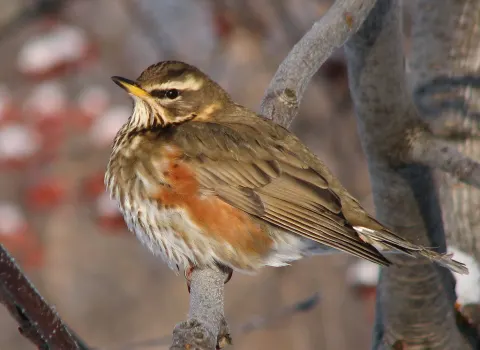
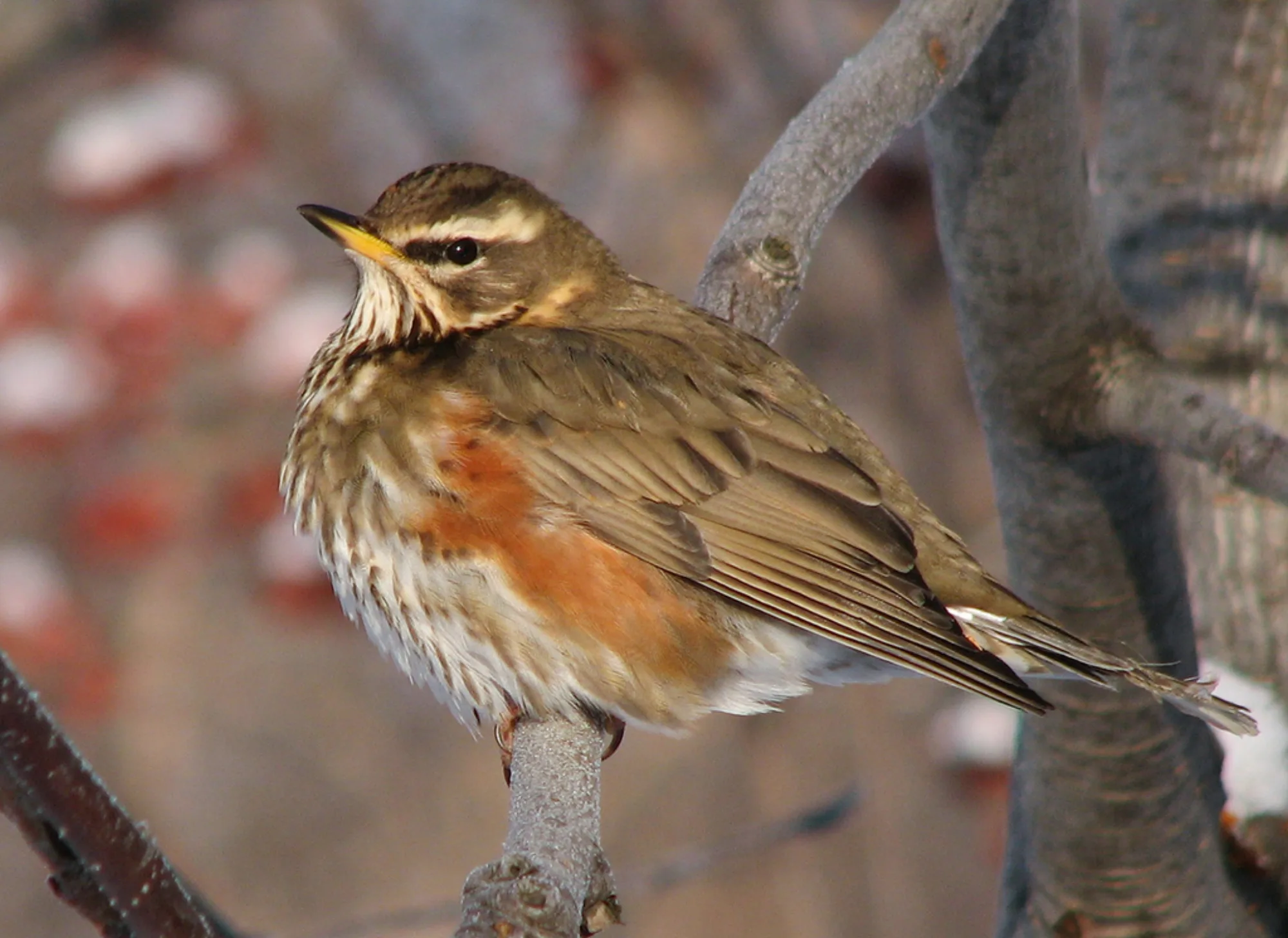
A creamy white stripe above the eye and flashes of red on the flanks and underwing make the Redwing distinctive. This thrush is slightly smaller than a song thrush, with a plain brown back and dark brown spots across its white underparts. Males give a varied, short song, and their flight call is a whistle. Songs vary between regions, while birds within a local population tend to share similar patterns.
Redwings breed across northern Europe and the Palearctic, from Iceland and northernmost Scotland east through Scandinavia and much of Russia. Their breeding habitats include conifer and birch forests and tundra. Migrating birds spend the winter across much of Europe, in north-west Africa and in south-west Asia, although some in the west of the breeding range stay resident. Migration takes place between autumn and early winter, often at night, when a long-carrying contact call may reveal passing birds. On migration and in winter, Redwings often gather in loose flocks and feed with fieldfares, common blackbirds and starlings. They eat insects and earthworms throughout the year, adding berries in autumn and winter, especially rowan and hawthorn.
A nest may be tucked into a shrub or placed on the ground, and holds four to six eggs. These hatch after 12 to 13 days, and the chicks fledge 12 to 15 days later. The young rely on their parents for a further 14 days. Severe winters can cause heavy mortality, while cold, wet summers can reduce breeding success.
Written from the English Wikipedia article Redwing (CC BY-SA 4.0).
- Records
- 525,461
- Countries
- 13
No atlas park has a record of the Redwing in or around it yet.
These are open occurrence records, so they show where people looked for and recorded the Redwing as much as where it lives. Cells are up to 25 km across, and every location is generalised to its cell.
Generalised encounter areas, not exact locations. Each shape is a grid cell coloured by how likely the species is there.
- Very likelyNorway25 km zone · high confidence · 177395 records · updated 80 days ago
- Very likelyUnited Kingdom25 km zone · high confidence · 143528 records · updated 80 days ago
- Very likelyFinland25 km zone · high confidence · 93594 records · updated 80 days ago
- Very likelyIceland25 km zone · high confidence · 40294 records · updated 80 days ago
- Very likelyBelgium25 km zone · high confidence · 39341 records · updated 80 days ago
- Very likelySweden25 km zone · high confidence · 9769 records · updated 80 days ago
- Very likelyFrance25 km zone · high confidence · 7641 records · updated 80 days ago
- Very likelyNetherlands25 km zone · high confidence · 3702 records · updated 80 days ago
- Very likelyÅland Islands25 km zone · high confidence · 3509 records · updated 80 days ago
- Very likelyDenmark25 km zone · high confidence · 2142 records · updated 80 days ago
Conservation status not assessed here yet, so every location is generalised to its grid cell.