Crested Newt
Triturus cristatus
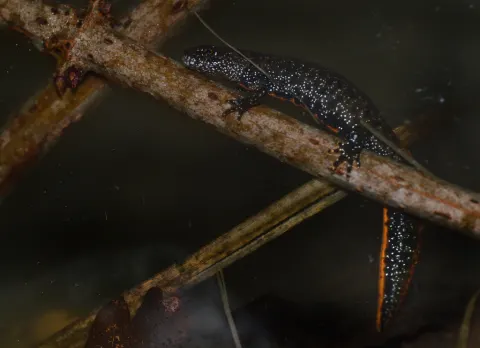
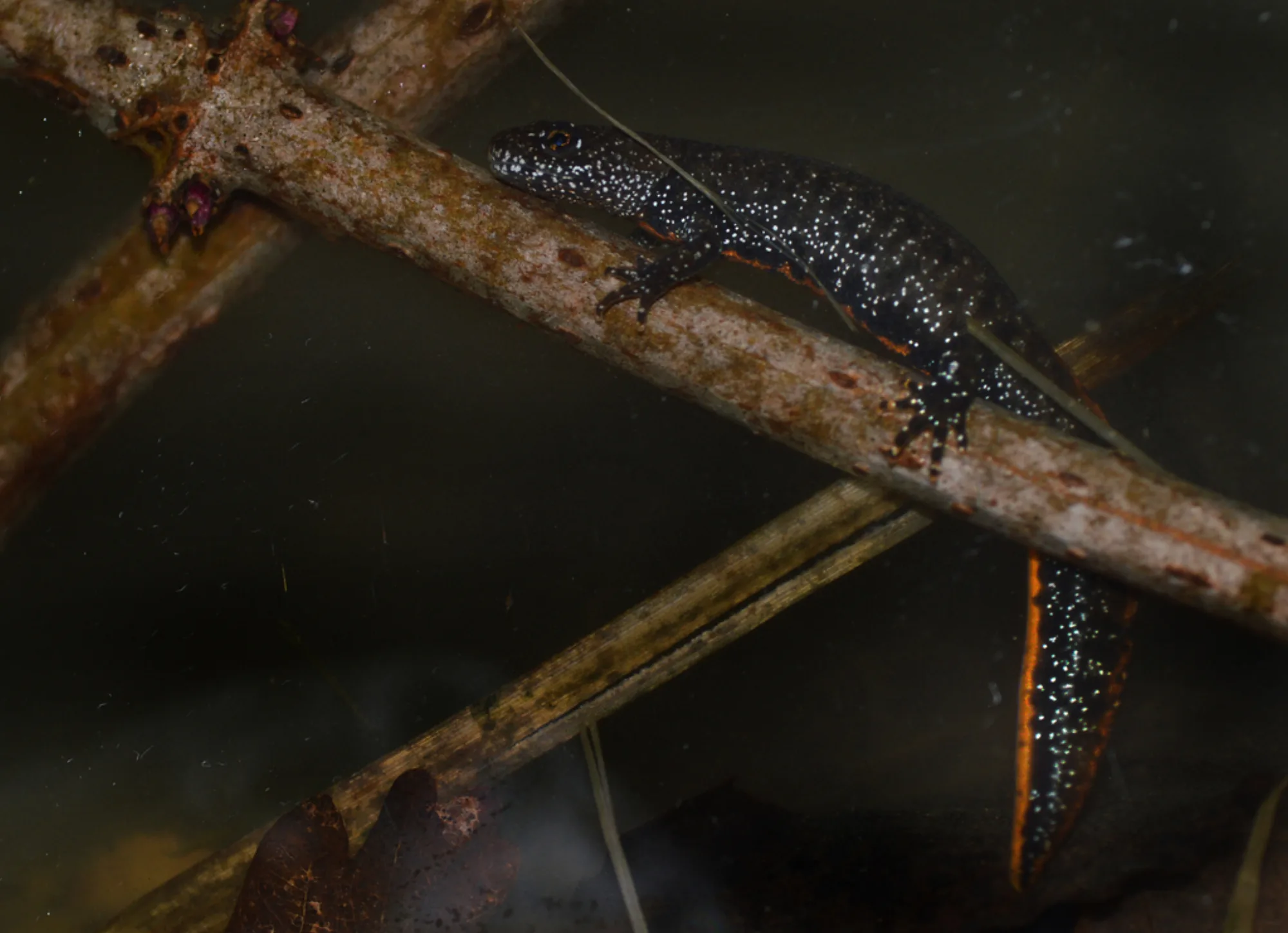
Dark brown above and yellow to orange beneath, the Crested Newt has rough skin and irregular dark blotches on its belly. Its flanks carry black spots and a dense scattering of white marks. Females can reach 16 cm in length and have a yellow line along the lower edge of the tail. In the breeding season, males grow a conspicuous jagged crest along the back and tail, with a break at the tail base.
The species ranges from Great Britain across northern and central Europe to parts of Western Siberia. It is generally found in lowlands, spending much of the year on land and favouring deciduous woodland or groves. Where there is no forest, it can also live in sheltered places such as hedgerows, scrub and swampy meadows. In spring, adults move to breeding water, often larger ponds with plenty of underwater plants and no fish. They are mostly active at night in the water, usually favouring deeper areas where they shelter among vegetation. On land, they hide beneath logs or bark, in stone walls and in small mammal burrows, sometimes sharing these refuges with other newts.
Their food is mainly invertebrates, including earthworms, insects, woodlice and slugs on land. In water they also eat tadpoles, young amphibians and smaller newts. A female lays around 200 eggs per season, folding them individually into the leaves of water plants. The larvae develop in the water, becoming land-dwelling juveniles two to four months after hatching. Populations are declining as urban and agricultural development destroys breeding sites and land habitat. Fragmentation makes it harder for these short-ranging newts to move between suitable habitats, while introduced fish and crayfish also threaten breeding ponds.
Written from the English Wikipedia article Northern crested newt (CC BY-SA 4.0).
- Records
- 68,264
- Countries
- 9
No atlas park has a record of the Crested Newt in or around it yet.
These are open occurrence records, so they show where people looked for and recorded the Crested Newt as much as where it lives. Cells are up to 25 km across, and every location is generalised to its cell.
Generalised encounter areas, not exact locations. Each shape is a grid cell coloured by how likely the species is there.
- Very likelyUnited Kingdom25 km zone · high confidence · 36532 records · updated 80 days ago
- Very likelyDenmark25 km zone · high confidence · 11554 records · updated 80 days ago
- Very likelySwitzerland25 km zone · high confidence · 7212 records · updated 80 days ago
- Very likelyFrance25 km zone · high confidence · 6409 records · updated 80 days ago
- Very likelyNorway25 km zone · high confidence · 2869 records · updated 80 days ago
- Very likelyGermany25 km zone · high confidence · 1690 records · updated 80 days ago
- Very likelyLiechtenstein25 km zone · high confidence · 1327 records · updated 80 days ago
- Very likelyLuxembourg25 km zone · high confidence · 522 records · updated 80 days ago
- LikelyAustria25 km zone · high confidence · 149 records · updated 80 days ago
Conservation status not assessed here yet, so every location is generalised to its grid cell.