Jackson's Chameleon
Trioceros jacksonii
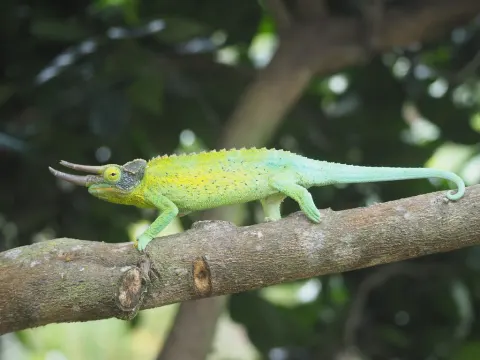
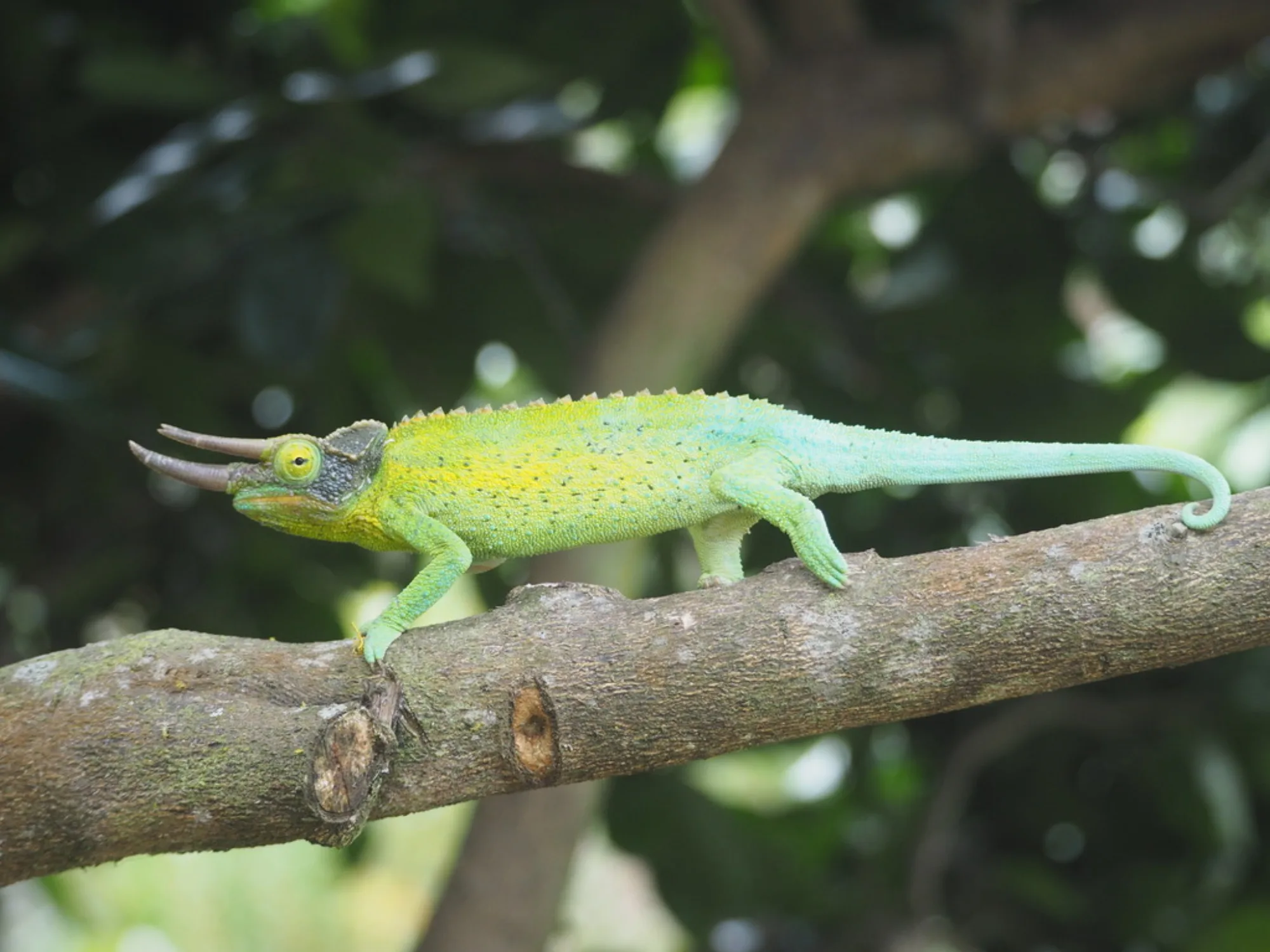
A male Jackson's Chameleon can be recognised by the three brown horns on its head, one on the nose and one above each eye. Females usually lack horns, though some have a trace of a nose horn. The lizard is usually bright green, sometimes with hints of blue and yellow, and its colour can change quickly with mood, health and temperature. Typical total length, including the tail, is 15 to 25 cm, although males can reach 38 cm.
Native to south-central Kenya and northern Tanzania, this tree-dwelling chameleon lives in woodlands and wet forests at elevations of 1,600 to 2,440 m. In Kenya it also occurs in wooded parts of some Nairobi suburbs; its only known Tanzanian location is Mount Meru. It has been introduced to Hawaii, Florida and California; in Hawaii it mainly occupies wet, shady places at 100 to 1,000 m. Rainfall in its native habitat is seasonal and exceeds 127 cm a year, with cool temperatures at night.
Jackson's Chameleon searches for food as it moves, feeding mainly on small insects but also taking animals such as spiders, centipedes, lizards and small birds. Males use colour displays and posturing to establish dominance, though they usually avoid physical fights. Females give birth to eight to thirty live young after a gestation of five to six months; one subspecies has five to ten young. In captivity, excessive heat or humidity can cause eye and upper respiratory infections. Introduced chameleons themselves threaten native invertebrates in Hawaii, including endemic tree snails, which they swallow whole with their shells.
Written from the English Wikipedia article Jackson's chameleon (CC BY-SA 4.0).
- Records
- 162
- Countries
- 3
- Atlas places
- 4
These are open occurrence records, so they show where people looked for and recorded the Jackson's Chameleon as much as where it lives. Cells are up to 25 km across, and every location is generalised to its cell.
Generalised encounter areas, not exact locations. Each shape is a grid cell coloured by how likely the species is there.
- Very likelyUnited States25 km zone · medium confidence · 133 records · updated 80 days ago
- Very likelyKenya25 km zone · medium confidence · 20 records · updated 80 days ago
- LikelyBenin25 km zone · medium confidence · 9 records · updated 80 days ago
Conservation status not assessed here yet, so every location is generalised to its grid cell.