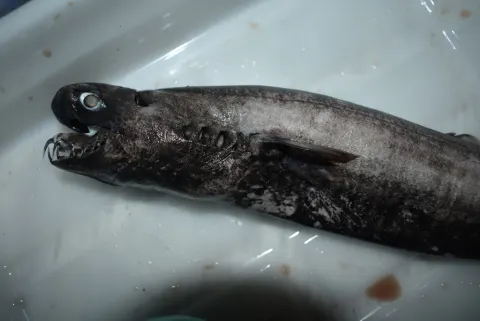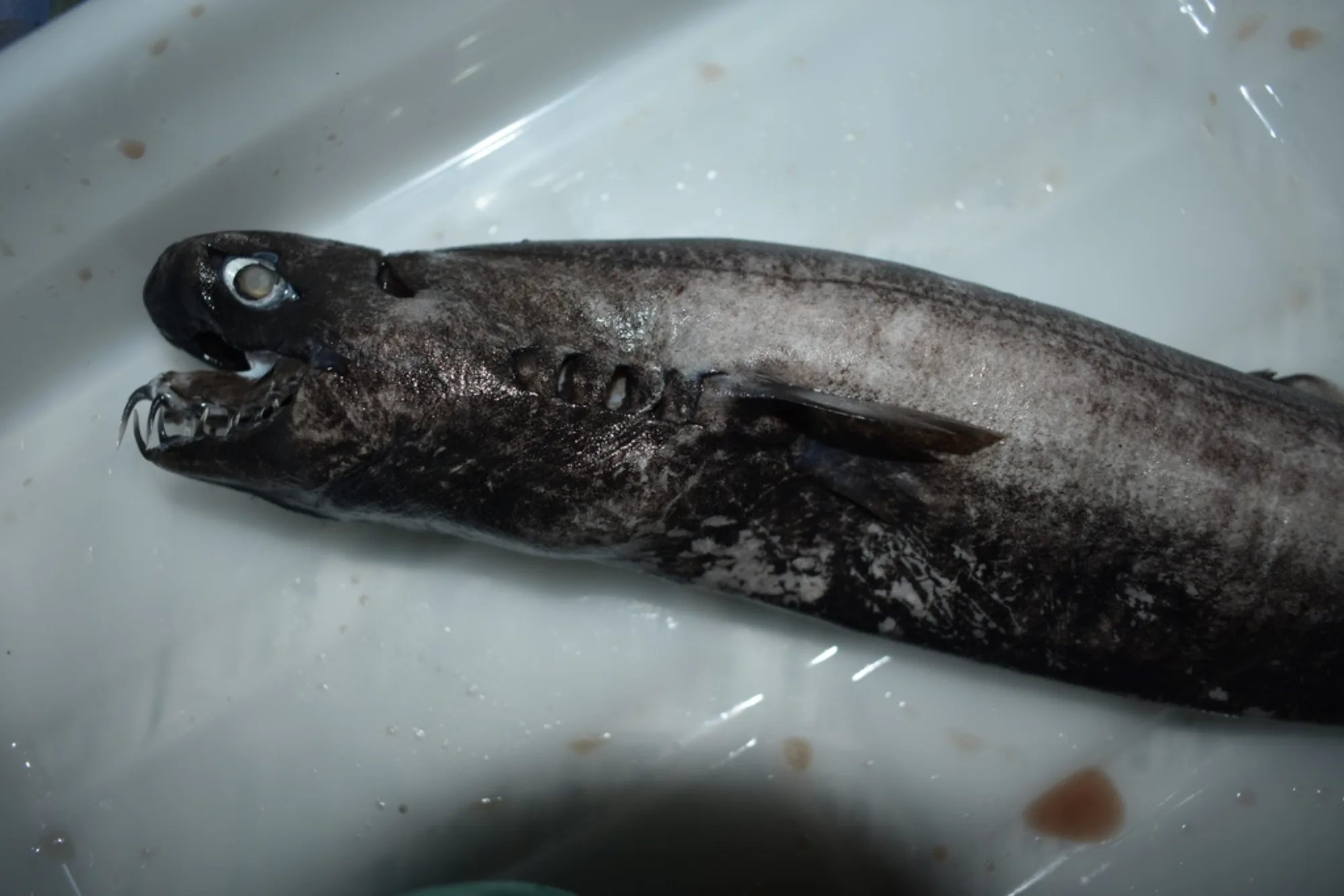
Viper Dogfish
Trigonognathus kabeyai
Reaching up to 54 cm in length, this slender black shark is easily identified by its unusual triangular jaws and long, widely spaced teeth. These fangs allow the Viper Dogfish to grab and impale its prey, which consists mostly of bony fishes like lanternfishes. By rapidly extending its jaws forward, the shark can swallow relatively large fish whole, sometimes reaching 40% of its own body length. Its dark body is covered in tiny light-emitting organs, which are most concentrated on the underside.
This species lives in the Pacific Ocean, specifically around seamounts and continental slopes off southern Japan, the Hawaiian Islands, and the Bonin Islands. It appears to move vertically through the water column each day, perhaps to follow food. During the daylight hours, it stays near the bottom at depths between 270 and 360 m. When night falls, it rises into the upper waters, often staying less than 150 m from the surface.
While little is known about its population, the Viper Dogfish gives birth to live young that are nourished by yolk while developing. Litters likely consist of fewer than 26 pups. These sharks face no dedicated commercial fishing pressure because they have no economic value. However, they are sometimes caught as incidental bycatch by vessels using bottom trawls or purse seines. Natural threats include being hunted by larger predators such as the bigeye tuna and the sickle pomfret.
Written from the English Wikipedia article Viper dogfish (CC BY-SA 4.0).
- Atlas places
- 0
These are open occurrence records, so they show where people looked for and recorded the Viper Dogfish as much as where it lives. Cells are up to 25 km across, and every location is generalised to its cell.
No encounter zones yet
Where and when you can expect to see Viper Dogfish is calculated from observation density. No zones have been computed for this species yet.
Conservation status not assessed here yet, so every location is generalised to its grid cell.