Rainbow Lorikeet
Trichoglossus moluccanus
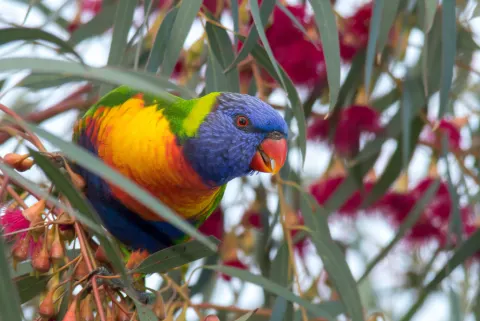
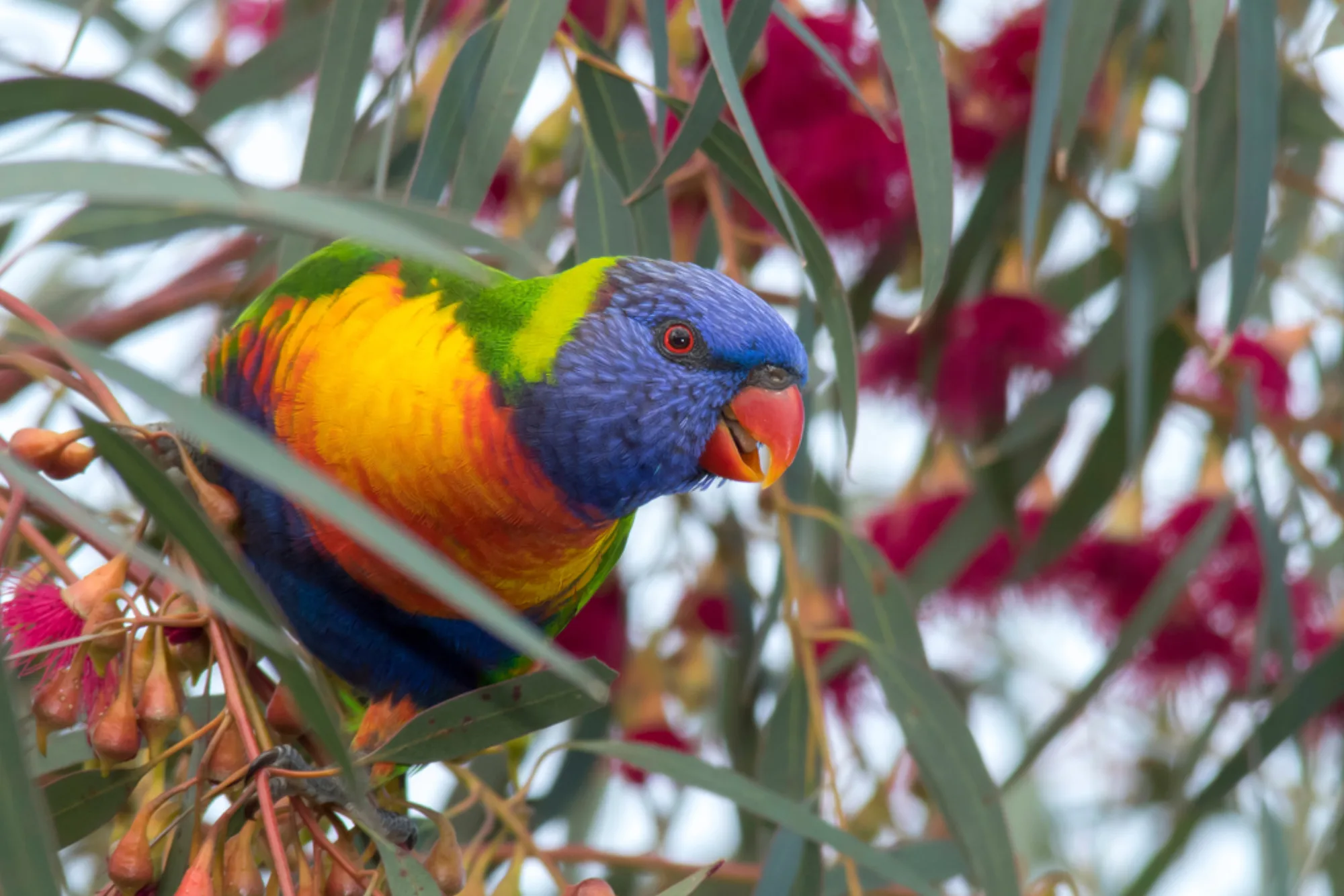
A flash of green wings and a deep blue head can signal a Rainbow Lorikeet. This medium-sized parrot measures 25 to 30 cm from head to tail, with an orange-yellow chest, a blue belly and a green back. In flight, a yellow bar stands out against the red beneath its wings. Adults have orange beaks, while young birds have black ones; males and females look alike.
Along Australia's east coast, the species is common between northern Queensland and South Australia. Look for it in rainforest, coastal bush and woodland, as well as wetlands and some human-made habitats. It has also been introduced to Perth, Tasmania, Auckland and Hong Kong. Rainbow lorikeets mainly eat fruit, pollen and nectar, including nectar from eucalyptus flowers. They visit garden feeders and can become accustomed enough to people to be fed by hand at campsites and in suburban gardens. At Queensland's Currumbin Wildlife Sanctuary, birds gather in a large, noisy flock for feeding. Pairs generally stay together for long periods, sometimes for life. They may nest in tree hollows, palm trunks or overhanging rock, sometimes sharing a tree with other pairs or bird species. In southern Australia, breeding usually runs from August to January, and a clutch contains one to three eggs.
Each year, an unexplained syndrome paralyses thousands of rainbow lorikeets across parts of Queensland and New South Wales, often leaving them unable to fly or eat. The seasonal pattern suggests plant poisoning, although the plant involved is unknown. Bread or bread coated with honey is also an inadequate diet for birds visiting gardens and can cause health and feather development problems in young lorikeets.
Written from the English Wikipedia article Rainbow lorikeet (CC BY-SA 4.0).
- Records
- 1,028,181
- Countries
- 9
- Atlas places
- 5
These are open occurrence records, so they show where people looked for and recorded the Rainbow Lorikeet as much as where it lives. Cells are up to 25 km across, and every location is generalised to its cell.
Generalised encounter areas, not exact locations. Each shape is a grid cell coloured by how likely the species is there.
- Very likelyAustralia25 km zone · high confidence · 1028069 records · updated 86 days ago
- PossiblePapua New Guinea25 km zone · medium confidence · 39 records · updated today
- PossibleNew Zealand25 km zone · medium confidence · 34 records · updated today
- PossibleUnited States25 km zone · medium confidence · 14 records · updated today
- PossibleVanuatu25 km zone · medium confidence · 10 records · updated today
- UncommonHong Kong SAR China25 km zone · medium confidence · 9 records · updated today
- UncommonPuerto Rico25 km zone · medium confidence · 4 records · updated today
- RareBelgium25 km zone · medium confidence · 2 records · updated today
- RareSingapore25 km zone · low confidence · 0 records · updated today
Conservation status not assessed here yet, so every location is generalised to its grid cell.