Trichogenes claviger
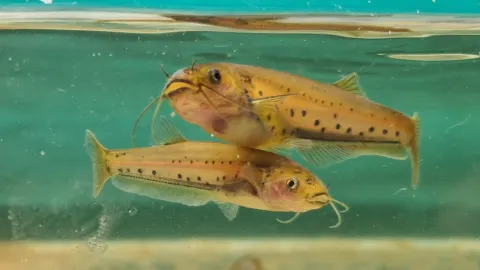
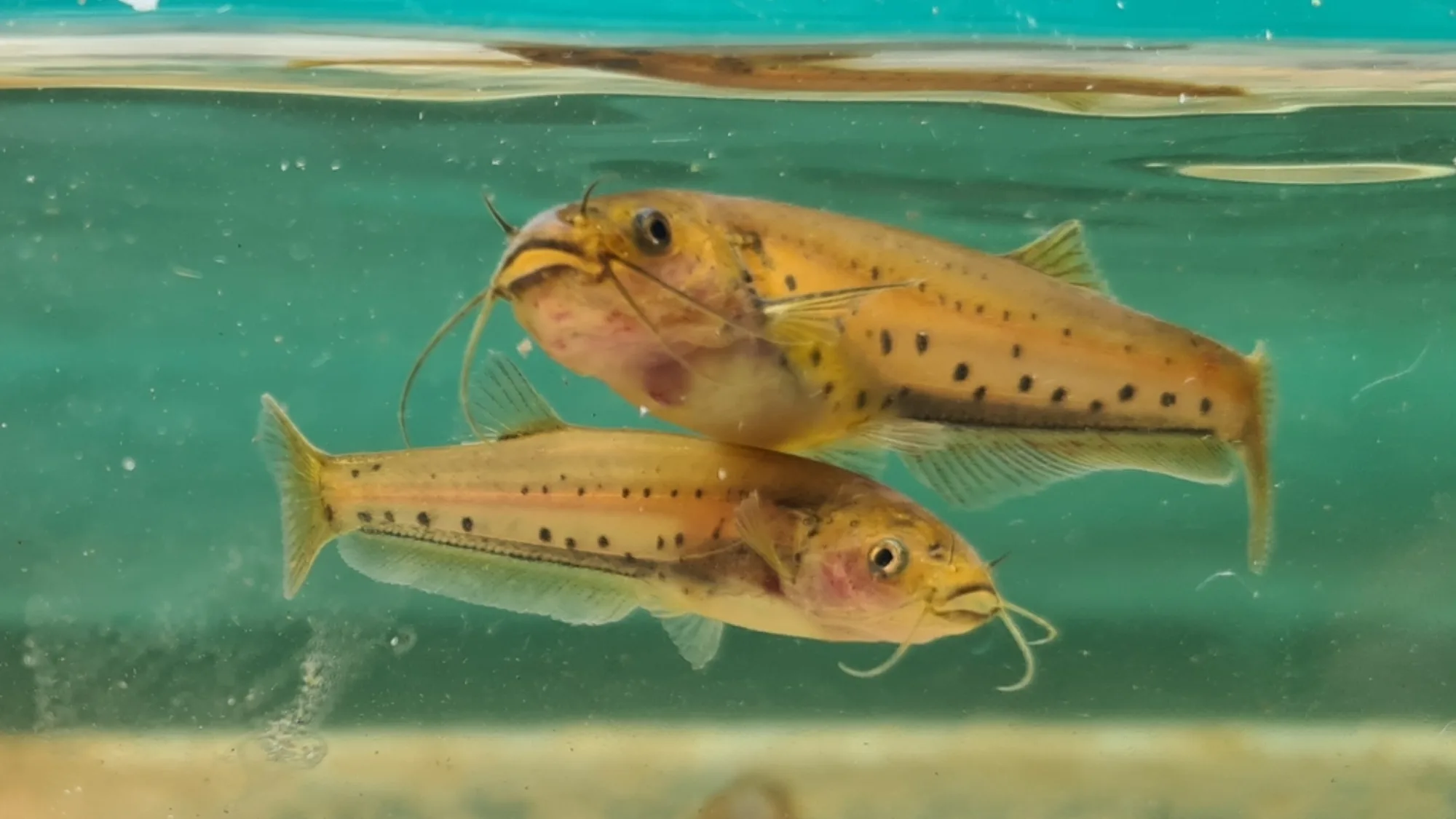
In the shaded streams of Brazil's Atlantic Forest, Trichogenes claviger is a small catfish with a line of dark spots along each side. The top of its head and its fins are yellowish, while its underside is whitish. Its spots vary in size and range from round to oval, with the largest forming a continuous line towards the tail. Collected specimens measured between 16 and 51 mm in standard length, a measure taken from the tip of the fish's nose to where its backbone ends. Males have an elongated, club-shaped protrusion near the gills.
The fish is known only from the Caetés forest in Espírito Santo, where it lives in small streams in the Itapemirim River catchment. At Picada Comprida, one known site, the stream runs slowly through mountainous rainforest at around 1,150 m. Its clear brown water flows over a sandy bed, partly covered by dead leaves and other organic material. At another site, fish were found in two deeper pools when the water was low during the dry season. Visitors can reach Picada Comprida within the Reserva Kaetés, where the fish are easy to see.
The catfish tends to swim in the middle of the water column and is probably active during the day. It sometimes gulps air at the surface, then releases bubbles, and swims tilted downward while carrying air. It feeds mostly on land-dwelling insects and other arthropods that fall onto the water, as well as some aquatic larvae. It is the only fish known to live in its habitat. Its small range and the loss of forest to deforestation are the main threats to this forest-dependent species.
Written from the English Wikipedia article Trichogenes claviger (CC BY-SA 4.0).
- Records
- 17
- Countries
- 1
No atlas park has a record of the Trichogenes claviger in or around it yet.
These are open occurrence records, so they show where people looked for and recorded the Trichogenes claviger as much as where it lives. Cells are up to 25 km across, and every location is generalised to its cell.
Generalised encounter areas, not exact locations. Each shape is a grid cell coloured by how likely the species is there.
- Very likelyBrazil25 km zone · medium confidence · 17 records · updated 80 days ago
Conservation status not assessed here yet, so every location is generalised to its grid cell.