Largehead Hairtail
Trichiurus lepturus
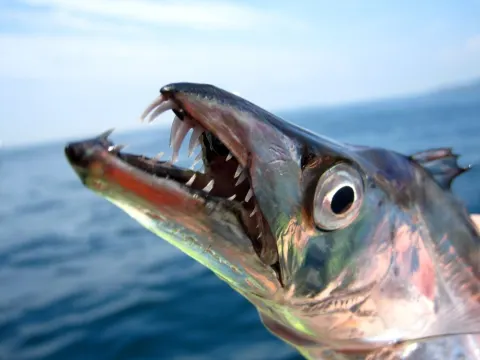
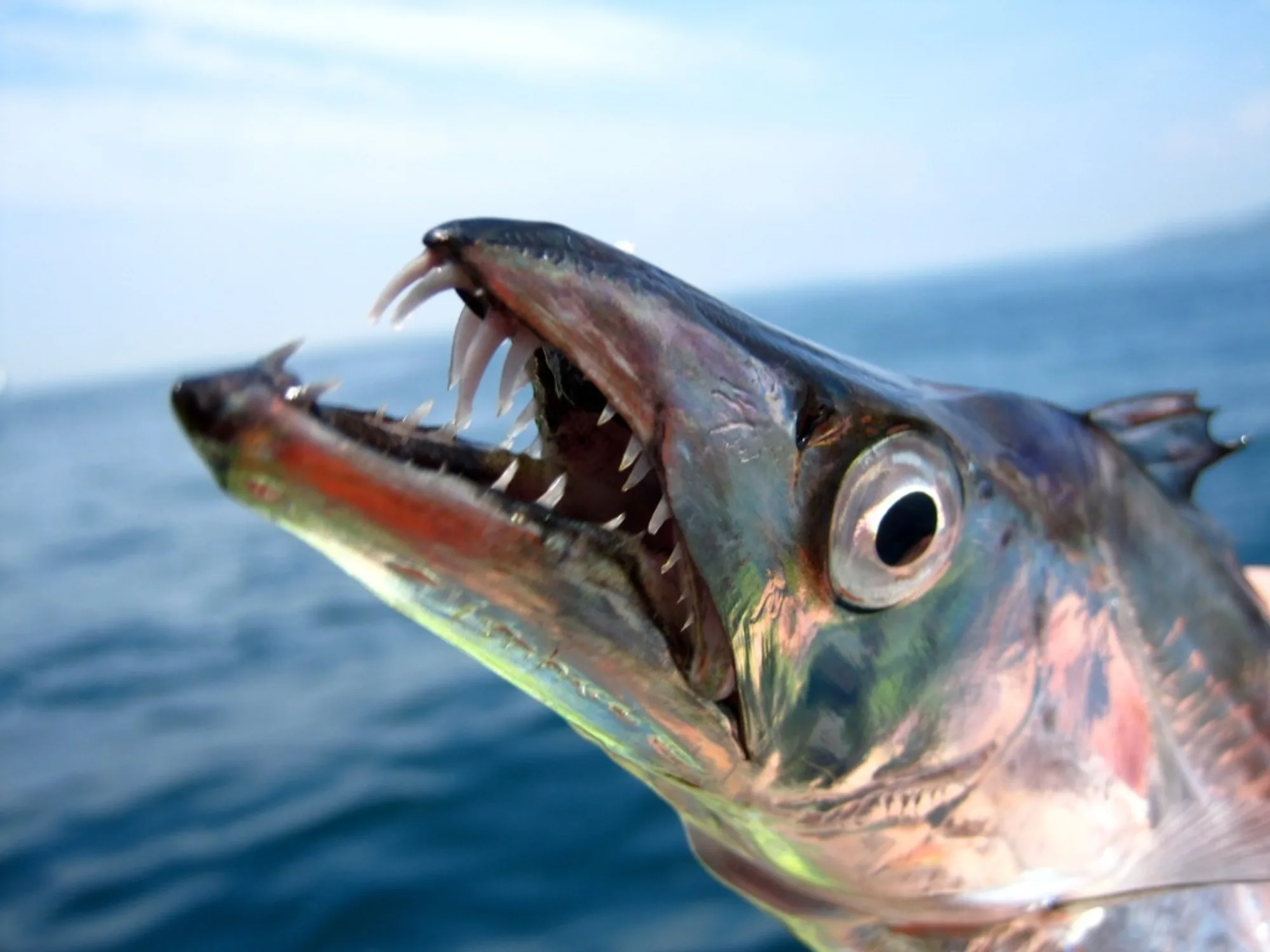
A long, flat body gives the Largehead Hairtail the appearance of a silver-blue ribbon tapering to a point. Its single back fin runs the length of its body, and its thin, pointed tail has none of the familiar shape of a fish tail. Large eyes and a large mouth filled with long, pointed teeth add to its distinctive appearance. Most individuals measure 0.5 to 1 m, although they regularly reach 1.5 to 1.8 m in Australia. The species occurs across tropical and temperate oceans, from the Mediterranean and Caribbean to the waters around much of Australia, but is absent from the central Pacific, including Hawaii. It favours shallow coastal waters over muddy bottoms, sometimes enters estuaries and has been recorded as deep as 589 m.
Often gathering in large, dense schools, hairtails usually live near the seabed but can appear at the surface at night. Young fish rise at night to eat krill and small fish, then return to the seabed during the day. Large adults reverse this pattern and feed mainly on fish, including young hairtails, as well as squid and shrimp. Some populations migrate, and water temperature also influences breeding. Spawning takes place throughout the year in tropical regions, but generally in spring and summer in colder regions. Each female produces many thousand eggs during a spawning season, and these hatch after three to six days.
Fishing is a major pressure across much of the species' range, with bottom trawls and beach seines among the methods used. Reported landings exceeded 1.3 million tonnes in 2009, with the largest catches coming from the Northwest Pacific.
Written from the English Wikipedia article Largehead hairtail (CC BY-SA 4.0).
- Records
- 16,765
- Countries
- 27
- Atlas places
- 2
These are open occurrence records, so they show where people looked for and recorded the Largehead Hairtail as much as where it lives. Cells are up to 25 km across, and every location is generalised to its cell.
Generalised encounter areas, not exact locations. Each shape is a grid cell coloured by how likely the species is there.
- Very likelyColombia25 km zone · medium confidence · 11691 records · updated 80 days ago
- Very likelyMozambique25 km zone · high confidence · 2474 records · updated 80 days ago
- Very likelyUnited States25 km zone · medium confidence · 2013 records · updated 80 days ago
- Very likelyAustralia25 km zone · medium confidence · 277 records · updated 80 days ago
- Very likelyTaiwan25 km zone · medium confidence · 71 records · updated 80 days ago
- Very likelyMexico25 km zone · medium confidence · 43 records · updated 80 days ago
- Very likelySouth Africa25 km zone · medium confidence · 40 records · updated 80 days ago
- Very likelyBrazil25 km zone · medium confidence · 37 records · updated 80 days ago
- LikelyChina25 km zone · medium confidence · 35 records · updated 80 days ago
- LikelyPanama25 km zone · medium confidence · 28 records · updated 80 days ago
Conservation status not assessed here yet, so every location is generalised to its grid cell.