West Indian Manatee
Trichechus manatus
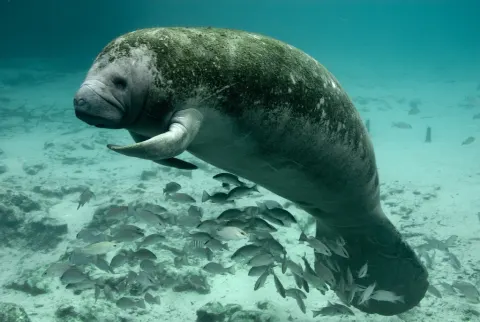
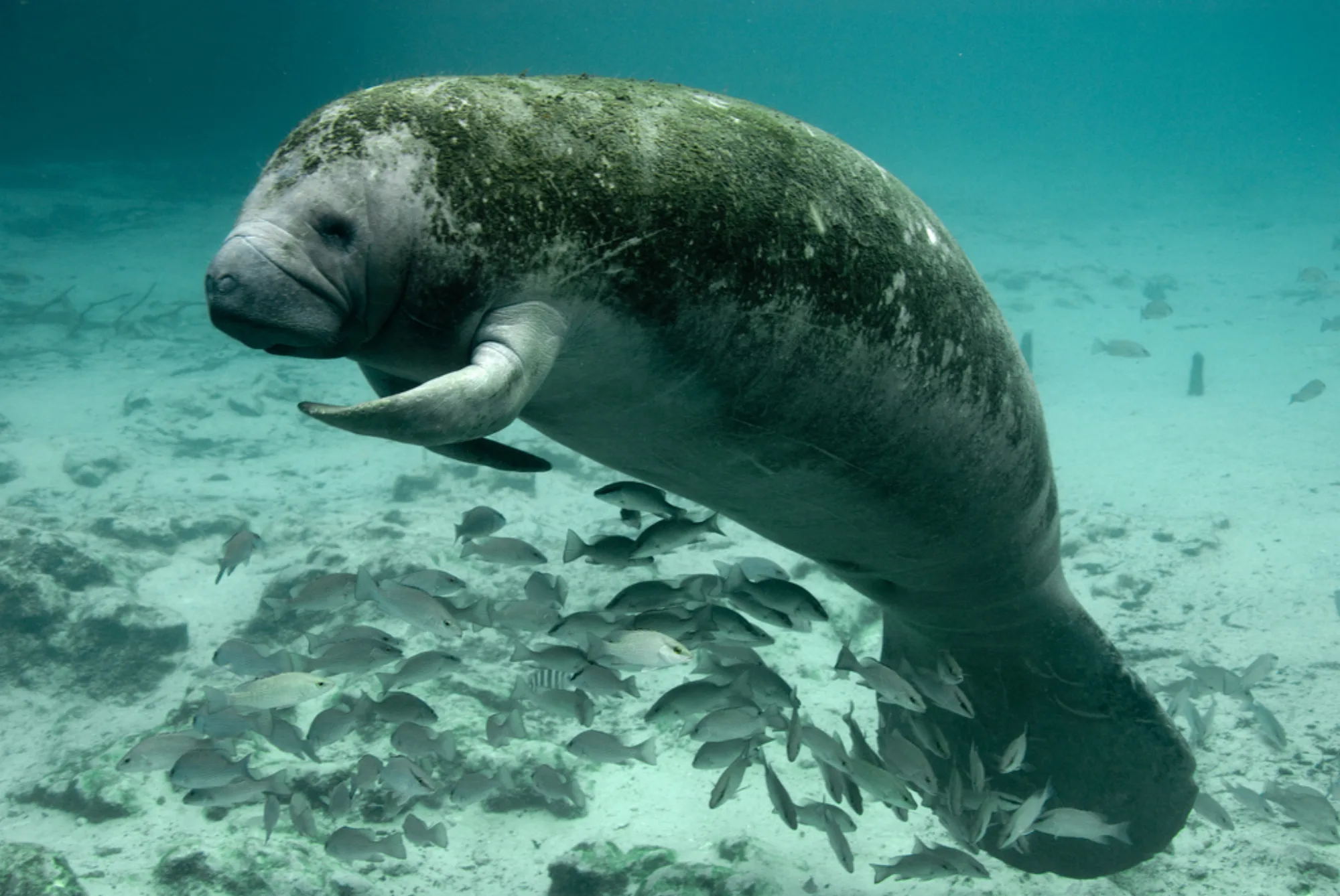
A broad paddle-shaped tail moves the West Indian Manatee through warm water, while sensitive whiskers help it find food and navigate. This large aquatic mammal is usually 2.7 to 3.5 m long and weighs 200 to 600 kg, with females generally larger than males. Its thick skin is grey, though algae and other organisms can change its colour, and white scars can remain visible for decades. Like other mammals, it breathes air.
Its range extends from the eastern United States through the Caribbean to northern Brazil. It favours shallow coastal waters, rivers and estuaries, and can live in both fresh and salt water. In winter, Florida manatees gather at warm-water refuges, including natural springs and places warmed by discharge from power plants. Large concentrations occur around Crystal River and Blue Spring in Florida. Manatees are often solitary, but also gather in breeding herds and communicate with squeaks and screeches. They graze on aquatic plants, especially seagrass in coastal areas, and may also eat grasses, roots, mangrove leaves and algae when tides are high enough. A female usually has one calf at a time, and the calf stays with her for up to two years, learning where to find warm water and summer migration routes.
Boat collisions are a major threat: manatees cannot swim quickly, and shallow water may leave them little room to escape an approaching vessel. Other pressures include habitat loss, pollution, discarded fishing gear and harmful algal blooms. Blooms can poison manatees or kill seagrass, leaving them short of food. Antillean manatees also face fragmented habitat and continued illegal hunting.
Written from the English Wikipedia article West Indian manatee (CC BY-SA 4.0).
- Records
- 846
- Countries
- 7
- Atlas places
- 1
These are open occurrence records, so they show where people looked for and recorded the West Indian Manatee as much as where it lives. Cells are up to 25 km across, and every location is generalised to its cell.
Generalised encounter areas, not exact locations. Each shape is a grid cell coloured by how likely the species is there.
- Very likelyUnited States25 km zone · medium confidence · 380 records · updated 80 days ago
- Very likelyColombia25 km zone · high confidence · 161 records · updated 80 days ago
- Very likelyFrench Guiana25 km zone · medium confidence · 122 records · updated 80 days ago
- Very likelyBrazil25 km zone · medium confidence · 117 records · updated 80 days ago
- Very likelyMexico25 km zone · medium confidence · 51 records · updated 80 days ago
- LikelyBelize25 km zone · medium confidence · 11 records · updated 80 days ago
- PossiblePuerto Rico25 km zone · medium confidence · 4 records · updated 80 days ago
Conservation status not assessed here yet, so every location is generalised to its grid cell.