Leopard Shark
Triakis semifasciata
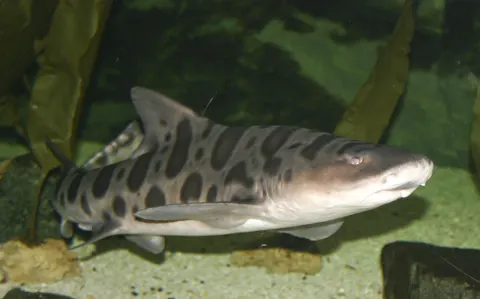
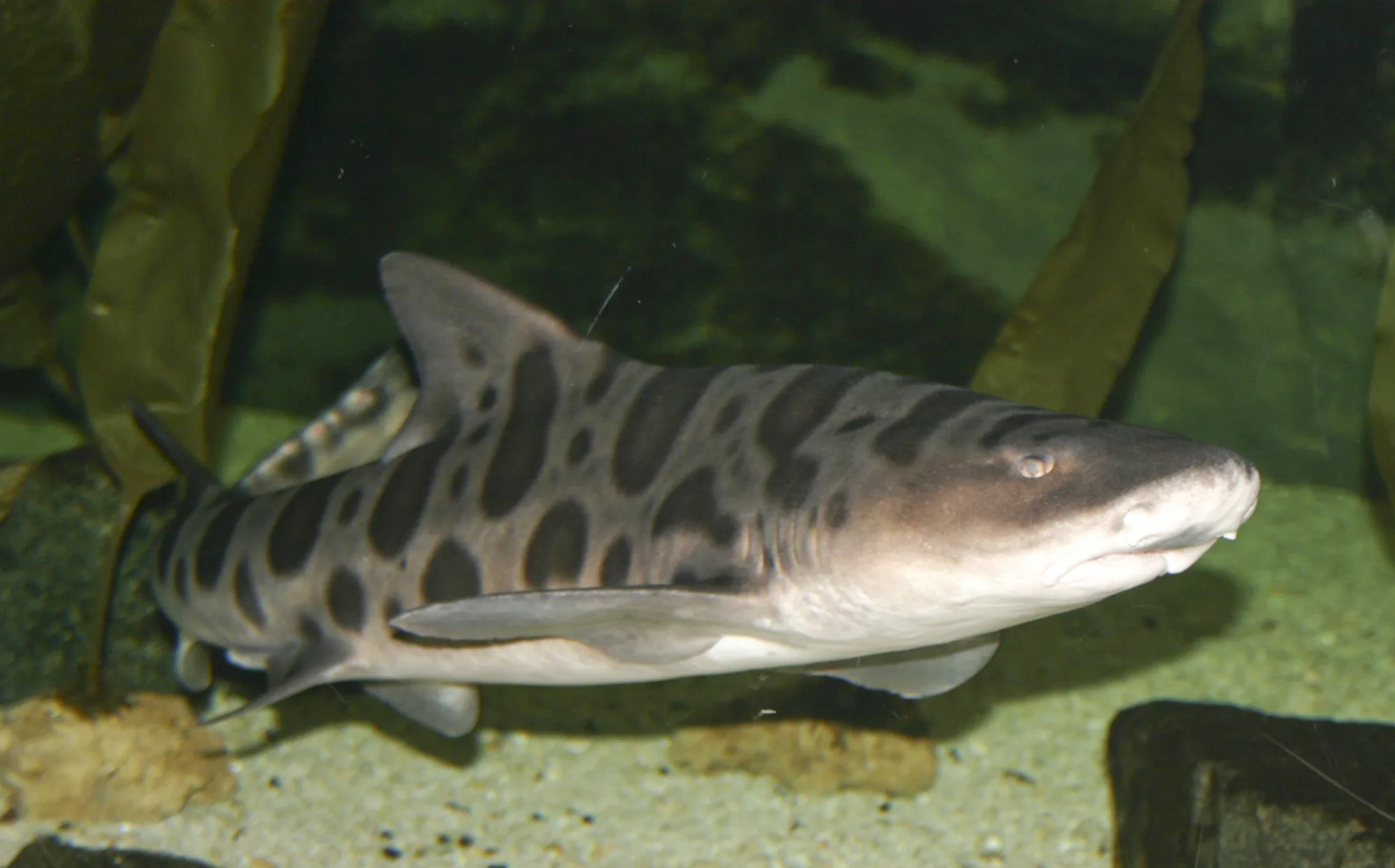
Black saddles and large spots stand out against the silvery to bronzy grey back of the Leopard Shark, a houndshark usually measuring 1.2 to 1.5 m long. Its snout is short and rounded, and its underside is plain and whitish. Wary and quick to flee, it poses almost no danger to people.
Leopard sharks range from Oregon south to Mazatlán, Mexico, in the eastern Pacific, including the Gulf of California. They favour sandy or muddy flats in sheltered bays and estuaries, but can also be seen near kelp beds, rocky reefs and the open coast. Usually found near the seabed, they are most plentiful from the intertidal zone down to 4 m. Large schools may appear suddenly and disappear again after a few hours. The sharks are more active at night, though they sometimes rest motionless on the bottom. In places such as Tomales Bay, they follow the tide onto mudflats to feed, retreating as the water falls. Their varied prey includes crabs, shrimp, clams, fish, fish eggs and innkeeper worms. Most remain in a local area for much of their lives, although some travel much farther.
Females give birth to live young, with as many as 37 in a litter. In northern areas, bays and sloughs serve as nurseries; farther south, females give birth in more open areas. Leopard sharks are caught for food and the aquarium trade, and are also taken accidentally in bottom trawls. Their slow growth and limited movement between regions make local populations susceptible to depletion. Pollution is another concern: sharks living near human development can accumulate mercury, pesticides and PCBs.
Written from the English Wikipedia article Leopard shark (CC BY-SA 4.0).
- Records
- 71,888
- Countries
- 4
- Atlas places
- 1
These are open occurrence records, so they show where people looked for and recorded the Leopard Shark as much as where it lives. Cells are up to 25 km across, and every location is generalised to its cell.
Generalised encounter areas, not exact locations. Each shape is a grid cell coloured by how likely the species is there.
- Very likelyUnited States25 km zone · high confidence · 71878 records · updated 80 days ago
- PossibleMexico25 km zone · medium confidence · 6 records · updated 80 days ago
- UncommonAustralia25 km zone · medium confidence · 4 records · updated 80 days ago
- RareThailand25 km zone · low confidence · 0 records · updated 80 days ago
Conservation status not assessed here yet, so every location is generalised to its grid cell.