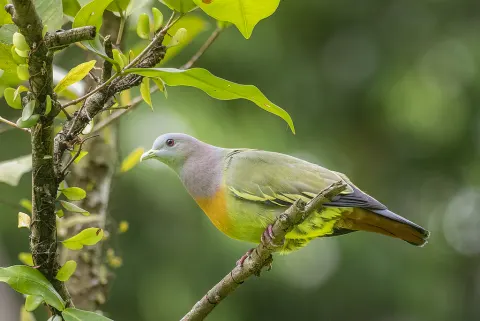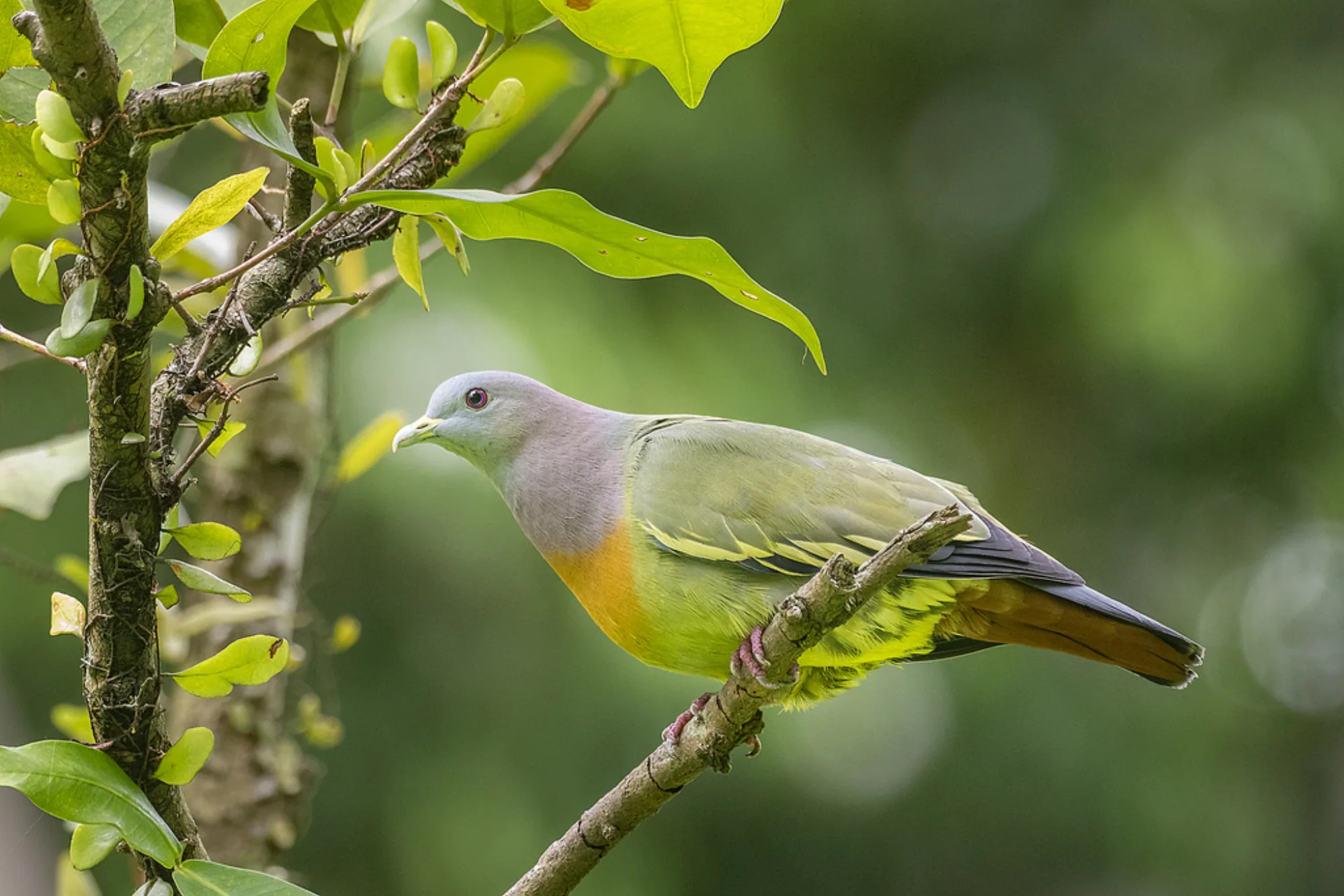
Pink-necked Green Pigeon
Treron vernans
A flash of green in a fruiting tree could be a Pink-necked Green Pigeon, a medium-sized member of the pigeon and dove family. It measures 25 to 30 cm long and weighs around 105 to 160 g. Males have grey heads and olive-green backs, with pink on the neck and upper breast and orange below. In flight, yellow edging on the wings creates a bar, while the grey tail ends in a black band. The smaller female has a yellowish face, throat and belly, with a greenish crown and back of the neck; young birds resemble her but are greyer above. Usually quiet, the species gives whistling calls and may call at communal roosts or when it finds food.
Across Southeast Asia, its range stretches from southern Myanmar, Thailand, Cambodia and Vietnam through the Malay Peninsula and Indonesian islands to the Philippines and the Moluccas. It favours open places, from coastal mangroves and forest edges to farmland, plantations and gardens. It is more common in lowlands and near the coast, and can live even in crowded cities where fruiting trees are available. Look for it in the middle of the forest canopy, where it clings to fine branches to reach fruit, especially figs. These social pigeons feed in small groups or gather in larger flocks when food is plentiful, and hundreds may roost together.
Breeding has been recorded throughout the year. A pair lays two eggs in a flimsy platform of twigs in a tree, shrub or hedge, and both parents help incubate them and raise the chicks. Hunting puts pressure on the species in Thailand, Malaysia and Sumatra, and it is also targeted by the cage bird trade. White-bellied sea-eagles have been reported preying on it, while peregrine falcons have been implicated in its disappearance from Anak Krakatau.
Written from the English Wikipedia article Pink-necked green pigeon (CC BY-SA 4.0).
- Records
- 74,585
- Countries
- 9
- Atlas places
- 8
These are open occurrence records, so they show where people looked for and recorded the Pink-necked Green Pigeon as much as where it lives. Cells are up to 25 km across, and every location is generalised to its cell.
Generalised encounter areas, not exact locations. Each shape is a grid cell coloured by how likely the species is there.
- Very likelySingapore25 km zone · high confidence · 29994 records · updated 86 days ago
- Very likelyMalaysia25 km zone · high confidence · 26222 records · updated 86 days ago
- Very likelyThailand25 km zone · high confidence · 10356 records · updated 86 days ago
- Very likelyIndonesia25 km zone · high confidence · 5895 records · updated 86 days ago
- Very likelyPhilippines25 km zone · high confidence · 1515 records · updated 86 days ago
- Very likelyVietnam25 km zone · high confidence · 322 records · updated 86 days ago
- Very likelyBrunei25 km zone · high confidence · 137 records · updated 86 days ago
- LikelyCambodia25 km zone · medium confidence · 144 records · updated 86 days ago
- RareMyanmar (Burma)25 km zone · low confidence · 0 records · updated today
Conservation status not assessed here yet, so every location is generalised to its grid cell.