Spectacled Bear
Tremarctos ornatus
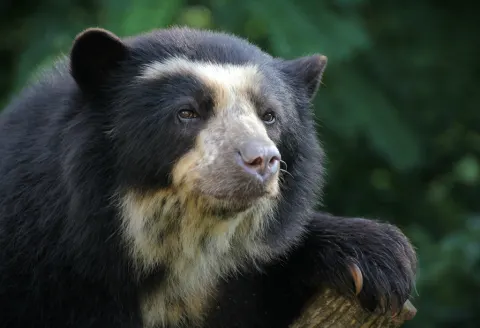
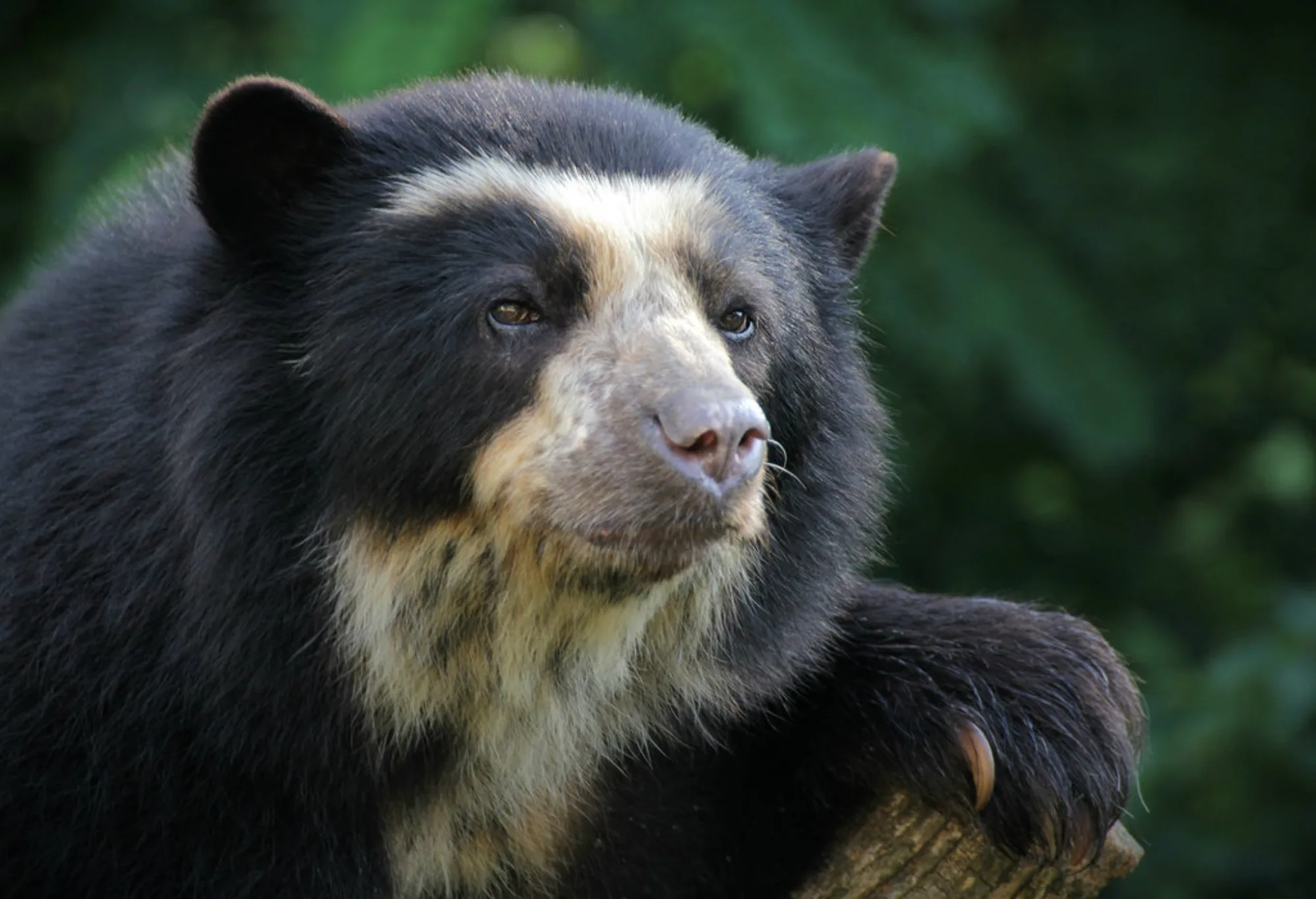
Pale markings around the face give some Spectacled Bears the appearance of wearing glasses, though the pattern varies between individuals and not every bear has the familiar spectacles. This mid-sized bear has dark fur ranging from black to brown or even reddish, often with beige or ginger markings on the face and upper chest. South America's sole native bear lives almost entirely in the Andes, ranging from Venezuela through Colombia, Ecuador and Peru to western Bolivia and northwestern Argentina. Its habitats range from humid mountain cloud forests to high-altitude grasslands, dry forests and scrub deserts.
A capable climber, the bear often retreats up a tree when it encounters people. In the branches it may build a platform where it can rest and store food, and which may also help conceal it. Bears usually live alone, although small groups sometimes feed together where food is plentiful. Their diet is mostly plant-based, including bromeliads, palm nuts, bamboo hearts and fallen fruit, but they also eat animals and carrion. In cloud forests they may be active by day or night, while bears in the Peruvian desert have been reported resting under vegetation during the day. Wild births usually fall between December and February, and mothers generally have one to three cubs. The young often remain with their mother for a year before becoming independent.
Logging, farming and illegal mining contribute to habitat loss, while fragmented habitat can leave populations isolated and expose bears to hunting. Bears also face poaching during conflicts with people: they may raid crops, and farmers sometimes kill them because they fear losing cattle.
Written from the English Wikipedia article Spectacled bear (CC BY-SA 4.0).
- Records
- 1,526
- Countries
- 3
- Atlas places
- 5
These are open occurrence records, so they show where people looked for and recorded the Spectacled Bear as much as where it lives. Cells are up to 25 km across, and every location is generalised to its cell.
Generalised encounter areas, not exact locations. Each shape is a grid cell coloured by how likely the species is there.
- Very likelyColombia25 km zone · high confidence · 1056 records · updated 80 days ago
- Very likelyEcuador25 km zone · medium confidence · 462 records · updated 80 days ago
- LikelyPeru25 km zone · medium confidence · 8 records · updated 80 days ago
Conservation status not assessed here yet, so every location is generalised to its grid cell.