Vietnam Mouse-deer
Tragulus versicolor
Often called the silver-backed chevrotain, this small, even-toed ungulate is unique to the country of Vietnam. It is easily distinguished from other mouse-deer by its unusual two-tone coat. While the front of the body is a reddish brown, the rear is a contrasting grey. A distinct silver line runs along the back, and the throat features a pattern of white and dark reddish brown markings. This animal has big reddish brown ears and a rough coat that is notably dense on its back. Based on early records, it measures roughly 48 cm in length, with a short tail of about 5 cm.
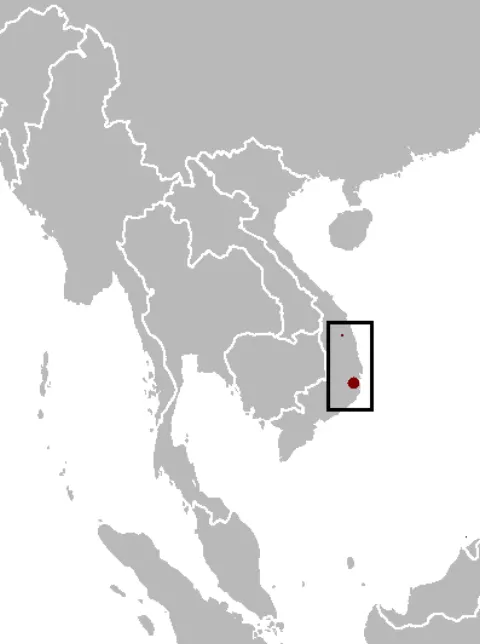
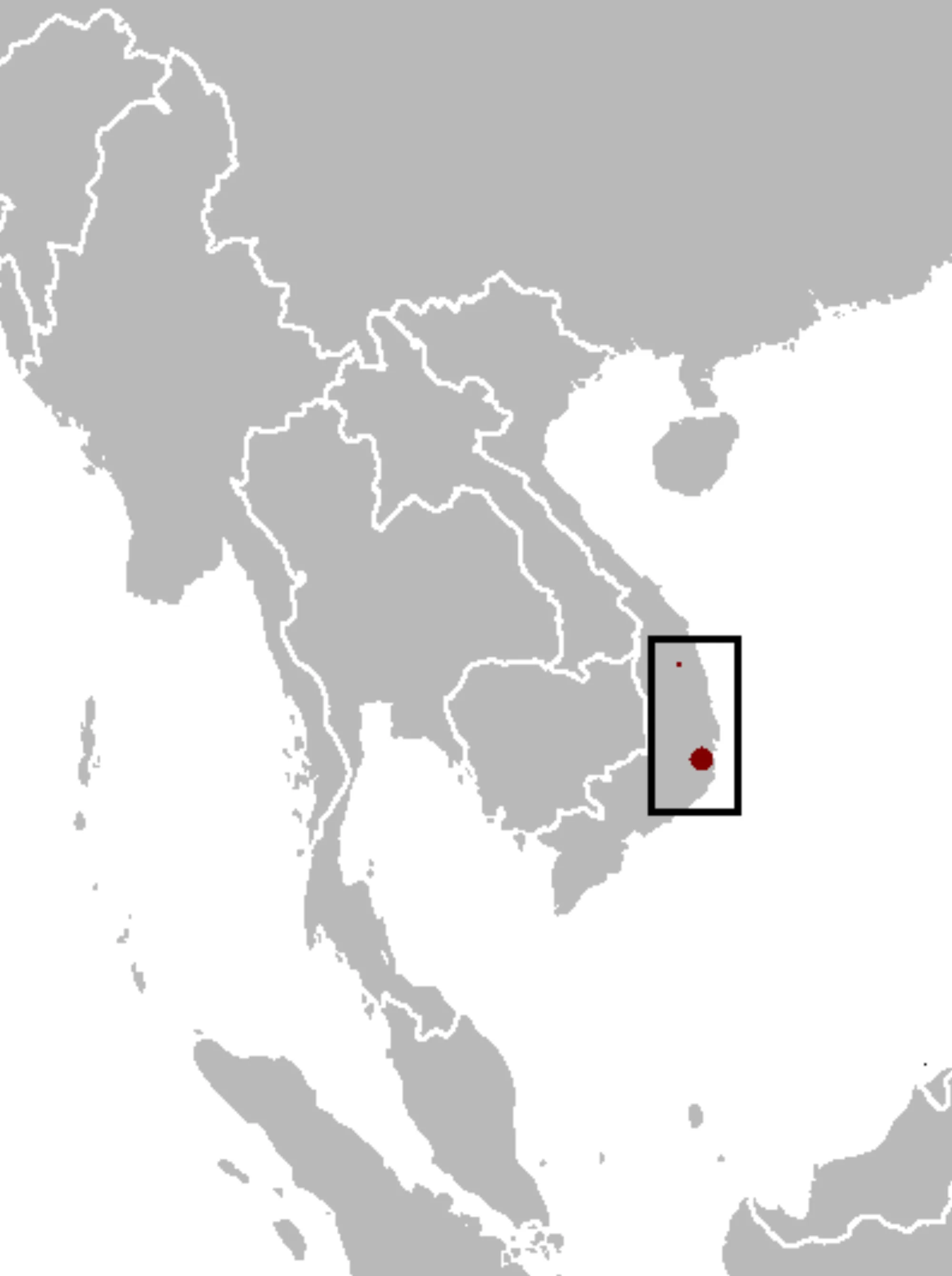
Travellers may find this elusive animal in the dry, low-lying forests of southern Vietnam. Historically, it was also recorded in semi-deciduous tropical forests. Information about its lifestyle remains limited, but evidence from camera traps in 2019 indicates that the Vietnam Mouse-deer is active during the day. It is generally a solitary creature, though it is sometimes seen moving in pairs. It has been found in the same areas as the lesser mouse-deer, suggesting the two species can live side by side.
For many years, researchers feared the Vietnam Mouse-deer had become extinct because there were no confirmed sightings in the wild for nearly three decades. It was not until 2019 that a study used camera trap images to prove the species still exists. The survival of these animals is under significant pressure from the loss of their habitat due to heavy deforestation. Additionally, local hunting has caused populations to decline over the years. Because it has only been seen in the wild three times, scientists are still working to understand the size and stability of the remaining population.
Written from the English Wikipedia article Vietnam mouse-deer (CC BY-SA 4.0).
- Atlas places
- 0
These are open occurrence records, so they show where people looked for and recorded the Vietnam Mouse-deer as much as where it lives. Cells are up to 25 km across, and every location is generalised to its cell.
No encounter zones yet
Where and when you can expect to see Vietnam Mouse-deer is calculated from observation density. No zones have been computed for this species yet.
Conservation status not assessed here yet, so every location is generalised to its grid cell.