Philippine Mouse-deer
Tragulus nigricans
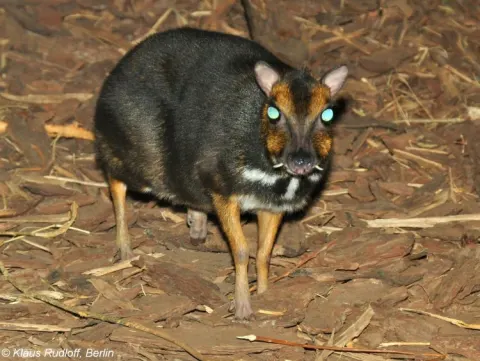
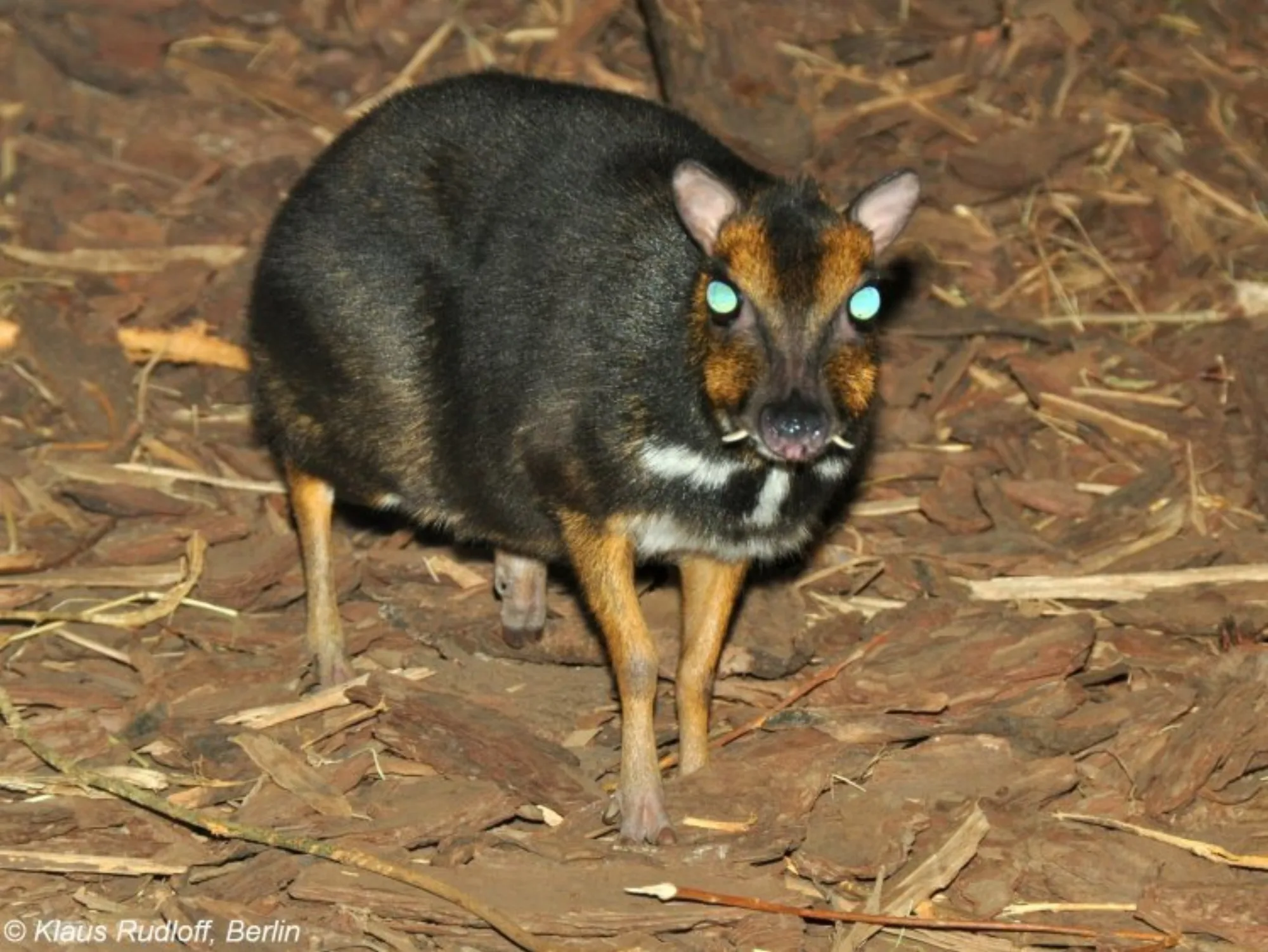
Found only on Balabac and the nearby islands of Bugsuk and Ramos, the Philippine Mouse-deer is one of the smallest hoofed mammals on Earth. Despite its name, it is a chevrotain rather than a true deer. It stands about 18 cm tall at the shoulder with a dark head, arched back, and slender legs. Its black and brown coat is marked by three white stripes that run from the chin down a jet black throat. You can distinguish them from deer by their lack of antlers; instead, males possess long, tusk-like canine teeth used for defense and fighting.
This solitary, nocturnal animal spends its days hidden in the dense undergrowth of primary and secondary forests. As the sun sets, it emerges to find leaves and flowers in more open areas, including mangroves and seashores. It is a fast-maturing species, reaching sexual maturity at 5 months and living for roughly 14 years. Usually, a single offspring is born after a gestation period of 140 to 177 days.
Local folklore often depicts the animal as a clever trickster, and it is considered sacred by the Molbog people. However, the population is falling. The primary threat is the conversion of forest habitat into coconut plantations and other agricultural lands. They are also targeted by hunters for the wild animal trade, and for their meat and skin. Although the species is protected by law, it does not currently live within any of the country's funded priority conservation sites.
Written from the English Wikipedia article Philippine mouse-deer (CC BY-SA 4.0).
- Atlas places
- 0
These are open occurrence records, so they show where people looked for and recorded the Philippine Mouse-deer as much as where it lives. Cells are up to 25 km across, and every location is generalised to its cell.
No encounter zones yet
Where and when you can expect to see Philippine Mouse-deer is calculated from observation density. No zones have been computed for this species yet.