Java Mouse-deer
Tragulus javanicus
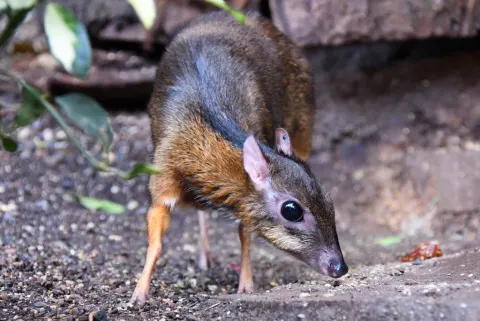
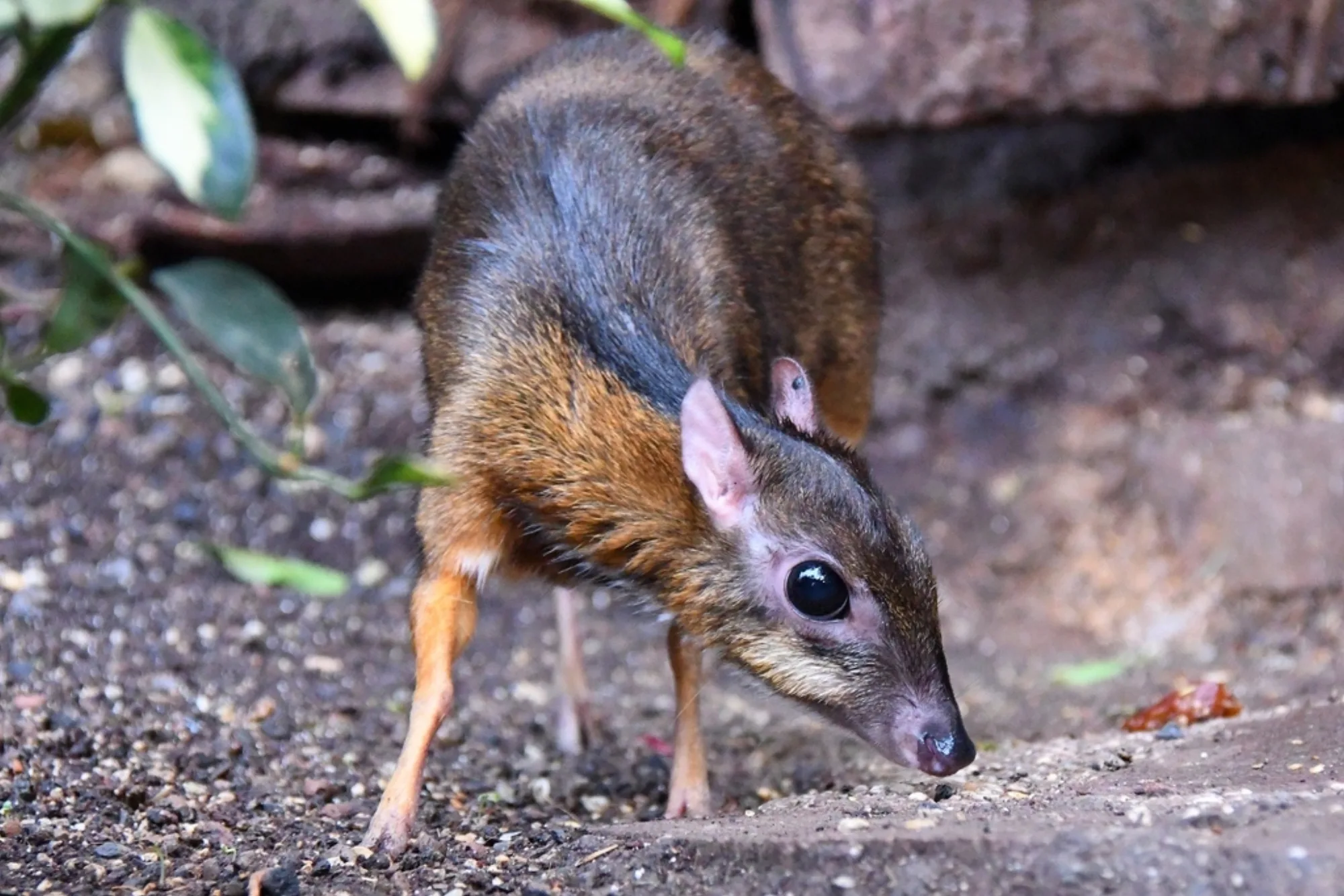
About the size of a rabbit when fully grown, the Java Mouse-deer is a small hoofed mammal with a rounded body, an arched back and slender, short legs. Its coat is reddish-brown above and white below, with pale spots or upright markings on the neck. Males have prominent, downward-pointing tusk-like teeth, while females are slightly smaller and lack them. The species lives in Java's tropical forests, favouring higher elevations, though it also occurs between 400 and 700 metres. Reports from Bali remain unverified.
During the day, it can roam forest openings thick with creeping bamboo, making tunnels through the vegetation to feeding and resting places. At night it moves towards higher, drier ridges, and it also favours dense growth along riverbanks. Its busiest times are the dim hours around dawn and dusk. Usually shy and solitary, it is mostly silent, but gives a shrill cry when frightened. When threatened, it can rapidly beat its hooves against the ground, making a sound like a drum roll. It eats mainly plants, including leaves, shoots, buds and fallen fruit, as well as fungi; captive animals have also eaten insects.
Java Mouse-deer can breed throughout the year in captivity, though some sources place the wild breeding season in November and December. A typical litter contains one fawn, which can stand within 30 minutes of birth. Dogs, crocodiles, wild cats, birds of prey and snakes all pose a threat. People have reduced the population through habitat destruction and by hunting and trapping the animals for food, pelts and pets. Hunting continues despite legal protection, and protected areas still need enforcement.
Written from the English Wikipedia article Java mouse-deer (CC BY-SA 4.0).
- Records
- 0
- Countries
- 2
- Atlas places
- 1
These are open occurrence records, so they show where people looked for and recorded the Java Mouse-deer as much as where it lives. Cells are up to 25 km across, and every location is generalised to its cell.
Generalised encounter areas, not exact locations. Each shape is a grid cell coloured by how likely the species is there.
- Very likelyCambodia25 km zone · low confidence · 0 records · updated 80 days ago
- UncommonIndonesia25 km zone · low confidence · 0 records · updated 80 days ago
Conservation status not assessed here yet, so every location is generalised to its grid cell.