Sitatunga
Tragelaphus spekii
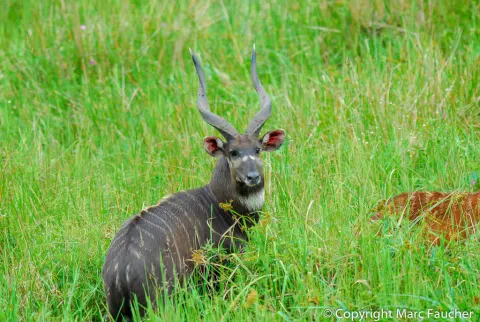
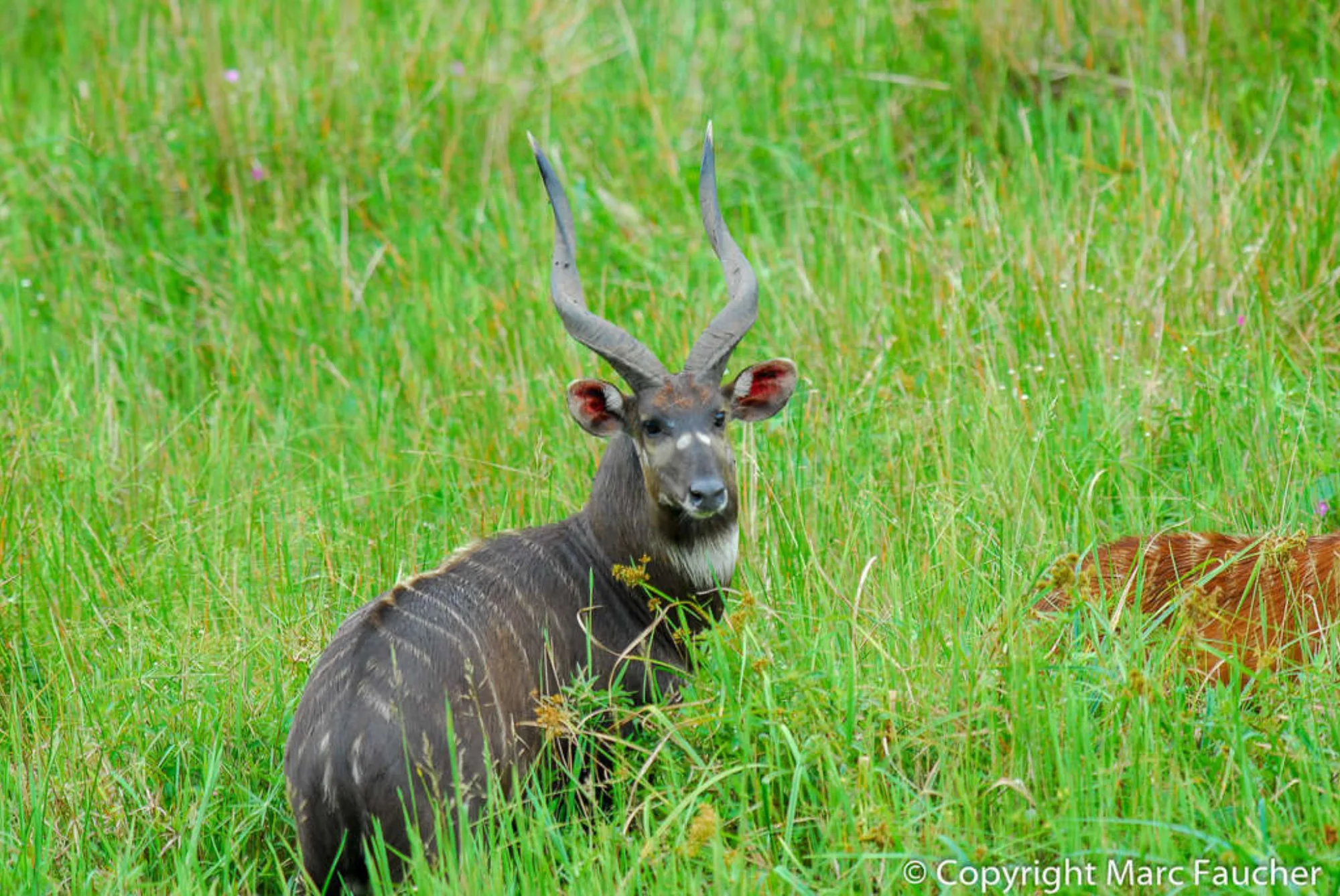
At home in Africa's wetlands, the Sitatunga is a medium-sized antelope with a shaggy, water-repellent coat and long, splayed hooves that help it move through its swamp habitat. Females are generally chestnut, while males darken with age from grey to dark brown and develop a rough mane and a white stripe along the back. Only males have horns, which are spiral-shaped, and both sexes have white facial markings and often faint stripes and spots. Its colouring helps conceal it among vegetation, while pointed toes allow it to move slowly and almost silently through water.
Found across central Africa and in parts of western, eastern and southern Africa, Sitatunga favour swamps and marshes, including forest clearings, riverside thickets and mangroves. They follow established tracks through the swamp, often towards reed beds or feeding grounds. Most activity takes place after dawn, before dusk and at night; during the heat of the day, they rest in flat areas or reed beds. Usually solitary or in pairs, they sometimes gather in larger, loosely connected groups. They are good swimmers and may submerge when threatened, leaving only the nose and eyes above the surface. Feeding mainly at wetland edges, they select fresh grasses, sedges, new leaves and other vegetation. Breeding takes place throughout the year, and after nearly eight months a female generally gives birth to one calf, which she keeps hidden in cover.
Habitat loss is the gravest threat. Wetland loss can isolate populations, while lasting changes in water levels affect vegetation and food. Fires put Sitatunga at risk in the Bangweulu and Busanga swamps; in Senegal, heavy hunting for food and damage to their habitat have left them very rare.
Written from the English Wikipedia article Sitatunga (CC BY-SA 4.0).
- Records
- 56
- Countries
- 5
- Atlas places
- 1
These are open occurrence records, so they show where people looked for and recorded the Sitatunga as much as where it lives. Cells are up to 25 km across, and every location is generalised to its cell.
Generalised encounter areas, not exact locations. Each shape is a grid cell coloured by how likely the species is there.
- Very likelyBenin25 km zone · medium confidence · 56 records · updated 80 days ago
- PossibleGabon25 km zone · low confidence · 0 records · updated 80 days ago
- UncommonTanzania25 km zone · low confidence · 0 records · updated 80 days ago
- UncommonZambia25 km zone · low confidence · 0 records · updated 80 days ago
- RareUganda25 km zone · low confidence · 0 records · updated 80 days ago
Conservation status not assessed here yet, so every location is generalised to its grid cell.