Bongo
Tragelaphus eurycerus
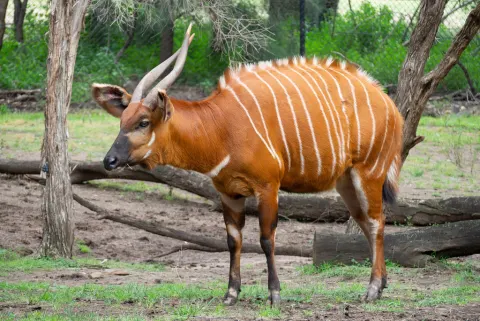
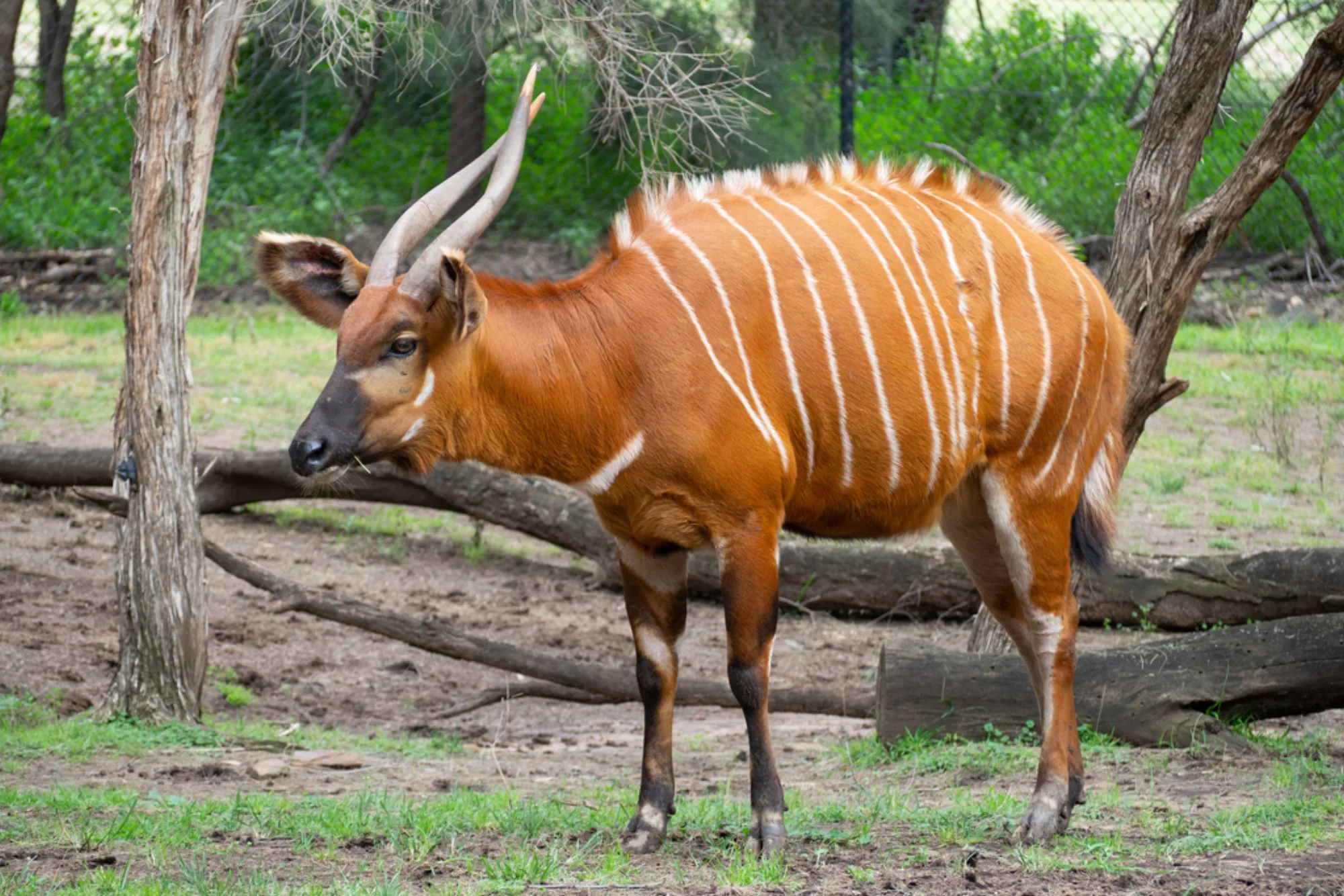
A glimpse of chestnut and pale stripes in thick forest may reveal a Bongo, a large African antelope that is active mostly at night. Its reddish-brown coat carries black-and-white markings and 10 to 15 vertical white-yellow stripes, while both sexes have heavy, slightly spiralled horns that sweep back over the body. The neck, chest and legs are generally darker than the rest of the coat, particularly in males, whose colouring deepens with age.
Bongos live in dense tropical forest in Central and West Africa, with isolated populations in Kenya. In central Kenya, wild mountain bongos are confined to a handful of mountainous areas. Bongos favour forest mosaics with fresh, low-growing vegetation and can also inhabit bamboo forests. They need permanent water and abundant herbs and low shrubs throughout the year. Shy and easily startled, they can flee quickly through dense undergrowth, laying their horns back as they run. Males usually live alone, while females and their young form groups of six to eight. Although most active at night, bongos sometimes move about during the day. They browse on leaves, vines, bark, roots and fruit, among other plant foods, and regularly visit natural salt licks.
After a pregnancy of about 285 days, a female gives birth to one calf. Newborns lie hidden for a week or longer, with their mothers making brief visits to feed them, before joining nursery herds. Across the range, forest clearance for agriculture, uncontrolled timber cutting and hunting for meat have reduced the areas bongos occupy. Poaching and pressure on habitat have driven a rapid decline in wild mountain bongos, leaving small, isolated populations in Kenya.
Written from the English Wikipedia article Bongo (antelope) (CC BY-SA 4.0).
- Records
- 12
- Countries
- 3
No atlas park has a record of the Bongo in or around it yet.
These are open occurrence records, so they show where people looked for and recorded the Bongo as much as where it lives. Cells are up to 25 km across, and every location is generalised to its cell.
Generalised encounter areas, not exact locations. Each shape is a grid cell coloured by how likely the species is there.
- Very likelyCentral African Republic25 km zone · medium confidence · 12 records · updated 80 days ago
- LikelyLiberia25 km zone · low confidence · 0 records · updated 80 days ago
- PossibleCongo - Brazzaville25 km zone · low confidence · 0 records · updated 80 days ago
Conservation status not assessed here yet, so every location is generalised to its grid cell.