Dusky Langur
Trachypithecus obscurus
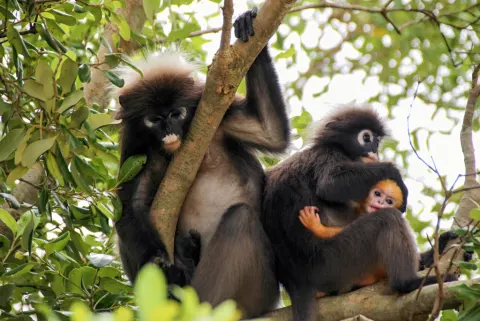
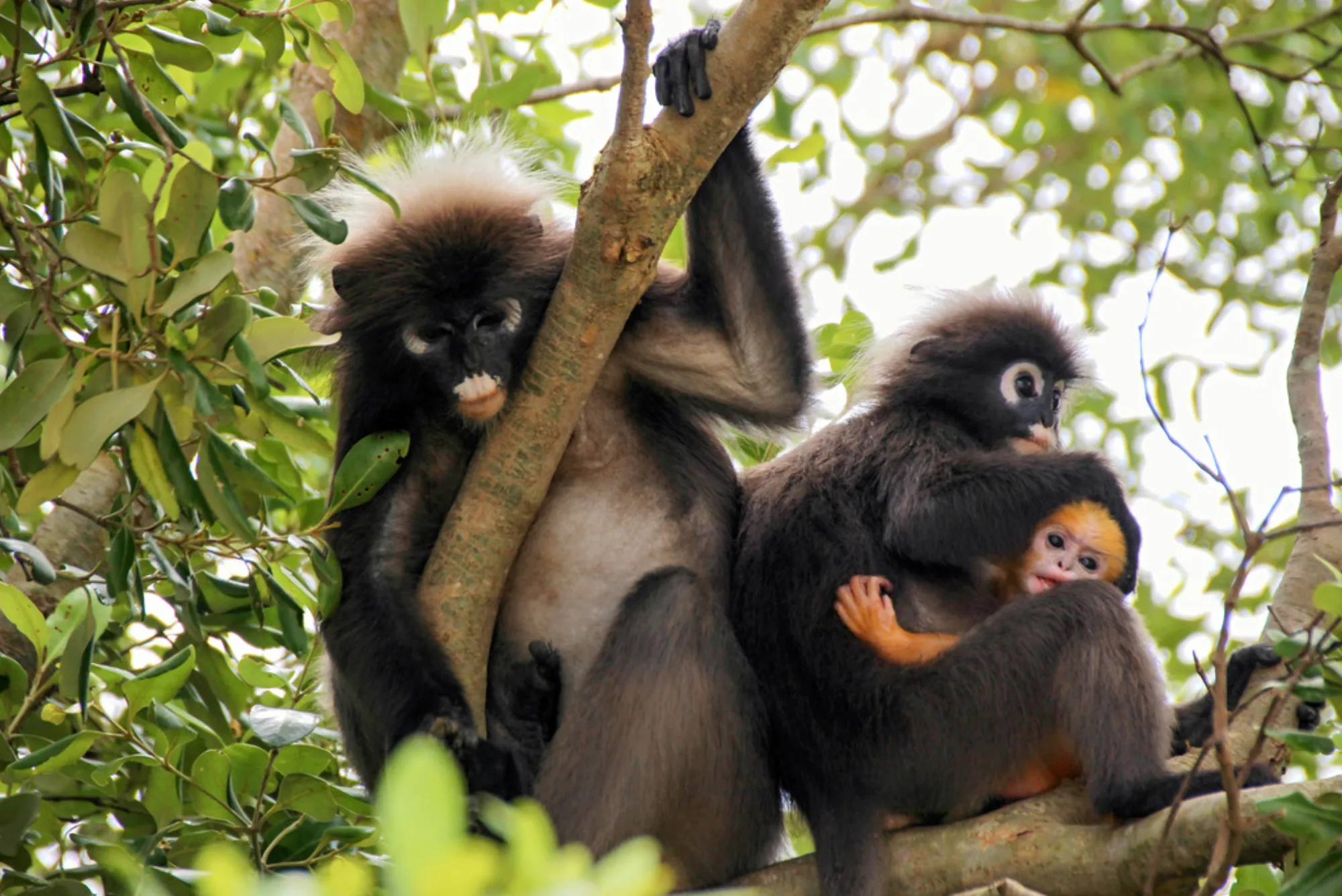
Bright white rings around the eyes give the Dusky Langur another name: the spectacled langur. This small primate has fur that can be brown, black or grey across its back, with a lighter belly. Infants are born orange, but their coat changes colour as they mature. It lives in tropical forests in Peninsular Malaysia, Myanmar and Thailand, and has occasionally been seen in Singapore. In the forest canopy, it tends to feed on leaves growing high up and often rests at those heights while eating.
Dusky Langurs live in troops that split into smaller groups to find food during the day. They eat more vegetation than fruit, though they favour fruit when it is available, and its availability varies with the season. Studies in Malaysia have recorded feeding, resting, moving, grooming and play among their daily activities. Hostility within a troop appears to be uncommon, and monkeys may reconcile after a fight by embracing. Males can reproduce throughout the year, with no evidence of a seasonal mating period.
Habitat loss and degradation, human land use and poaching all threaten the species. Roads through tropical forests have brought a large increase in deaths from traffic, while packs of domestic dogs also prey on the monkeys. People also kill them for meat or because they are regarded as agricultural pests. Infants are hunted and sold internationally as pets, and some die when their owners fail to care for them properly. In Penang, canopy bridges are being tested to see whether they can reduce road deaths.
Written from the English Wikipedia article Dusky leaf monkey (CC BY-SA 4.0).
- Records
- 376
- Countries
- 3
- Atlas places
- 2
These are open occurrence records, so they show where people looked for and recorded the Dusky Langur as much as where it lives. Cells are up to 25 km across, and every location is generalised to its cell.
Generalised encounter areas, not exact locations. Each shape is a grid cell coloured by how likely the species is there.
- Very likelyThailand25 km zone · medium confidence · 201 records · updated 80 days ago
- Very likelyMalaysia25 km zone · medium confidence · 175 records · updated 80 days ago
- RareSingapore25 km zone · low confidence · 0 records · updated 80 days ago
Conservation status not assessed here yet, so every location is generalised to its grid cell.