Horse Mackerel
Trachurus trachurus
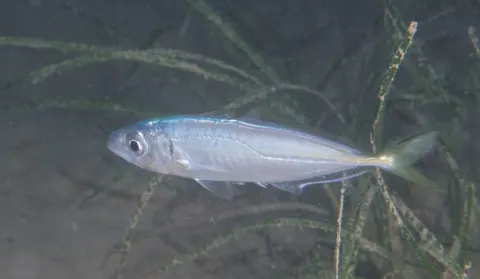
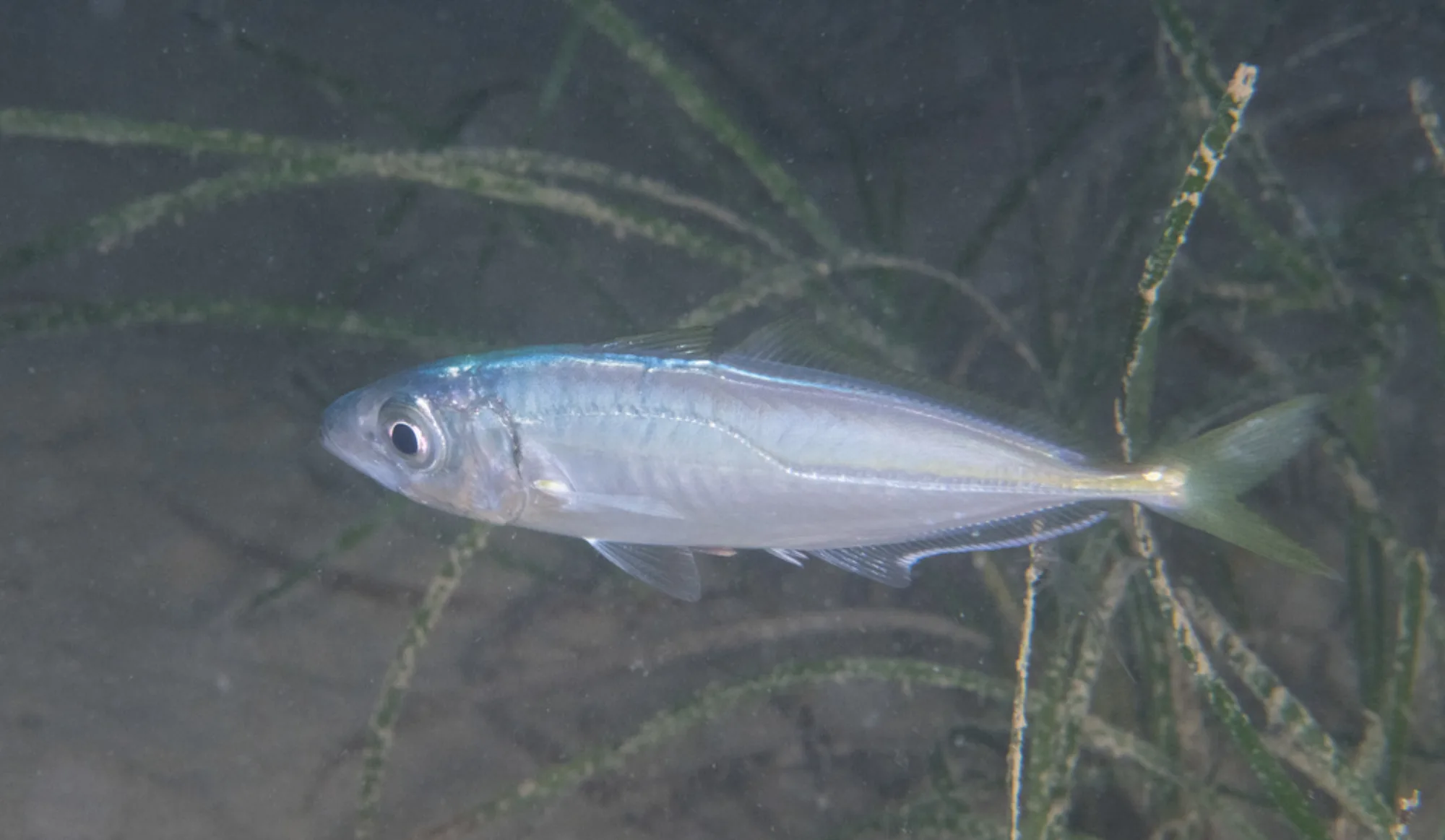
With its slender, flattened body and large head, the Horse Mackerel is a jack mackerel also known as the Atlantic horse mackerel or common scad. Its dark blue back contrasts with silvery sides and a white belly, while a dark spot marks the gill cover. Normally around 25 cm long, it can reach 60 centimetres. A curved row of bony plates runs towards the tail, where the plates become larger and harder.
This fish ranges through the north and eastern Atlantic and the Mediterranean, as well as the Black Sea and Sea of Marmara. In the Atlantic, its reported range stretches from Norway to South Africa and may continue along the southern African Indian Ocean coast to Maputo, Mozambique, although its southern range depends on how a closely related fish is classified. It usually lives over sandy ground at depths of 100 to 200 m, but has also been reported much deeper and sometimes occurs nearer the surface. Horse mackerel migrate north in summer and return south as the sea cools. Young fish often shelter among jellyfish tentacles and form shoals with young herring and other horse mackerels. Both young and adults eat copepods, shrimps, small fish and squid. Breeding seasons vary by region: off Ireland, spawning takes place irregularly from June to August, peaking in July, while off Mauritania the main season runs from November to January.
Commercial fishing is a significant pressure, with the species caught using gear including trawls, longlines and purse seines. Populations have declined slowly amid increased fishing pressure, with low recruitment since 2004. Declines greater than ninety percent have been recorded off the West African coast, although no population decline has been reported in European waters.
Written from the English Wikipedia article Atlantic horse mackerel (CC BY-SA 4.0).
- Records
- 24,438
- Countries
- 10
No atlas park has a record of the Horse Mackerel in or around it yet.
These are open occurrence records, so they show where people looked for and recorded the Horse Mackerel as much as where it lives. Cells are up to 25 km across, and every location is generalised to its cell.
Generalised encounter areas, not exact locations. Each shape is a grid cell coloured by how likely the species is there.
- Very likelyIreland25 km zone · high confidence · 6776 records · updated 80 days ago
- Very likelyFrance25 km zone · high confidence · 6625 records · updated 80 days ago
- Very likelySpain25 km zone · high confidence · 6143 records · updated 80 days ago
- Very likelyNetherlands25 km zone · high confidence · 3165 records · updated 80 days ago
- Very likelyUnited Kingdom25 km zone · high confidence · 1003 records · updated 80 days ago
- Very likelyNorway25 km zone · high confidence · 353 records · updated 80 days ago
- Very likelyBelgium25 km zone · high confidence · 110 records · updated 80 days ago
- Very likelyGermany25 km zone · high confidence · 108 records · updated 80 days ago
- Very likelySweden25 km zone · high confidence · 95 records · updated 80 days ago
- LikelyPortugal25 km zone · high confidence · 60 records · updated 80 days ago
Conservation status not assessed here yet, so every location is generalised to its grid cell.