Greater Weever
Trachinus draco
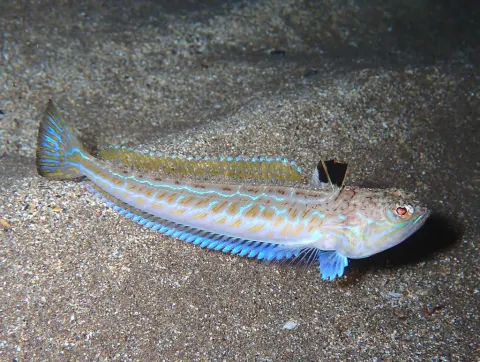
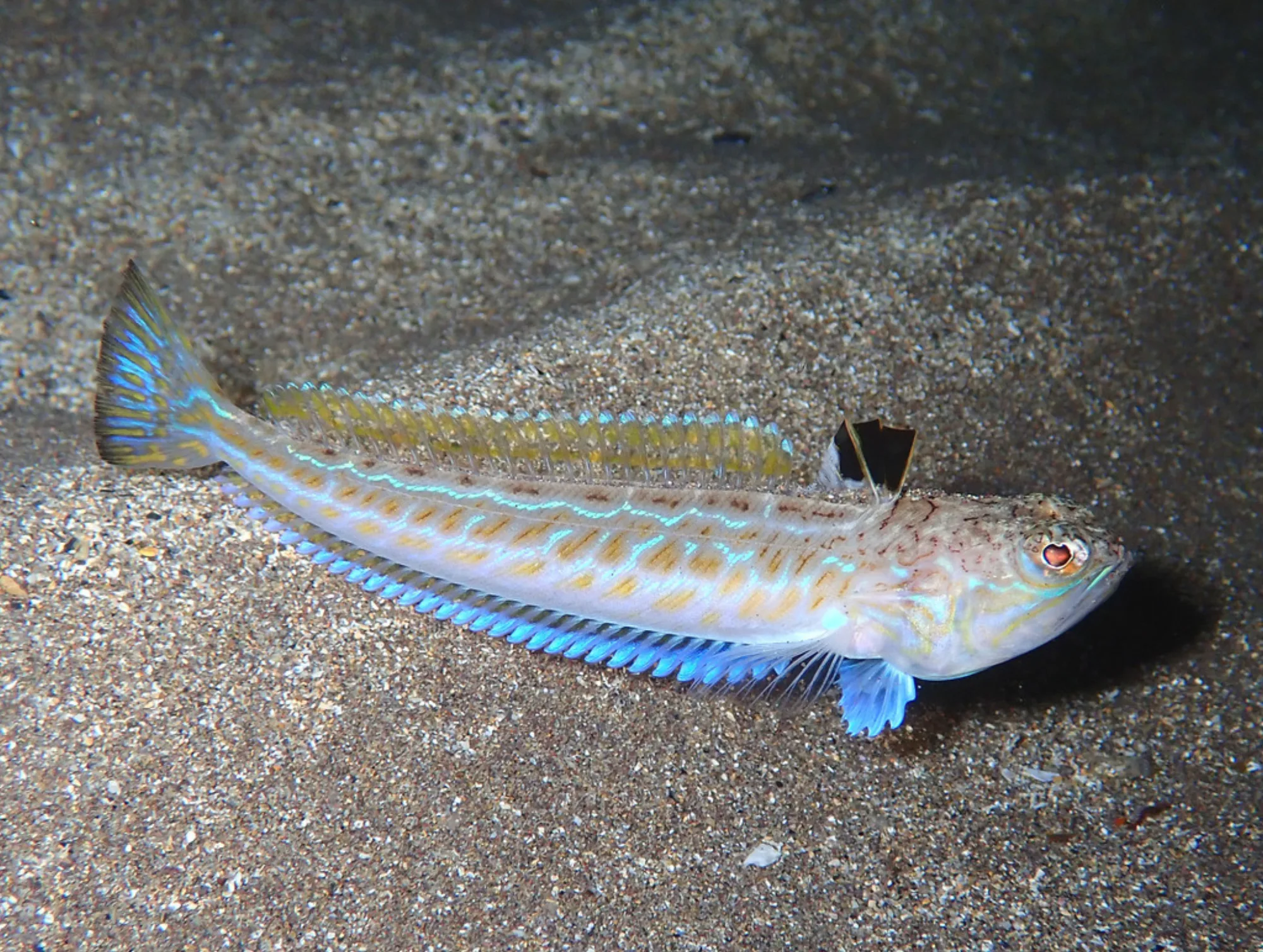
With its long, flattened body and eyes set high on a broad head, the Greater Weever is a fish adapted to life close to the seabed. Its back is greenish brown, while its yellowish brown sides carry broken blue and yellow stripes angled towards the front, as well as slanting black stripes. Venomous spines on its first dorsal fin and gill covers can cause serious injury if the fish is accidentally stepped on or handled.
The fish lives along the eastern Atlantic coast from Norway to Morocco and reaches the Mediterranean, Aegean and Black Seas. It occurs from shallow water down to 150 m, mostly over sand or mud. By day it buries itself in fine sand, leaving only its eyes and the tip of its dorsal fin exposed, then attacks passing prey suddenly. It is believed to swim freely at night, including in open water. Catches in the Adriatic suggest that its main foods are small fish, decapods and opossum shrimps, although it also eats animals such as cephalopods and bivalves. Diet changes with size: opossum shrimps are common prey for fish under 20 cm, while fish and cephalopods make up a greater share as weevers grow.
The breeding period appears to begin in June and continue until October, although one set of observations points to spawning between June and August, peaking in July. Eggs are laid in open water, where both eggs and larvae form part of the zooplankton. Greater weevers are caught as by-catch and sold commercially in France and Spain.
Written from the English Wikipedia article Greater weever (CC BY-SA 4.0).
- Records
- 654
- Countries
- 17
No atlas park has a record of the Greater Weever in or around it yet.
These are open occurrence records, so they show where people looked for and recorded the Greater Weever as much as where it lives. Cells are up to 25 km across, and every location is generalised to its cell.
Generalised encounter areas, not exact locations. Each shape is a grid cell coloured by how likely the species is there.
- Very likelySweden25 km zone · high confidence · 409 records · updated 80 days ago
- Very likelyFrance25 km zone · medium confidence · 63 records · updated 80 days ago
- Very likelySpain25 km zone · medium confidence · 52 records · updated 80 days ago
- Very likelyNorway25 km zone · medium confidence · 34 records · updated 80 days ago
- Very likelyDenmark25 km zone · medium confidence · 23 records · updated 80 days ago
- Very likelyBelgium25 km zone · medium confidence · 22 records · updated 80 days ago
- Very likelyCape Verde25 km zone · medium confidence · 6 records · updated 80 days ago
- Very likelyIsrael25 km zone · medium confidence · 6 records · updated 80 days ago
- Very likelyGreece25 km zone · medium confidence · 5 records · updated 80 days ago
- Very likelyPortugal25 km zone · medium confidence · 5 records · updated 80 days ago
Conservation status not assessed here yet, so every location is generalised to its grid cell.