Brown Thrasher
Toxostoma rufum
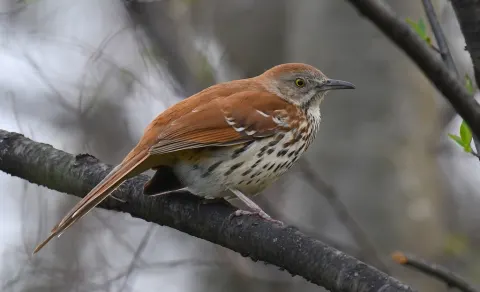
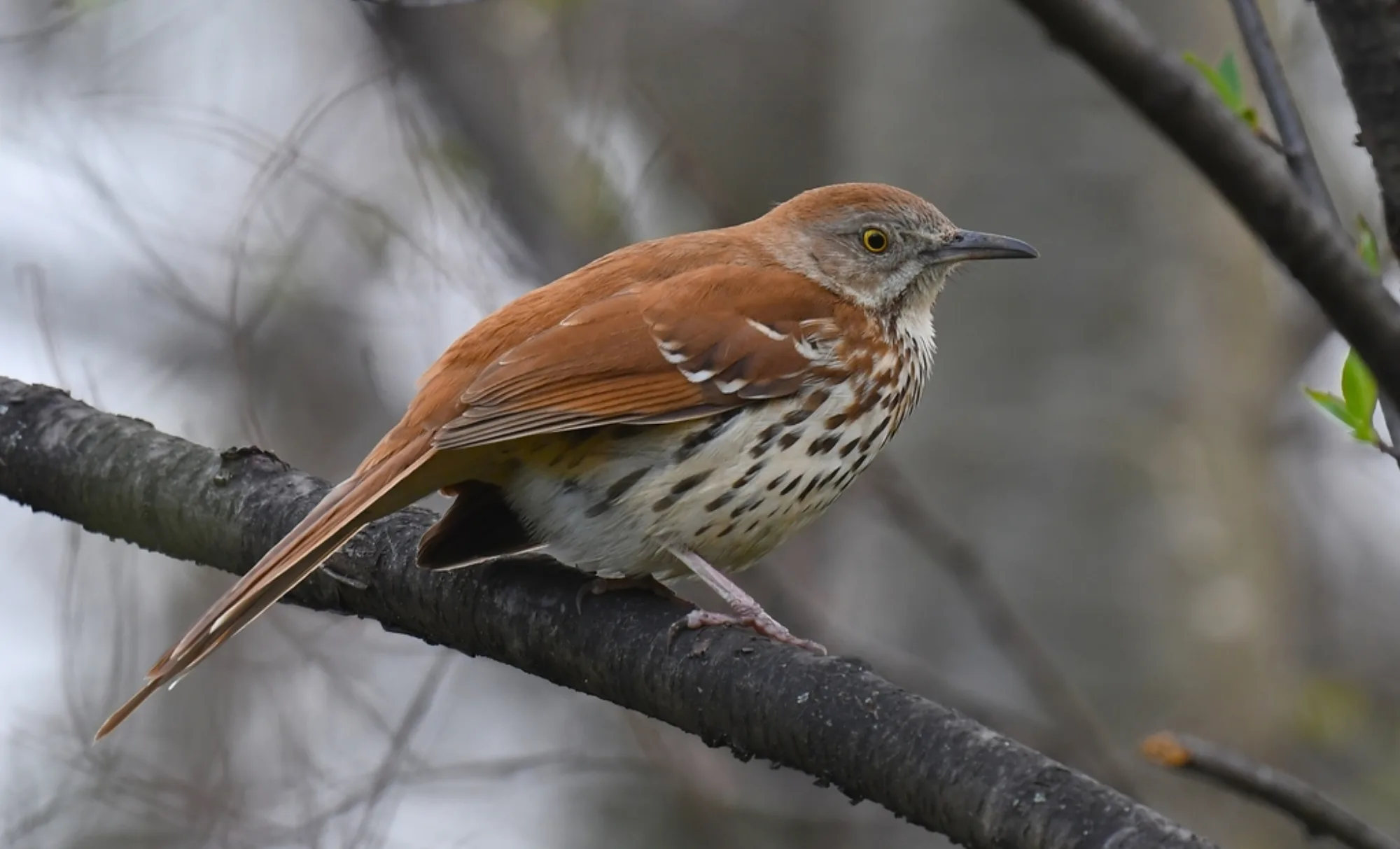
Look for the Brown Thrasher low in a thicket, or listen for a male singing from an exposed branch. This bird has reddish-brown upperparts, a pale, streaked underside, yellow eyes and a long, rounded tail. Its long bill curves downward, and males and females look alike. The smaller wood thrush can be confused with it, but has rounded spots below, dark eyes and a shorter tail. The thrasher's varied song includes short phrases that may be repeated for minutes.
Brown Thrashers are common from central and eastern parts of the United States into central and southern Canada. They favour woodland edges, thickets and dense brush, and also use farmland and areas near suburbs. Birds remain year-round in the southern part of the range, while some others migrate short distances at night. Usually elusive, they spend much of their time on or near the ground and may retreat into cover with cackling calls when disturbed. They sweep through leaves and ground debris with their bills, looking for insects, berries, nuts, seeds and other food.
Both parents build a twig nest, usually in a dense shrub or low tree, though sometimes on the ground. The female lays 3 to 5 eggs, and both parents incubate them and feed the young. Thrashers defend their nests vigorously and may strike people or other animals. Loss of suitable habitat has reduced their numbers in some areas. Nest predation is another threat, with snakes, birds of prey and cats among their predators.
Written from the English Wikipedia article Brown thrasher (CC BY-SA 4.0).
- Records
- 1,310,128
- Countries
- 2
- Atlas places
- 2
These are open occurrence records, so they show where people looked for and recorded the Brown Thrasher as much as where it lives. Cells are up to 25 km across, and every location is generalised to its cell.
Generalised encounter areas, not exact locations. Each shape is a grid cell coloured by how likely the species is there.
- Very likelyUnited States25 km zone · high confidence · 1255811 records · updated 80 days ago
- Very likelyCanada25 km zone · high confidence · 54317 records · updated 80 days ago
Conservation status not assessed here yet, so every location is generalised to its grid cell.