Lappet-faced Vulture
Torgos tracheliotos
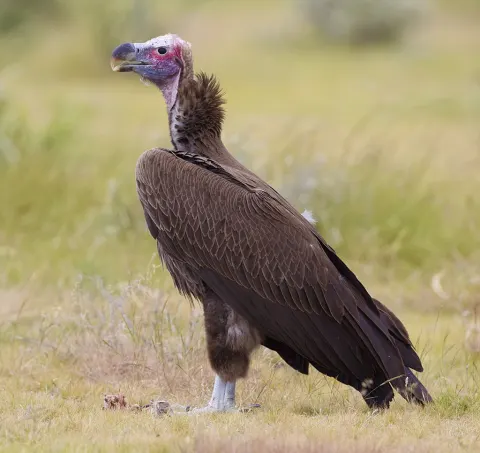
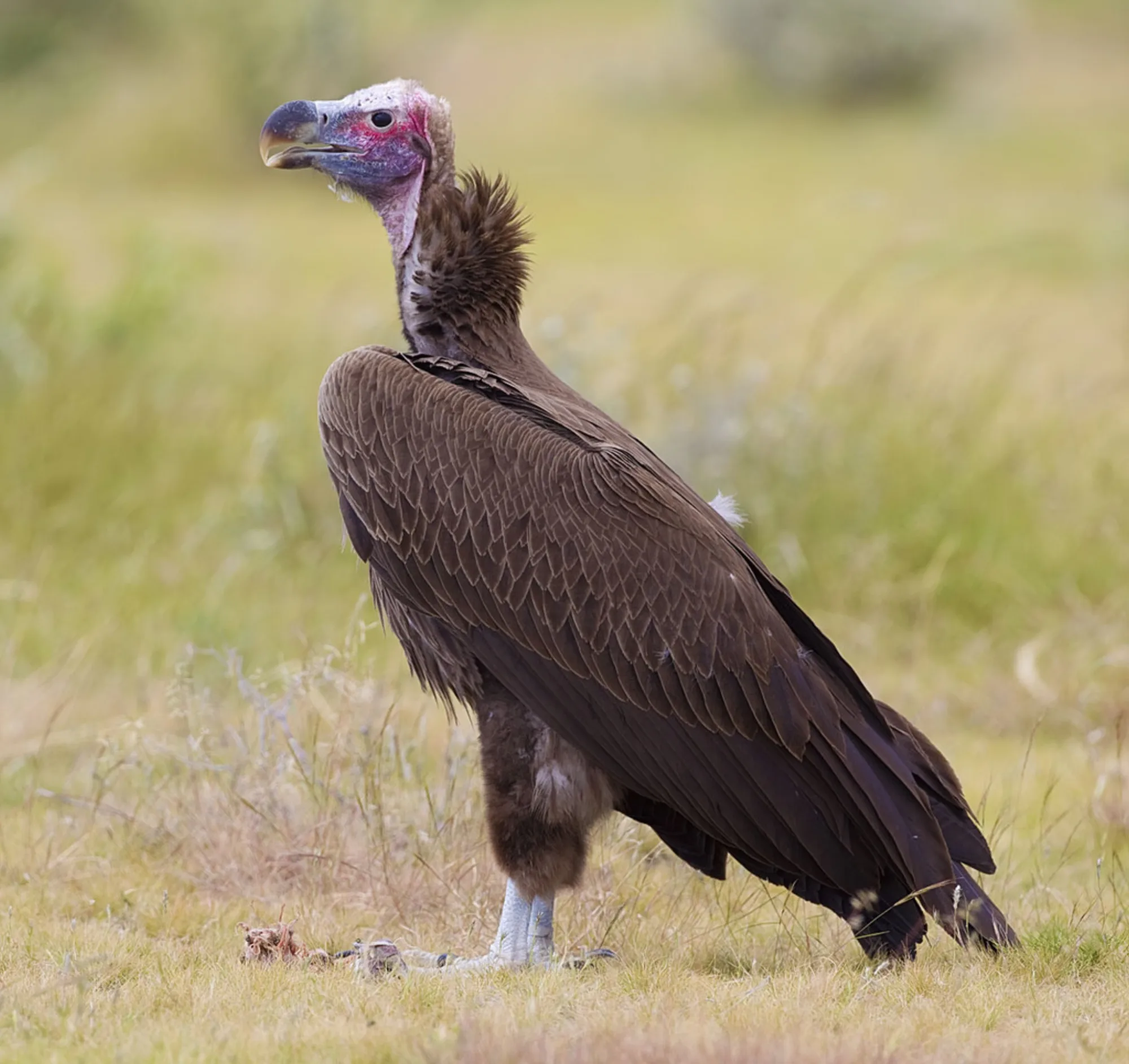
With broad wings spanning 2.5 to 2.9 m, the Lappet-faced Vulture is a huge bird of open country. Its dark upperparts contrast with white thigh feathers, while its bald head bears distinctive fleshy folds along the sides. Head colour varies across its range, from reddish in southern Africa to pink and grey on the Arabian Peninsula. In flight, look for broad wings with slightly pointed, serrated-looking tips.
The species occurs patchily across much of Africa and the Arabian Peninsula, although it is absent from large parts of central and western Africa. It favours dry savannah, thornbush, arid plains and deserts with scattered trees, usually in undisturbed open country with little grass. Generally solitary, it finds carcasses by sight or by watching other vultures. Its powerful bill can tear through tough hides, though it also waits at the edge of a feeding crowd for scraps of skin and other coarse tissue. Large carcasses can draw groups of vultures, and watering holes are another place where they may gather.
Breeding times vary by region, with nesting recorded throughout the year in eastern Africa. A large stick nest is usually placed high in an Acacia tree, and both parents incubate the one or two eggs. Young birds may depend on their parents for a year or more. Habitat destruction, cultivation and disturbance at nesting sites contribute to declines, as does poisoning. Some birds ingest pesticides intended for other animals, while others are shot or poisoned deliberately. Poachers sometimes poison carcasses because circling vultures can reveal their activities to authorities.
Written from the English Wikipedia article Lappet-faced vulture (CC BY-SA 4.0).
- Records
- 22,930
- Countries
- 30
- Atlas places
- 48
- Kruger National Park· South Africa
- Serengeti National Park· Tanzania
- Ngorongoro Conservation Area· Tanzania
- Okavango Delta· Botswana
- Maasai Mara National Reserve· Kenya
- Etosha National Park· Namibia
- Namib-Naukluft· Namibia
- Chobe National Park· Botswana
- Tsavo East National Park· Kenya
- Kafue National Park· Zambia
- Tsavo West National Park· Kenya
- Akagera National Park· Rwanda
- Bwabwata National Park· Namibia
- Hwange National Park· Zimbabwe
- Kidepo Valley National Park· Uganda
- Lake Manyara National Park· Tanzania
- Nyerere National Park· Tanzania
- Queen Elizabeth National Park· Uganda
- Samburu National Reserve· Kenya
- South Luangwa National Park· Zambia
- Tarangire National Park· Tanzania
- Zambezi National Park· Zimbabwe
- Amboseli National Park· Kenya
- Gonarezhou National Park· Zimbabwe
- iSimangaliso Wetland Park· South Africa
- Kgalagadi Transfrontier Park· South Africa
- Lower Zambezi National Park· Zambia
- Makgadikgadi Pans National Park· Botswana
- Mana Pools National Park· Zimbabwe
- Mudumu National Park· Namibia
- Murchison Falls National Park· Uganda
- Nkasa Rupara National Park· Namibia
- Ruaha National Park· Tanzania
- Aberdare National Park· Kenya
- Bangweulu Wetlands· Zambia
- Central Kalahari Game Reserve· Botswana
- Hell's Gate National Park· Kenya
- Hluhluwe-iMfolozi Park· South Africa
- Kilimanjaro National Park· Tanzania
- Kunene / Kaokoveld· Namibia
- Lake Mburo National Park· Uganda
- Lake Nakuru National Park· Kenya
- Liuwa Plain National Park· Zambia
- Meru National Park· Kenya
- Mikumi National Park· Tanzania
- Nairobi National Park· Kenya
- Udzungwa Mountains National Park· Tanzania
- Waterberg Plateau Park· Namibia
These are open occurrence records, so they show where people looked for and recorded the Lappet-faced Vulture as much as where it lives. Cells are up to 25 km across, and every location is generalised to its cell.
Generalised encounter areas, not exact locations. Each shape is a grid cell coloured by how likely the species is there.
- Very likelyTanzania25 km zone · high confidence · 7501 records · updated 86 days ago
- Very likelyKenya25 km zone · medium confidence · 4274 records · updated 86 days ago
- Very likelySouth Africa25 km zone · high confidence · 4176 records · updated 86 days ago
- Very likelyUganda25 km zone · high confidence · 1585 records · updated 86 days ago
- Very likelyNamibia25 km zone · high confidence · 1192 records · updated 86 days ago
- Very likelyBotswana25 km zone · medium confidence · 996 records · updated 86 days ago
- Very likelyZambia25 km zone · medium confidence · 664 records · updated 86 days ago
- Very likelyUnited Arab Emirates25 km zone · high confidence · 460 records · updated 86 days ago
- Very likelyOman25 km zone · medium confidence · 443 records · updated 86 days ago
- Very likelyZimbabwe25 km zone · high confidence · 387 records · updated 86 days ago
Conservation status not assessed here yet, so every location is generalised to its grid cell.