False Gharial
Tomistoma schlegelii
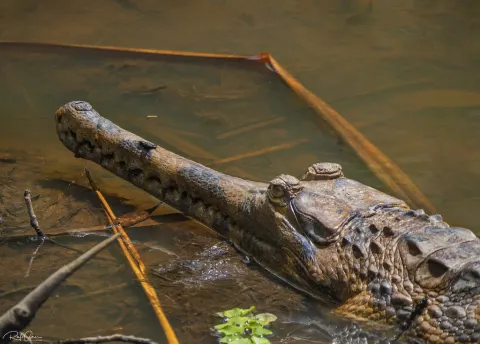
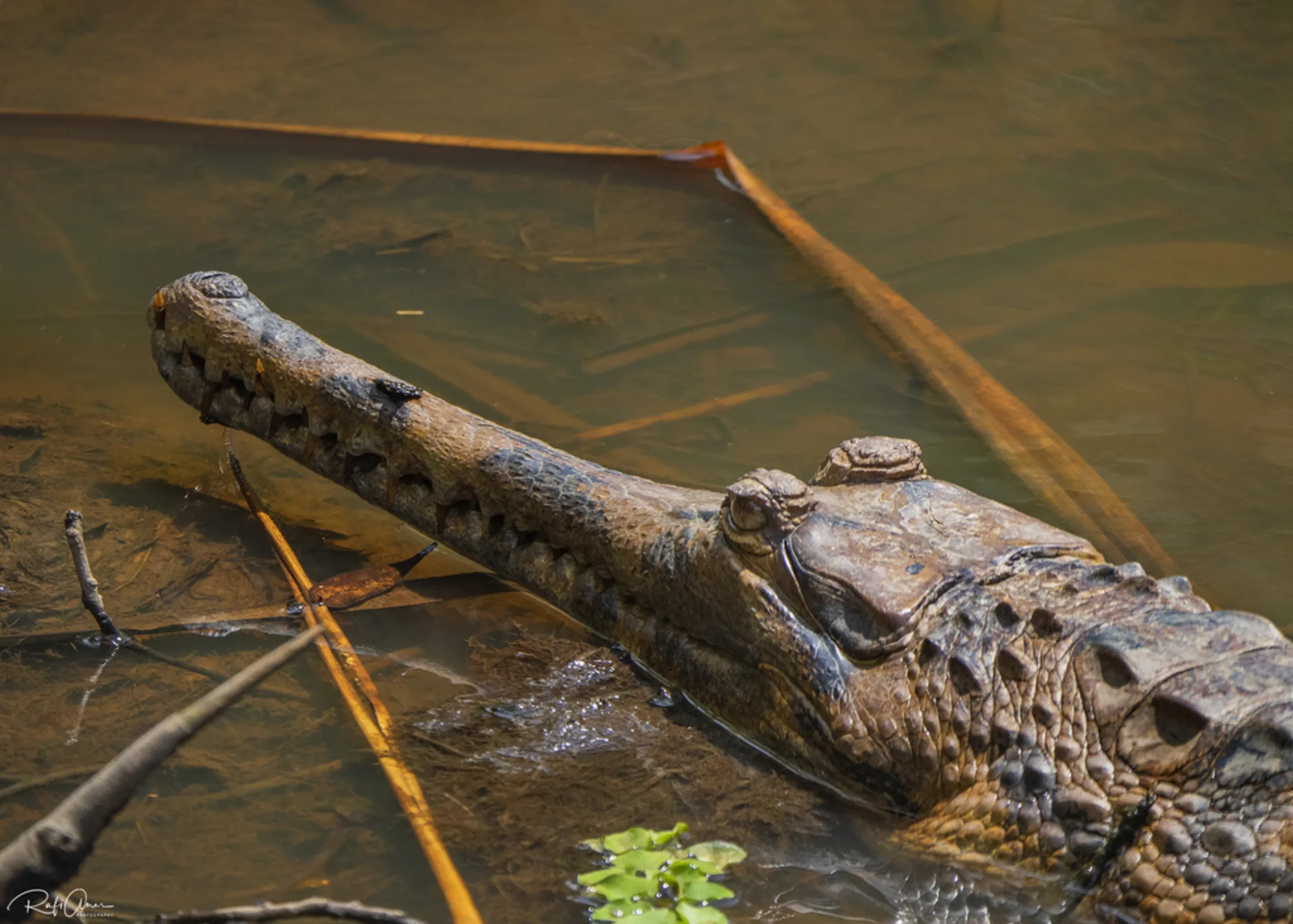
With its extremely long, slender snout and dark reddish-brown colouring, the False Gharial is a freshwater crocodilian of Southeast Asia. Dark brown or black spots and bands mark its back and tail, while its underside is greyish-white with some dark mottling along the sides. Males can reach 5 m and weigh up to 600 kg; females can reach 4 m. Young animals have black mottling on the sides of their jaws, bodies and tails.
The species is native to Peninsular Malaysia, Borneo and Sumatra, where it lives in peat swamps and swamp forests in the lowlands. It has disappeared locally from Java and Thailand, and its distribution in eastern Sumatra has contracted through hunting, logging, fires and agriculture. Although its narrow snout once suggested a diet limited to fish and very small vertebrates, evidence now points to a broader menu. Mature adults also take larger prey, such as deer and water birds, as well as proboscis monkeys, long-tailed macaques and reptiles. Females build mound nests and lay clutches of 13 to 35 eggs; courtship coincides with rainy periods from November to February and April to June.
Across much of its range, freshwater swamps are drained and converted to commercial oil palm plantations, leaving less habitat available. People also hunt the crocodilian for its skin and meat, and often collect its eggs to eat. Surveys in the mid 2000s found a patchy, disconnected distribution, raising the risk of genetic isolation, while some groups in unprotected areas lacked viable breeding adults. Some populations in Indonesia have reportedly rebounded, though fears of attacks have also arisen among local people.
Written from the English Wikipedia article False gharial (CC BY-SA 4.0).
- Records
- 5
- Countries
- 1
- Atlas places
- 2
These are open occurrence records, so they show where people looked for and recorded the False Gharial as much as where it lives. Cells are up to 25 km across, and every location is generalised to its cell.
Generalised encounter areas, not exact locations. Each shape is a grid cell coloured by how likely the species is there.
- Very likelyIndonesia25 km zone · medium confidence · 5 records · updated 80 days ago
Conservation status not assessed here yet, so every location is generalised to its grid cell.