Sacred Kingfisher
Todiramphus sanctus
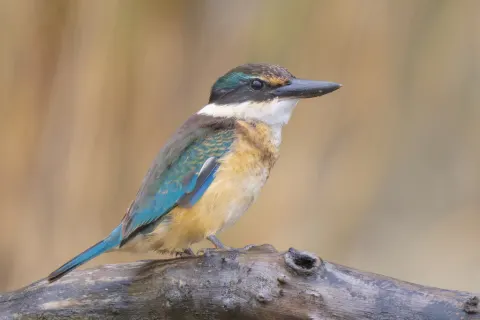
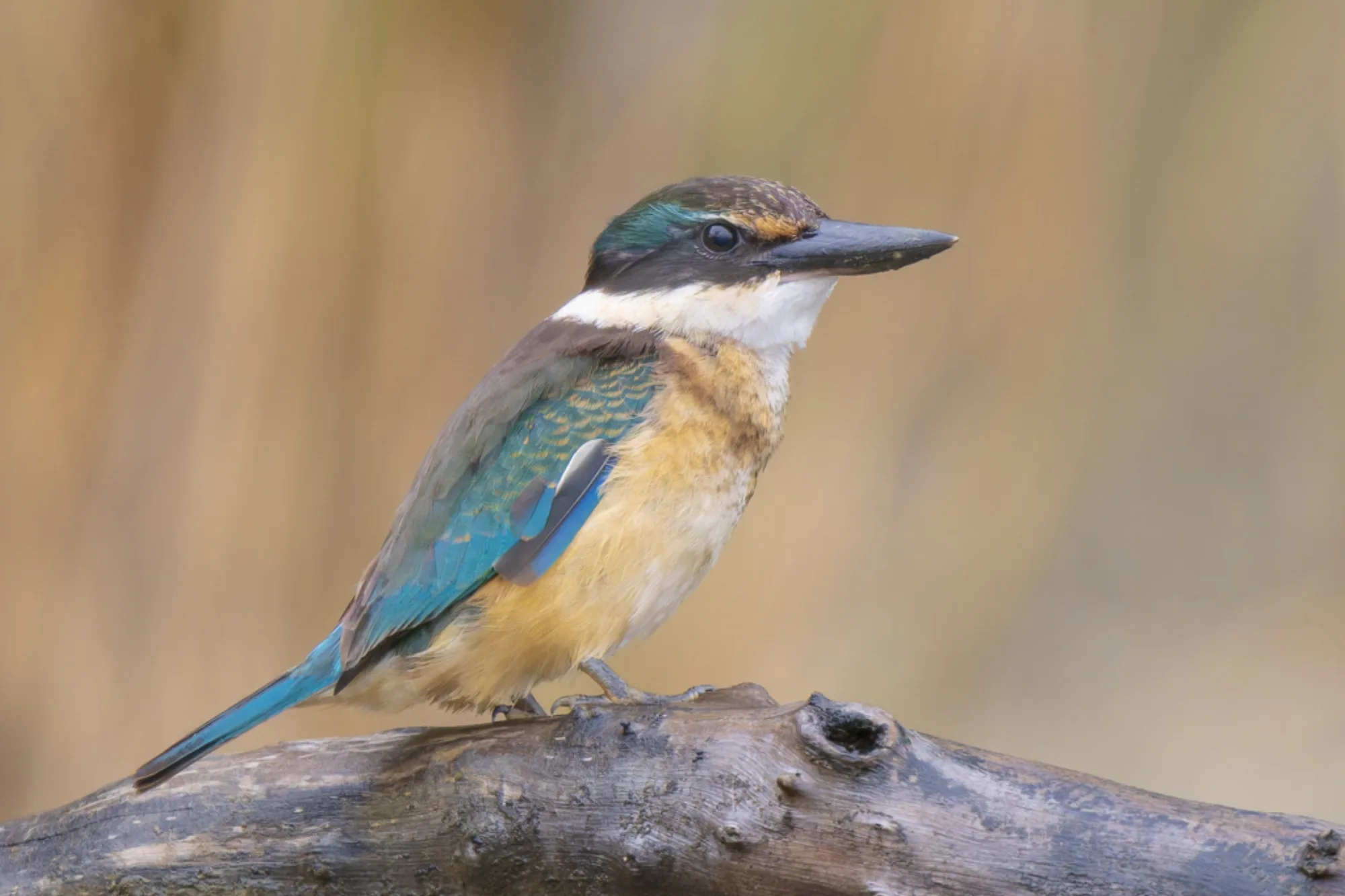
Look for the Sacred Kingfisher perched low on a branch, watching for passing prey. This medium-sized woodland bird has blue-green or turquoise upperparts, contrasting with its white belly and collar. A black mask crosses its face, and adults measure 20 to 23 cm in length. Females tend to be greener and duller than males, while young birds can show mottled brown or buff edging on the collar and underparts.
Its range includes Australia, New Zealand, New Guinea, eastern Indonesia and parts of Melanesia. In Australia, it lives in places as varied as open eucalypt forests, mangroves, wetlands, farmland, parks and gardens. Birds from the southern two-thirds of Australia head north after breeding, travelling as far as New Guinea, the eastern Solomon Islands and Indonesia. They return south to Australia in August and September. In New Zealand, some move from higher ground, or from forest, towards the coast after breeding.
From its perch, the kingfisher swoops down to seize prey, sometimes hovering, before returning to beat and swallow its catch. Its varied diet includes insects, spiders, small crustaceans, frogs, small rodents and reptiles, with fish eaten infrequently. Breeding runs from August to March, mostly between September and January, and pairs often raise two broods. Both birds dig a nest, choosing sites such as river banks, large branches or termite mounds. The female lays 3 to 6 white eggs, and both parents incubate them, though the female does most of this work. Both parents feed the young in the nest for up to 4 weeks and continue feeding them after they leave it.
Written from the English Wikipedia article Sacred kingfisher (CC BY-SA 4.0).
- Records
- 260,709
- Countries
- 5
- Atlas places
- 9
- Blue Mountains National Park· Australia
- Daintree National Park· Australia
- Great Sandy National Park (K'gari)· Australia
- Abel Tasman National Park· New Zealand
- Baluran National Park· Indonesia
- Kakadu National Park· Australia
- Rakiura National Park· New Zealand
- Tongariro National Park· New Zealand
- West Bali National Park· Indonesia
These are open occurrence records, so they show where people looked for and recorded the Sacred Kingfisher as much as where it lives. Cells are up to 25 km across, and every location is generalised to its cell.
Generalised encounter areas, not exact locations. Each shape is a grid cell coloured by how likely the species is there.
- Very likelyAustralia25 km zone · high confidence · 174335 records · updated 81 days ago
- Very likelyNew Zealand25 km zone · high confidence · 83957 records · updated 81 days ago
- Very likelyPapua New Guinea25 km zone · high confidence · 1041 records · updated 81 days ago
- Very likelyNorfolk Island25 km zone · high confidence · 967 records · updated 81 days ago
- Very likelyIndonesia25 km zone · high confidence · 409 records · updated 81 days ago
Conservation status not assessed here yet, so every location is generalised to its grid cell.