Pinecone Lizard
Tiliqua rugosa
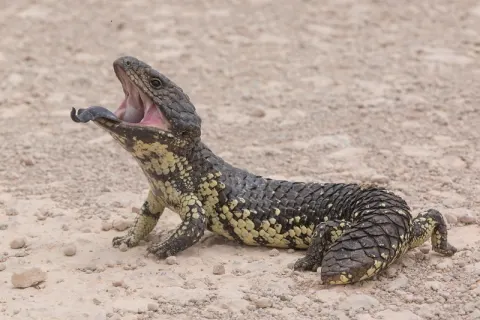
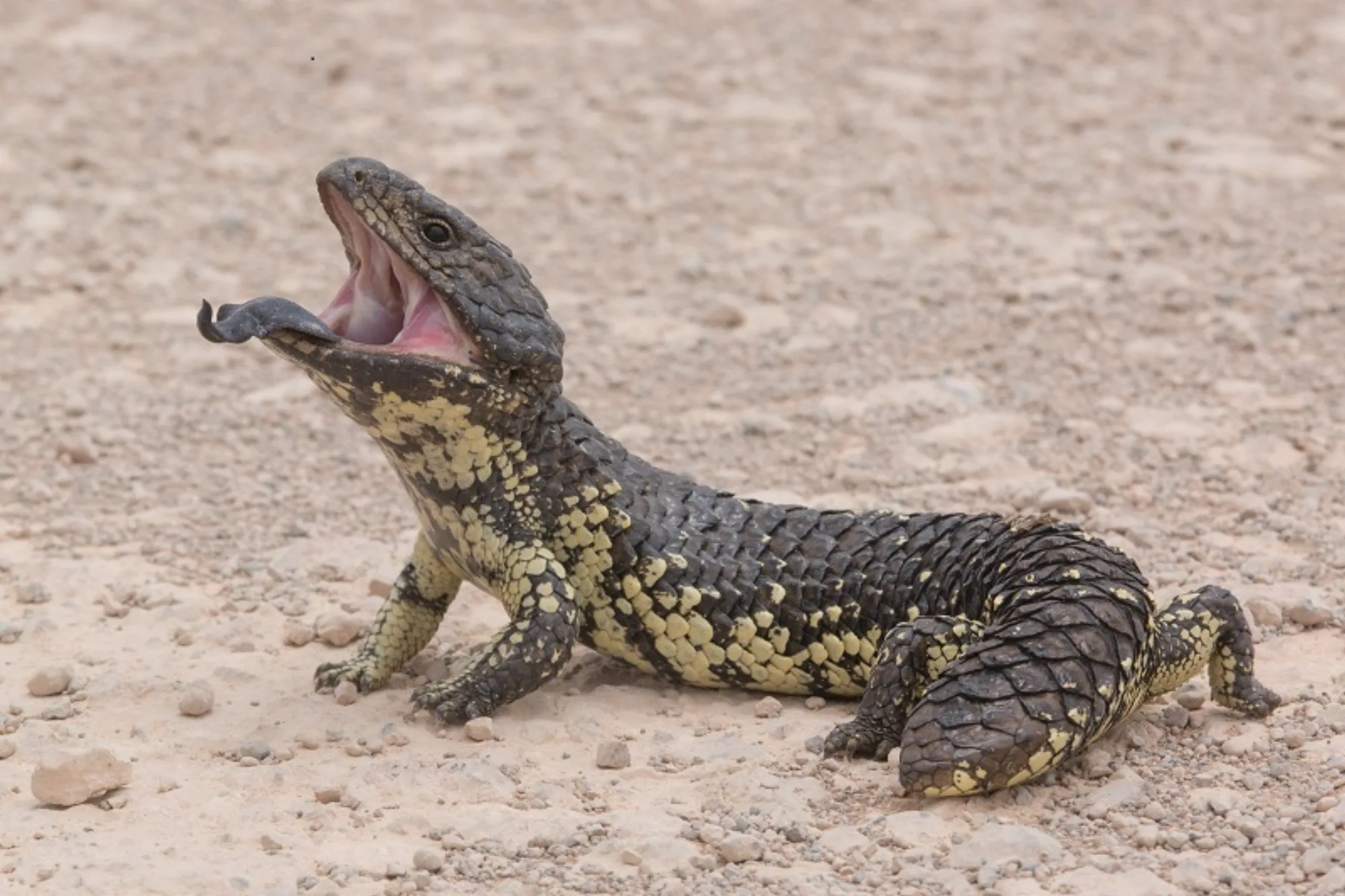
With its heavy armour, broad head and short, blunt tail, the Pinecone Lizard has a distinctive shape. This slow-moving Australian skink ranges in colour from dark brown to cream, and has a bright blue tongue inside a pink mouth. Its tail resembles its head, which may help confuse predators, and stores fat for winter brumation. When threatened, it may open its mouth, show its tongue and hiss, or bite in defence.
The species lives across arid and semiarid parts of southern and western Australia, with a range extending from Broome across the south and north into Queensland. It also occurs in Victoria and New South Wales, though it does not reach the coast in those states. Look for it in shrubland, eucalyptus forest, desert grassland and sandy dunes, sheltering beneath low foliage or basking in open places. Roadsides, paddock edges and other cleared ground are favoured sunning spots. Individuals have stable home ranges and may share burrows, especially as conditions become hotter and drier.
Pinecone Lizards browse through vegetation for food, eating plants and flowers as well as snails, insects and carrion. They give birth to live young, usually two to three at a time, and pairs may reunite each year for up to 20 years. Young lizards spend several months alongside their parents, then become independent. Introduced foxes and cats are potential threats, while birds of prey and large snakes also hunt these skinks in Western Australia. Ticks and nematodes commonly parasitise them.
Written from the English Wikipedia article Tiliqua rugosa (CC BY-SA 4.0).
- Records
- 12,399
- Countries
- 1
- Atlas places
- 2
These are open occurrence records, so they show where people looked for and recorded the Pinecone Lizard as much as where it lives. Cells are up to 25 km across, and every location is generalised to its cell.
Generalised encounter areas, not exact locations. Each shape is a grid cell coloured by how likely the species is there.
- Very likelyAustralia25 km zone · medium confidence · 12399 records · updated 80 days ago
Conservation status not assessed here yet, so every location is generalised to its grid cell.